






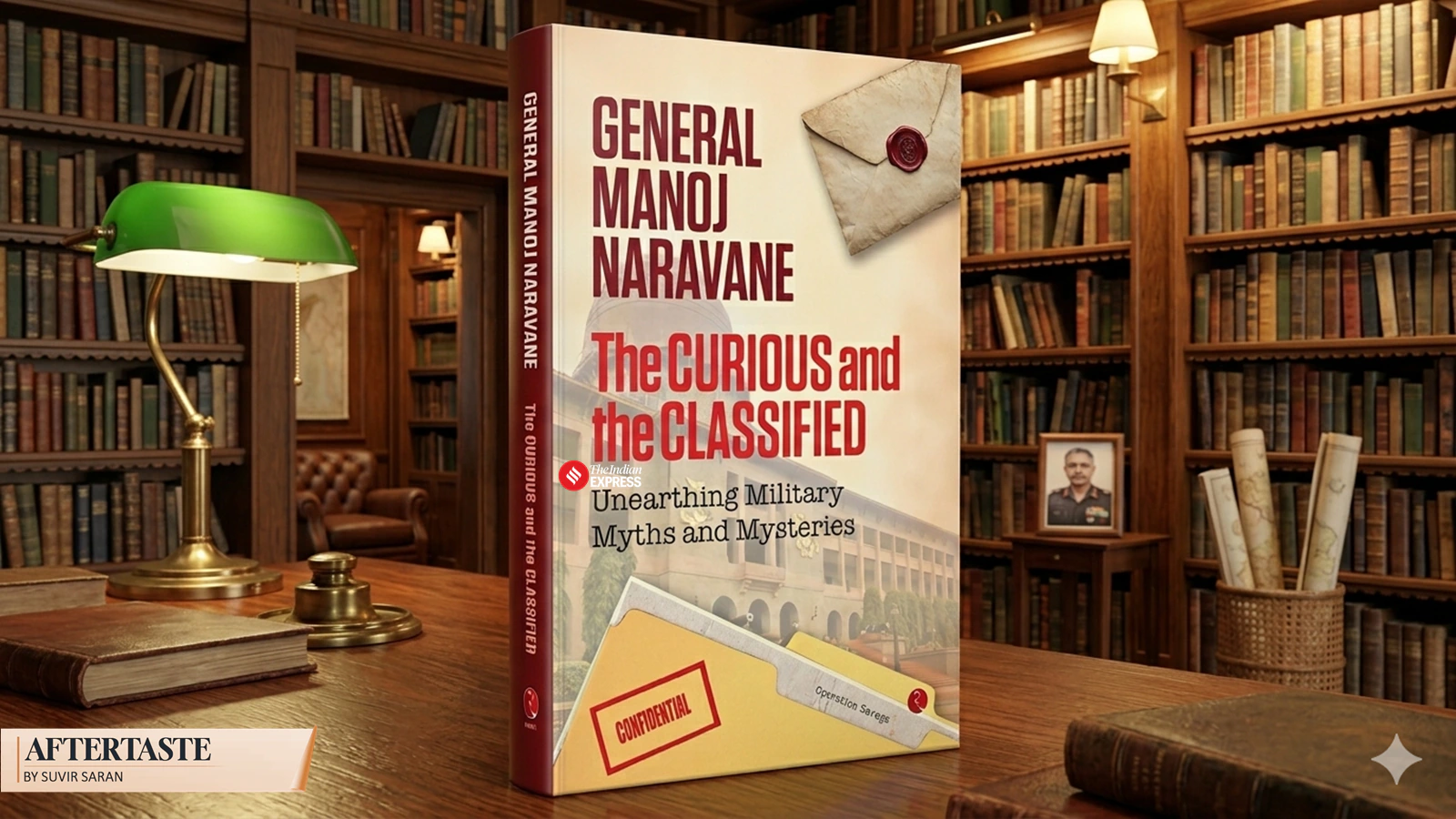
It does not begin with battle. It begins with banter.
With a question tossed across a mess table, with a ritual poured into two bottles and three glasses, with a rank briefly forgotten and a story quietly shared. The Curious and the Classified resists the expected entry point into the Indian armed forces. There are no marching boots at the threshold, no medals clinking for attention. Instead, General Manoj Naravane ushers us in through the side door—through wit, whimsy, and the warm, worn corridors of memory.
What unfolds is not a manual of military might, but a mosaic of military mind.
Naravane writes as a soldier-scholar, but more importantly, as a custodian of culture. The book gathers myths, mischief, and meaning with a collector’s care. A backronym becomes a breadcrumb; a regimental legend becomes a lantern. In these pages, the Indian armed forces are not merely an institution of discipline—they are revealed as an ecosystem of emotion, an inheritance of habits, a theatre where the absurd and the sacred sit side by side without apology.
And what a theatre it is.
Consider the deceptively simple ritual of “Do bottle, teen glass.” On the surface, it is quaint—two beers shared among three officers. But Naravane lets the moment breathe, and in that breath, something profound appears. Hierarchy loosens its grip. Rank recedes. The room softens. It is, as he reminds us, not about drinking but about sharing—about creating a commons within command, a fleeting fellowship within formality. In that small, almost comic act, one glimpses the deeper grammar of soldiering: that discipline may structure life, but camaraderie sustains it.
Conversations and confessions
This is where the book finds its quiet brilliance—its ability to humanise without trivialising, to demystify without diminishing. The armed forces, so often framed in spectacle or slogan, are here rendered in shades of lived experience. Leave applications become dramas of diplomacy. Mess conversations turn into confessions. Even bureaucracy carries a pulse, a personality, a peculiar poetry.
Naravane’s prose is accessible without being simplistic, affectionate without being indulgent. There is an ease to his storytelling that invites rather than instructs. One senses a writer who has seen enough to know that authority need not announce itself—it can arrive softly, in anecdote and aside. The tone carries the cadence of conversation, the rhythm of recollection, the restraint of someone who understands that not everything needs to be said for something meaningful to be shared.
Story continues below this ad
If there is a larger argument embedded within the anecdotes—and there is—it is this: institutions endure not only through rules, but through rituals; not only through command, but through culture. The “curious” and the “classified” are not binaries but braided strands. The visible quirks and the veiled histories together form the fabric of belonging. Through humour and heritage, through slang and story, the book reveals how a life of rigour is made livable.
Terrains of military life
There are moments, admittedly, when one wishes the narrative would linger longer in its own shadows. The affection that animates the book occasionally softens its edge; the lightness that makes it so readable sometimes keeps it from plumbing deeper complexities. The emotional and psychological terrains of military life—its fractures, its moral ambiguities—are touched upon more than they are thoroughly excavated. Yet even this restraint feels less like omission and more like intention. Naravane is not writing an exposé; he is preserving a pulse.
And preservation, here, is an act of quiet urgency.
For what the book ultimately offers is access—rare, respectful, and resonant. It allows the civilian reader to step inside without trespassing, to understand without appropriating. One comes away not with the spectacle of the soldier, but with the texture of soldiering. The weight of a badge. The echo of a toast. The inheritance of a story told one generation to the next so that something essential is never entirely lost.
In an age that often reduces institutions to headlines and histories to hashtags, The Curious and the Classified insists on something slower, subtler, and far more enduring. It reminds us that behind every uniform is a universe—not of abstraction, but of anecdote; not of ideology, but of intimacy.
Story continues below this ad
And when the final page turns, what lingers is not the clang of command, but the murmur of memory.
A laugh shared. A ritual repeated. A culture carried.
Not classified, after all—but carefully, compassionately revealed.