









Swiss author Nelio Biedermann is all of 22, and his second novel, Lázár, is already one of the most talked-about works in literary circles across Europe and the Anglophone world. Originally written in German and now translated into 31 languages, it is a gothic family saga infused with magic realism, spanning three generations of Hungarian nobility against the backdrop of increasingly fraught 20th-century world events: the absorption of Ukraine into the Soviet Union, the rise of Hitler, the Holocaust, the Death Marches, the two World Wars, and the Hungarian Uprising in 1956. At 21, critics were already comparing him to Thomas Mann, what is all the more remarkable is that he began writing the novel at age 16, drawing on his own family history, including silences he is still trying to decipher. He spoke to The Indian Express from his home in Zurich over a video call. Edited excerpts:
You descend from Hungarian nobility, much like the protagonists of Lázár. How much of the novel is drawn from your own family? What was the process of excavating that history like?
It is kind of hard to tell what is drawn from my family and what is just fiction. Even my father couldn’t really tell it apart. But that was also my aspiration—to create something where you couldn’t tell exactly what is fiction and what is reality. The characters are all fictional, but the things they experience are very close to what my family lived through.

My grandmother used to tell these stories over and over. For us children, they were fairy tales, and these very adventurous stories. Because of that, I knew a lot already. But when I started writing, I soon realised I didn’t know enough. So I went to Budapest, where my great-uncle still lives, to research and ask banal questions, such as what they ate, how they dressed, to create the atmosphere.
Your grandmother told you a cleansed fairy tale, but you wrote a gothic tale brimming with magic realism (translucent child, magical forest, manor with memories, and a creeping madness) and violence. How did the childhood tales take a dark turn?
That is a good question. It certainly was not in the stories my grandmother used to tell. But maybe I always had a sense of this darkness in the family story, because as I grew older, I realised it wasn’t as easy as she made it seem. There is this horror not only in the century, but also in the families themselves. My great-uncle has this small archive, a family biography going back a long time. I was astonished to see how many ancestors had died by suicide. So that darkness certainly existed, and I wanted to include it. I was also probably influenced by ETA Hoffmann, who wrote these very dark, mystical, fairy-tale-like novels.
My great-uncle has this small archive, a family biography going back a long time. I was astonished to see how many ancestors had died by suicide
The novel displays an impressive empathy across gender and class. You write of the weight of land and lineage on the men, but the women are equally vivid: feral adolescence, crippling depression, invasive body searches, violation of working‑class women by soldiers and aristocrats alike. As a young male writer who started the novel aged 16, how did you go about capturing these interior lives? How did you go about writing the violent scenes?
Thank you.
Writing about male characters was easier, just because I could draw from my own experiences. What I tried to do was include a discourse about masculinity into the novel—I asked what I could add to the long tradition of family novels. I wanted to show how fathers influence sons, how they grow up similar to their fathers, want to be different, yet end up the same. When the patriarch loses his land, he loses his sense of self.
For women, I felt ambiguous. Core human experiences are similar—you can’t say a woman perceives the world completely differently. But there are things I, as a man, can’t really comprehend. So I had to observe very precisely, try to put myself in that perspective, and get feedback. These were the most difficult parts to write. I felt a responsibility towards people who suffered. Often it was more powerful to leave things out, take a step back. I watched interviews with women who experienced the Red Army, how sexual violence was used as a weapon. I re-edited those parts a lot. But I felt obligated to include it, because women were even more exposed to violence during wars.
Story continues below this ad
Your generation is often associated with a compression of language—the famous Gen Z vocabulary. Yet Lázár is the opposite, a sprawling, old-fashioned novel. How did a 16‑year‑old arrive at such an expansive form?
I mean, when I started writing, I knew I wanted to become an author, but I would never have told anyone. It isn’t something you can just become; you have to be lucky. So I didn’t tell anyone, but I wrote almost every day. This story felt very personal to me. I didn’t set out to do the opposite of what is common; I just felt this was the most powerful and natural way to tell my family’s story. I could have written a more contemporary novel, but it didn’t work. It felt more powerful to follow these characters, who didn’t know their future.
I started at 16 and quickly realised I wasn’t good enough. I put it aside, returned, put it aside again, and it only worked on the fifth attempt. It took shape in that process. At first, I didn’t know how it would end.
I didn’t set out to do the opposite of what is common; I just felt this was the most powerful and natural way to tell my family’s story.
What were the challenges of fictionalising a living family? The first page reveals Lajos’s illegitimacy. How did you think about your obligations to the living and the dead, and what was the cost, if any, in your own family?
My close family could differentiate between fiction and facts. The magical elements made it clear this is my invention, not a biography. They really enjoyed reading about the family this way, and of course, they are incredibly proud.
I was kind of afraid of my great-uncle’s reaction. He can read German, but wanted to wait for the Hungarian translation. He always told the good family stories. I knew there had to be a different side, and I had to include it, but probably he would rather I hadn’t. After a few months, my father told me my great-uncle had already read it in German, but he didn’t say anything. Now the Hungarian translation is out, and he still hasn’t commented. But he is proud of my success and the novel’s sales in Hungary.
Story continues below this ad
Your family certainly has an interesting history. Could you tell us an abbreviated version of the real story?
The big historical events are pretty much similar to the novel. My family had incredible wealth—all this land, these manor houses. I’m, however, unsure about their role during World War II. In the novel, Lajos organises the deportation of the Jews. I don’t know if that’s true, but in my great-uncle’s archive, I found photographs of my great-grandfather in a high military uniform. I asked my great-uncle, and he sincerely couldn’t tell me—he was born during the war. The possibility was enough for me to include.
After the war, under Communism, they were expropriated and lost everything. My family was deported to the east of Hungary for forced labour until Stalin died. Then they returned to Budapest but faced repressions because they were of nobility—they weren’t allowed to study. After the national uprising, when it became even harder for the nobility, my grandparents fled to Switzerland; my grandmother was 20, pregnant with my aunt. So my aunt and father were born there.
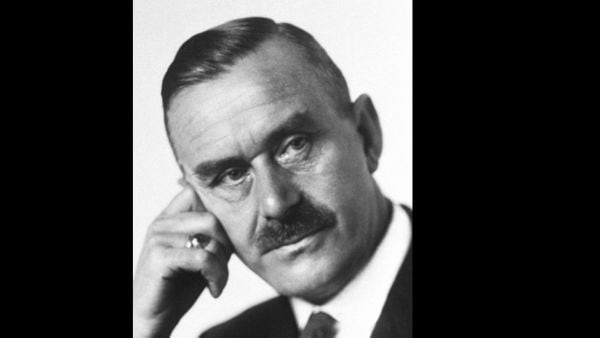 Thomas Mann was 25 years old when his debut novel, Buddenbrooks, was published in ݭ the book traces the rise and gradual decline of a wealthy German merchant family across four generations. (Wikimedia Commons)
There was a bidding war for your novel, you were called Wunderkind (wonder kid) in the Press, and were compared to Thomas Mann. At what point did you realise you had made it, and how have you dealt with the noise, the bouquets and the brickbats?
I think I still haven’t really arrived. At publishing parties, talking to famous authors I have read feels absurd and surreal. I still feel like this kid reading their novels. I forced myself not to believe the hype, to protect myself in case the novel failed. As for criticism, I try not to take it to heart because both praise and attacks are bad for your writing. It would be horrible if I believed I’m the new Thomas Mann. It’s just not true. But I understand the urge to compare—that happens. Maybe after a few novels, people won’t compare me to Mann anymore. It’s nice to be compared to him, though. With bad criticism, sometimes I felt people just wanted to oppose the praise. Sometimes what was criticised was intentional. I dislike it when people say I was too young to write about these things. That criticism was age-based. But it also helped get attention. And there was some criticism I really got, where I saw I maybe didn’t get it right. I’m 22, so hopefully I’ll get better. In 30 years, I’ll think I could have done this novel better.
It would be horrible if I believed I’m the new Thomas Mann. It’s just not true.
Has knowing that the next book will be measured against Lázár affected your next project? Do you feel the weight of this huge success?
What most people don’t know is that this isn’t my first novel. There was another, published only in Switzerland, now being translated into English. So I don’t have the weight of a debut success; I already had a novel, and I know I can do it again. This novel is personal, but not based on my own experiences, so I don’t feel I’ve exhausted my material.
Story continues below this ad
I finished Lázár in summer 2024, then had a year before publication. I started writing again right away; it feels natural. When the book was published, I was already working on something new. The new book is set in the present—two brothers—which I always found too difficult before, because with the past, you know what follows; it’s finished. The novels will be very different, but people will notice similar themes. I know this success is extraordinary. That’s not what I aspire to. I just want to write what feels natural. It would be a bad move to write another historical family novel. I think it’s good to do something different.
The novel begins with Russia’s annexation of Ukraine, and as you were writing, geopolitics kept providing eerie echoes. Did the present tense keep intruding on the historical imagination?
At the beginning, my focus was solely on the past. But as I kept writing, I stumbled upon more and more parallels. The annexation of Ukraine—you have to draw these parallels. I often got the question: why write about the past when there is so much happening in the present? My answer was always that I feel there are these parallels. And in a way, I did write about the present just in a different setting. It’s very important to remember this again and again, because only if you remember what happened can you try to do better next time. We see it every day that people forget history. There’s the saying that history doesn’t repeat itself, but it rhymes. Nowadays you can really see how it rhymes—things that have already happened are happening in a different way, but it feels similar. Sadly, my novel and these times are very relevant today as well.
History doesn’t repeat itself, but it rhymes.
To close: you’re a young writer who has produced an ambitious book so early in your career, while managing your studies side-by-side. What would you want a 16‑year‑old with a difficult, unwieldy idea to know about the act of staying with it?
People are often intimidated—I’m a bad example because on one hand, I can inspire, and on the other, intimidate. People only see the end product. They don’t see that I tried to write this novel again and again over six years, and the first drafts were horrible. People often wait for perfect circumstances: more time, holiday, finishing studies. That’s not how it works. I always had my studies besides writingm, and I wrote in the evening. Even if you write a page a day, after a year you have 365 pages—a decent novel. What’s most important is to stick to it, work in small steps, day by day, page by page. Then you can re-edit and do it again.
And there are so many great novels. I like to balance contemporary literature with the classics, because you can learn a lot from the classics, see how novels written centuries ago shaped today’s writing. They’ve been read for a reason. Often, the language isn’t modern, but the themes and descriptions are very modern. I also read a lot of contemporary fiction from different parts of the world, because you can learn from different literatures.