







The National Coalition for Women’s Reservation (NCWR), a nationwide alliance of women’s rights organisations and gender-justice movements, has launched a campaign demanding the immediate implementation of the Women’s Reservation Act and asking for it to be delinked from the census and delimitation exercises. Over the past month, NCWR has held public consultation meetings in New Delhi, Allahabad, Bengaluru, and Hyderabad. Similar meetings are being planned across other States as well to disseminate the message and to ensure that there is clarity about why the coalition demands the immediate implementation of women’s reservation and why delinking is important.
The coalition took root in April as a petition campaign from two Uttar Pradesh-based activists, Padma Singh and Kumudini. It garnered more than 800 signatures and became an ad hoc collective of individuals and groups who opposed the Union government’s attempt to enforce delimitation under the pretext of implementing the Nari Shakti Vandan Adhiniyam (Women’s Reservation Act, 2023), an Act that was passed in Parliament in September 2023, following a three-decade-long struggle by Indian women to secure the reservation of one-third of the seats in Parliament and State Assemblies.
According to an analysis by the Association for Democratic Reforms and National Election Watch, which was published in March, out of 4,666 MPs and MLAs across the country, only 464 are women. This amounts to just 10 per cent. Women hope that the Reservation Act could remedy this inequality in representation. More women in Parliament and Assemblies can ensure that women-specific legislation and matters are taken up with more urgency.
From the time of its enactment, the Union government tied the implementation of the Bill to a future census and delimitation exercise. Then, in April, in a Special Parliamentary Session that was convened in the middle of five Assembly elections, the government introduced a three-Bill package: the Constitution (131st Amendment) Bill, the Delimitation Bill, and the Union Territories Laws (Amendment) Bill. The government framed this entire package as the only way to implement women’s reservation and also urged that it be passed in Parliament before the 2029 general election. Via this Bill, the government also sought to increase the number of Lok Sabha seats to 850, thus bringing in delimitation but under the cover of women’s reservation.
When the Bill was defeated, the Union government framed it as a defeat of the Women’s Reservation Bill, even though that bill had already been passed in 2023. Speculation is now gaining ground that the Union government might attempt to reintroduce a delimitation-linked legislation when the monsoon session begins on July 21.
“In the 2024 election, the government’s stated goal was to cross 400 seats—a majority that would have enabled them to amend the Constitution. The Centre knows where its voter base lies. The North-South divide that could result from the proposed seat expansion is an important concern for us. Women’s reservation is being used as a cover for delimitation and gerrymandering,” said the Allahabad-based Padma Singh.
In order to stall such future attempts that seek to club women’s reservation with delimitation, the NCWR has begun its nationwide advocacy campaign. The coalition now has a National Coordination Committee.
NCWR’s core demands are implementation of 33 per cent women’s reservation immediately and unconditionally; insisting that delimitation and expansion of parliamentary seats are not pushed through in an undemocratic manner and not in the guise of women’s empowerment; and, most important, ensuring a participatory and inclusive process to identify the seats that are to be reserved for women. The activist and writer Radha Kumar, who is part of NCWR, has worked out an equitable formula to ensure this.

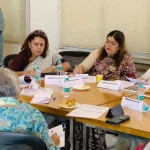
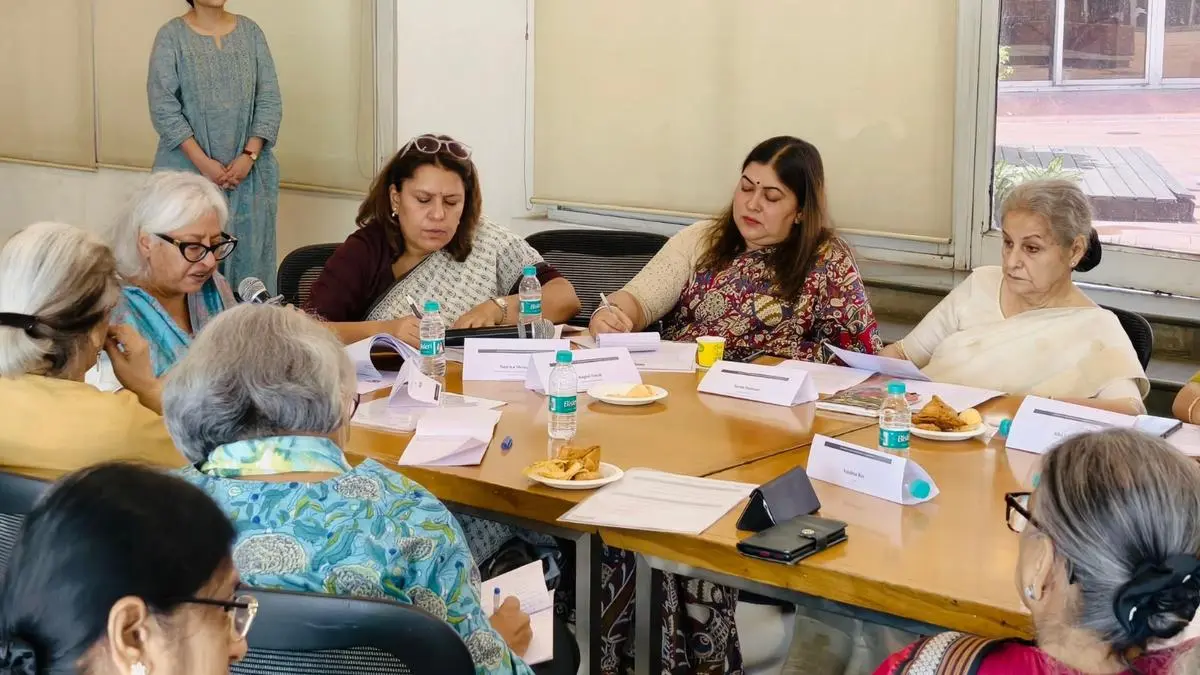
NCWR’s core demands are implementation of 33 per cent women’s reservation immediately and unconditionally; insisting that delimitation and expansion of parliamentary seats are not pushed through in an undemocratic manner and not in the guise of women’s empowerment; and, most important, ensuring a participatory and inclusive process to identify the seats that are to be reserved for women. In the picture, an NCWR meeting in Bengaluru.
| Photo Credit:
By Special Arrangement
“We are particularly concerned about the nefarious attempt to increase parliamentary strength and link it to women’s reservation. It’s an attack on federalism, on the democratic fabric, and a terrible weaponisation of women’s demand for fair reservations,” said Meera Sanghamitra from the National Alliance of People’s Movements (NAPM), which is part of NCWR.
While the Act has provisions for Dalit and Adivasi women’s reservation, NCWR demands meaningful representation across all marginalised communities, including NT-DNT, OBC, minority women, women with disabilities, transgender women, and persons of other marginalised genders.
“It is definitely an advocacy push; we would also like suitable legal amendments so that all the categories are formally included. While caste census data is not available yet, there is still a possibility to include a clause to create a fair sub-quota,” said Meera Sanghamitra. Without adequate safeguards, women’s reservation risks benefiting primarily those already privileged by caste, class, and political networks, reproducing existing power structures rather than transforming them, noted an NCWR press release.
Those associated with the women’s reservation movement recognise that identifying the 33 per cent women’s seats could be the big challenge. “The assumption was that it would be based on the Panchayati system (which uses a draw method). The problem is that lotteries are generally rigged. Instead, State commissions could be established, similar to the delimitation commission, with changes in composition that ensure equal and fair representation,” Radha Kumar told Frontline.
“We cannot leave the process to the EC or a judge appointed by the EC. We need two judges, one appointed by the government and the other by the opposition. Associate members should have decision-making rights [in such a commission] to ensure transparency and representativeness,” Kumar said, basing her suggestions on the experience of the Kashmir and Assam delimitations, where opposition voices were ignored when they raised objections to the delimitation commission.
Singh, an activist with nearly 35 years in the feminist movement, said that before the monsoon session, women’s organisations would meet as many MPs and MLAs as possible. “We met with Akhilesh Yadav and presented the details about our conditions for reservation, how seats should be distributed, why delimitation based on old census data is against UN standards,” she said.
The Telangana and Karnataka State-level consultations resolved to meet Chief Ministers and demand Assembly resolutions on the women’s reservation issue.
“This is a cause that should affect everyone. It’s a cause long overdue. Support from other movements and organisations is most welcome,” said Sanghamitra.
Also Read | Gender by decree
Also Read | Night shifts for women: Opportunity or exploitation?