










Last Updated:
A student’s claim that a university moved to revoke a $45,000 scholarship after an AI detector flagged a thesis as AI-generated has sparked outrage online




A researcher claims that their university is revoking a $45,000 merit scholarship after an AI detector flagged a thesis as AI-generated (Image-AI)
A viral post claiming that a university allegedly revoked a student’s $45,000 scholarship after an AI detection tool flagged a thesis as AI-generated has ignited widespread debate online.
The discussion began after an X post shared by user @reddit_lies showed a screenshot of a Reddit post titled, “My university is revoking my $45,000 scholarship over a false ‘AI detector’ match, refusing to look at my Google Docs edit history.”
The claim quickly gained traction across social media, prompting thousands of reactions from users who weighed in on the growing use of artificial intelligence detection tools in academic settings.

According to the Reddit post, the student, who said they were studying at a private university in New York on a merit-based scholarship worth $45,000 per year, was facing severe disciplinary action after an automated plagiarism detection system flagged their 30-page senior thesis.
The student claimed they had spent six months researching and writing the thesis manually before submitting it. However, they were later informed by their academic advisor that the university’s software had determined there was a “98% probability” that the document had been generated using artificial intelligence.
As a result, the student said they were formally accused of academic dishonesty and summoned before an academic integrity board. During a preliminary hearing, the student reportedly attempted to present Google Docs version history records showing months of edits, revisions, and drafting activity as evidence of their authorship.
According to the post, the disciplinary panel declined to review the material. The student alleged that university officials stated institutional policy required them to rely on the software’s official findings, which they described as highly calibrated and accurate.
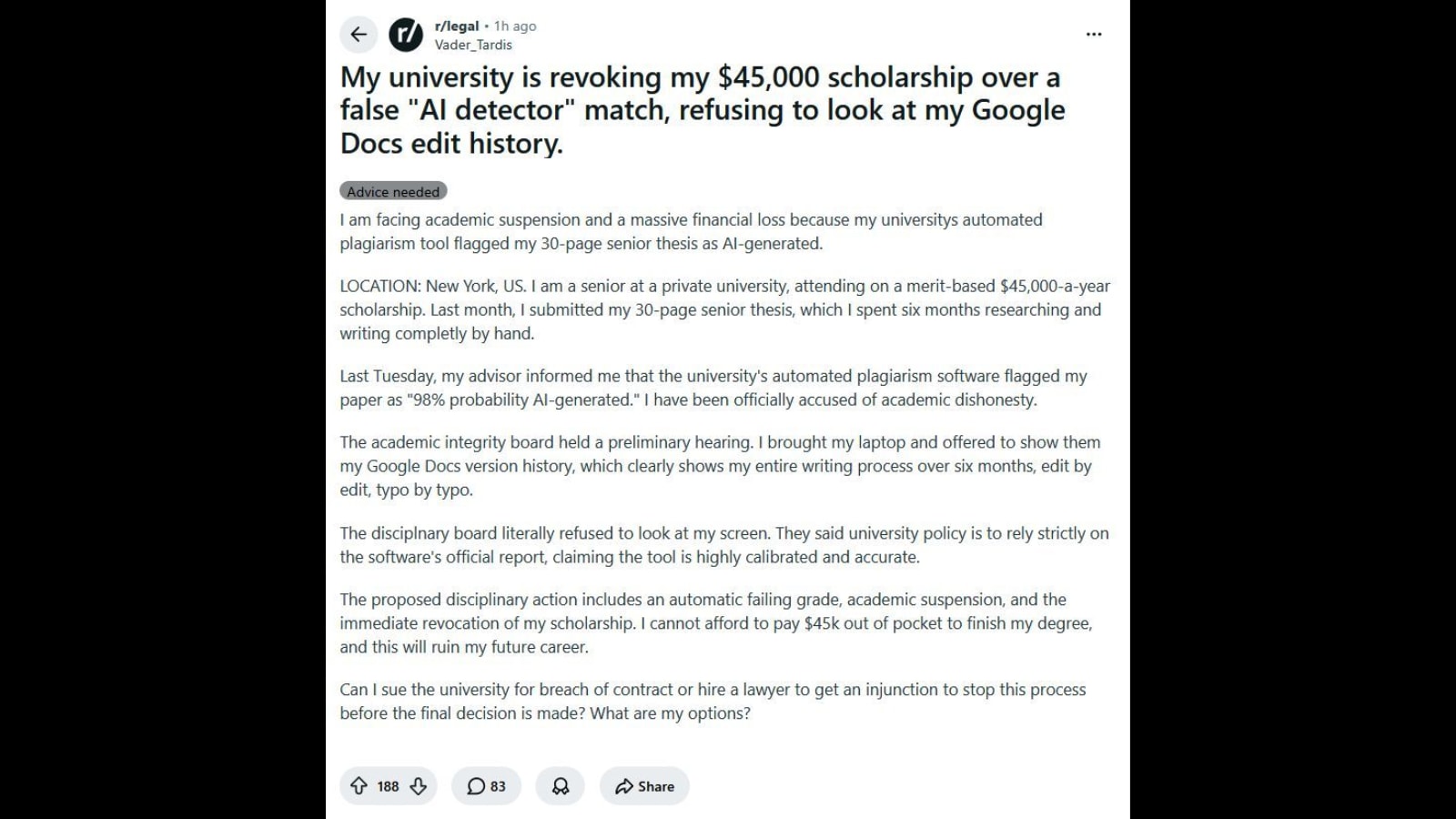
The consequences outlined by the student were significant. They claimed the proposed penalties included a failing grade, academic suspension, and the immediate loss of their scholarship. The student further stated that paying the tuition costs without financial aid would be impossible and that the allegations could have a lasting impact on future career prospects.
Seeking advice, the student asked whether legal action against the university might be possible and whether obtaining an injunction could halt the disciplinary process before a final decision was reached.
The post was accompanied by a caption from the X user that read: “Daily reminder that AI detectors are a scam and literally do not work.”
As the story spread, many social media users expressed concerns about false positives generated by AI detection software.
“I am a retired material sciences engineer with a few published research papers over my career. Want to hear some bullshit? A research article that I authored in 1976 was flagged as >98% AI generated 😆. That should tell you how accurate these systems are,” said one user.
“I would lawyer the fuck up and sue them. Especially with Google Docs edit history, which nobody can tweak,” said another.
A third user pointed to challenges faced by technical and scientific writers, saying, “If you work in a scientific or technical field… scientific or technical writing is often flagged as ai because of lack of variance in sentence structure that is custom in science and tech. (They prefer simple sentences over complex ones)”.
Another commenter highlighted the risks associated with false positives, writing, “These AI detectors for sure have to be modeled carefully true negatives happening is still absolutely fine but they’ve to understand what happens when there is a false positive. It’s a students career they’re messing up with.”
Drawing comparisons to automated moderation systems, one user remarked, “Just look at the mess Youtube created. They decided to have AI bots scrub channels to ban pure AI slop and it started throwing false positives on real content creators all over the place then all appeals got auto-denied. AI gets things wrong far too often to rely on it.”
Others argued that AI detection tools may penalize legitimate writing styles. “AI detectors punish you for writing better. They rated the bible as 100% AI written. Of course some AI patterns are obvious. It’s not X. It’s Y,” wrote another user.
Sharing a personal experience, one commenter added, “I wrote 80 page thesis for final year project with my own bare hands, even tho some portions like certificate, acknowledgement, and others were similar. But the core was entirely typed by me and it flagged as 65% AI and Plagiarism 😭”.
Read More