


Last Updated:
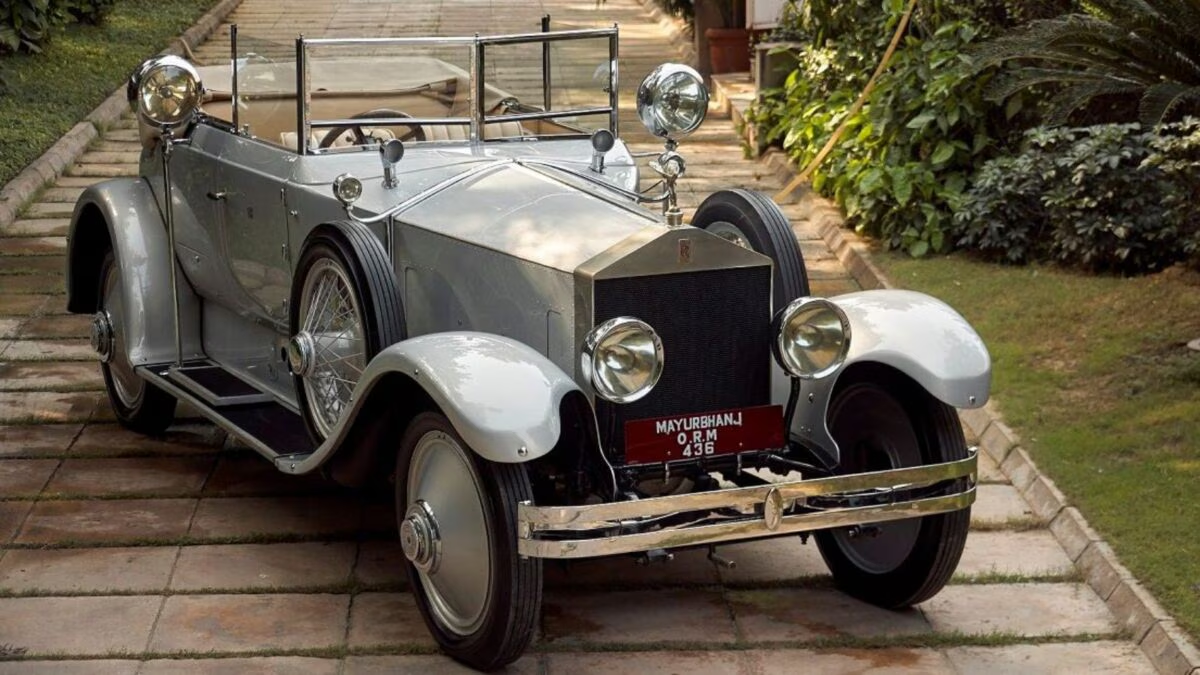
A 1907 Silver Ghost, a “Silver Dowry” car and a rare Phantom III are among the remarkable Rolls-Royces once owned by Indian royalty.



News18
During the early decades of the 20th century, Indian princely rulers became some of Rolls-Royce’s most important overseas customers. Many customised vehicles were tailored for royal processions, long-distance travel and court traditions.
Here are seven Maharajas whose Rolls-Royces remain among the most distinctive cars associated with India’s royal era.
1. Maharaja Madhavrao Scindia II of Gwalior – 1907 Silver GhostOne of the earliest and best-known examples was the Maharaja of Gwalior’s 1907 Rolls-Royce Silver Ghost, called the “Pearl of the East.” Maharaja Madhavrao Scindia II famously tested it by driving more than 1,000 kilometres through rough Indian terrain and over six mountain passes. The car made the trip without a breakdown, helping build the Silver Ghost’s reputation for dependability. Its pearl-coloured finish also made it stand out.
2. Maharaja Brijendra Singh of Bharatpur – 1926 Rolls-Royce TwentyAnother notable commission came from the Maharaja of Bharatpur, who acquired one of India’s earliest Rolls-Royce Twenty models in 1926. Known as the “Silver Dowry” Rolls-Royce, the 1926 Rolls-Royce Twenty owned by the Maharaja of Bharatpur was modified as a purdah car. It featured blue-tinted glass, hidden passenger compartments and retractable screens that allowed royal women to travel in privacy while remaining shielded from public view.
3. Maharaja Jayachamarajendra Wadiyar of Mysore – 1949 Silver Wraith Drophead CoupéThe Maharaja of Mysore was among Rolls-Royce’s most valued patrons. His 1949 Silver Wraith Drophead Coupé remains one of the best-preserved royal Rolls-Royces in existence today. The ruler’s enthusiasm for ordering multiple vehicles reportedly gave rise to the company’s internal expression “Doing a Mysore,” used to describe unusually large orders. The car later became part of a renowned private collection and remains a reminder of Mysore’s prominence in the history of luxury motoring.
4. Rajaram III, Maharaja of Kolhapur – 1937 Phantom IIIEqually striking was the 1937 Rolls-Royce Phantom III commissioned by Rajaram III, Maharaja of Kolhapur. Built as a Barker-bodied open tourer, it was one of only two such examples produced that year. Powered by a 7.3-litre V12 engine, the Phantom III was intended primarily for ceremonial duties, allowing royal passengers and visiting dignitaries to travel in full public view during processions and official engagements. The Phantom III itself was a landmark model, being Rolls-Royce’s first mass-produced V12-powered automobile.
5. Maharaja Vijaysinhji of Rajpipla – 1937 Phantom III The princely state of Rajpipla also developed a close association with the British manufacturer. Maharaja Vijaysinhji accumulated an extensive collection of Rolls-Royces, including a 1937 Phantom III that survives today. His fleet reflected the growing prestige attached to the marque among India’s ruling families during the interwar years.
6. Maharaja Bhupinder Singh of Patiala – Extensive Rolls-Royce CollectionMaharaja Bhupinder Singh of Patiala owned several Rolls-Royce cars, and recent reporting puts his fleet at anywhere from 27 to 44 vehicles. Rolls-Royce’s own archive also shows him in a 1919 Silver Ghost belonging to the Patiala royal family
7. Maharaja Ganga Singh of Bikaner – Bespoke Royal Rolls-RoycesThe Maharaja of Bikaner was another notable Rolls-Royce owner who ordered customised vehicles suited to the demands of royal travel in India’s harsh climate. Like many rulers of the period, he worked closely with coach builders to ensure that comfort, durability and ceremonial requirements were incorporated into the final design.
Historical records show that Indian Maharajas were among Rolls-Royce’s most important customers during the early 20th century, frequently commissioning customised vehicles tailored to their requirements, from ceremonial use to privacy-focused designs.
Today, these royal automobiles survive as more than collector’s items. Many of these vehicles survive today in museums and private collections, providing insight into the automotive preferences of India’s princely rulers.
Read More