





Last Updated:
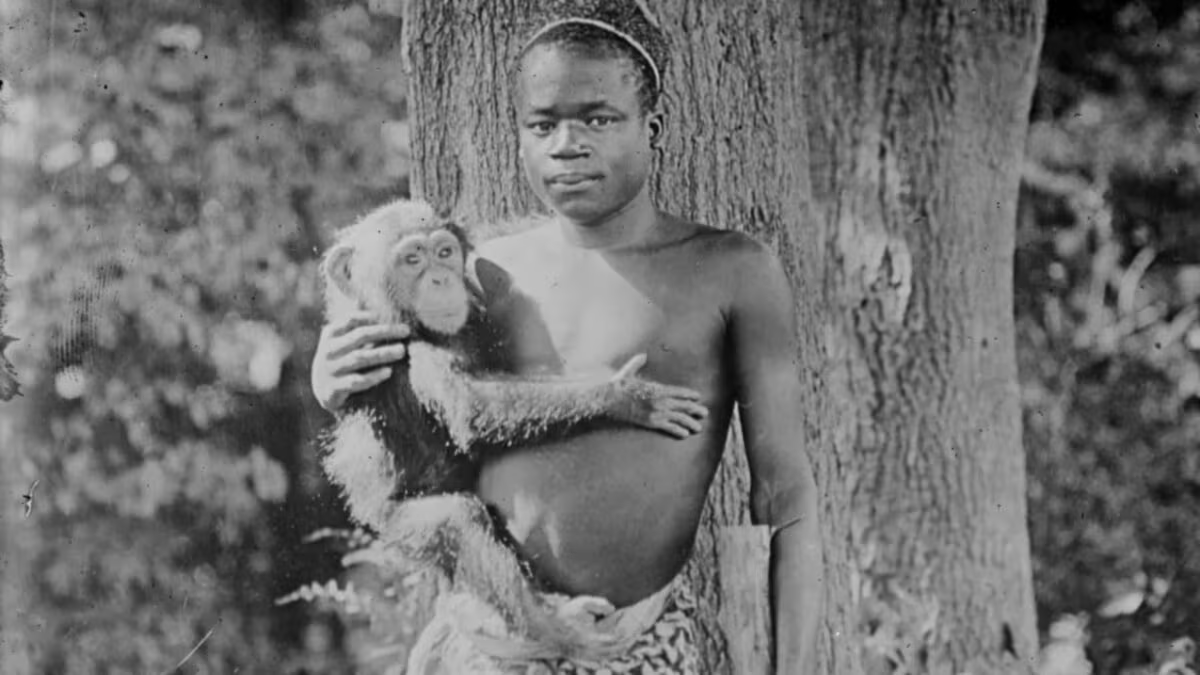
In September 1906, visitors to New York’s Bronx Zoo encountered an exhibit unlike any other: a young Congolese man displayed beside an orangutan.




News18
Visitors arriving at the Bronx Zoo in New York found a new attraction in the Monkey House: Ota Benga, a young man from what was then the Congo Free State, displayed alongside an orangutan as part of a public exhibit. Zoo officials promoted the display as educational. Critics called it degrading. Within weeks, protests forced the exhibit to close.
On September 8, 1906, crowds gathered at the zoo to see Benga, a Mbuti man who had been brought to the United States two years earlier. He had previously appeared at the 1904 St. Louis World’s Fair, where Indigenous and non-Western peoples were displayed in anthropology exhibits that were popular at the time.
At the Bronx Zoo, the arrangement developed gradually. Benga had been helping around the grounds and spending time in the Monkey House. Eventually, zoo leaders turned him into an attraction. A sign identified him as “The African Pygmy, Ota Benga” and announced that he would be exhibited each afternoon during September.
William Hornaday, the zoo’s director, regarded the exhibit as a legitimate spectacle for visitors. Supporters defended it as a scientific display reflecting prevailing theories about race and human evolution. Today, historians view it as an example of the pseudoscientific racism that was widespread in the early twentieth century.
Many New Yorkers were fascinated. Newspapers reported large crowds. Some visitors laughed, pointed, or treated Benga as a curiosity. Others were deeply uncomfortable.
“It is too bad that there is not some society for the prevention of cruelty,” Reverend Robert Stuart MacArthur said during the controversy, according to contemporary reports. “We send our missionaries to Africa to Christianize the people, and then we bring one here to brutalize him.”
African American ministers and community leaders organized some of the strongest opposition. Clergy members argued that the display reduced a human being to the status of an animal and reinforced racist stereotypes already common in American society. They appealed to city officials and demanded Benga’s release.
One minister involved in the protests reportedly told fellow campaigners that the issue was simple. “A man is a man,” he argued, rejecting claims that the exhibit served any educational purpose. While accounts vary, the sentiment reflected the position taken by many Black church leaders of the period.
Under growing pressure, the zoo ended the exhibition. By late 1906, Benga had been released into the care of Reverend James H. Gordon, who supervised an orphanage in Brooklyn. He later moved to Virginia, where supporters helped him attend school and adapt to life in the United States.
But the damage was lasting. Benga struggled with isolation and the loss of his homeland. Efforts to return to Africa were disrupted by world events and financial difficulties. In 1916, at about 32 years old, he died by suicide in Lynchburg, Virginia.
More than a century later, the story continues to resonate. Historians, civil rights advocates and museums have revisited the episode as a warning about the consequences of racial prejudice disguised as science. Memorials and historical markers now recognize Benga’s life and the injustice he endured.
The crowds that lined up outside the Monkey House in 1906 expected to see something unusual. What they witnessed instead was a revealing portrait of their era: a society willing to place a man behind a barrier and call it education. The exhibit lasted only weeks. Its legacy has lasted generations.
Read More