








Last Updated:
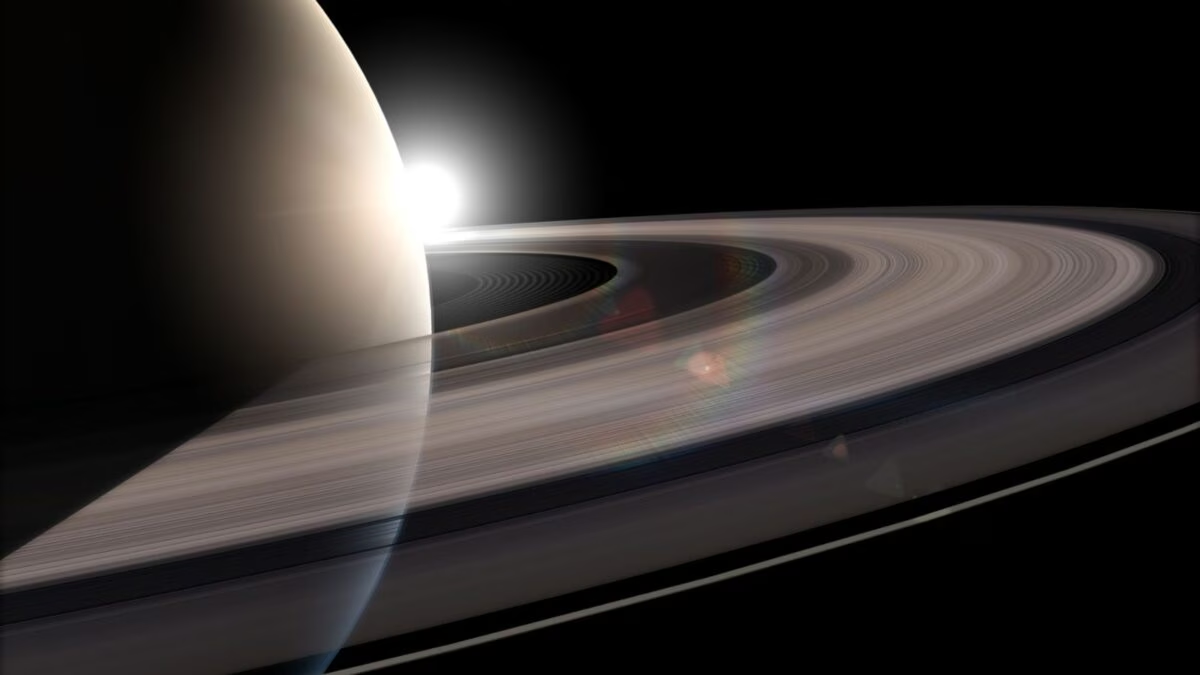
They are among the most beautiful sights in the Solar System, but Saturn’s iconic rings are slowly fading away—and one day, they could vanish entirely.




News18
If there were a popularity contest among planets, Saturn would have a clear advantage.
Those spectacular rings have made it the poster child of the Solar System for generations. They appear in textbooks, films and children’s drawings. Yet scientists say this cosmic trademark is living on borrowed time.
Saturn’s rings are disappearing.
The rings are made mostly of billions of pieces of ice, ranging from tiny grains to chunks as large as houses. Together, they form the dazzling bands that circle the giant planet. From a distance, they look solid. Up close, they are more like a vast swarm of icy debris.
For decades, astronomers assumed the rings would be around indefinitely. Then spacecraft observations began telling a different story.
Data gathered from the NASA mission, called Cassini, showed that Saturn was slowly absorbing ring material through a phenomenon referred to as “ring rain.” Charged ice and dust particles were pulled into the atmosphere of the planet because of the force of Saturn’s magnetic field.
In simple terms, Saturn is gradually consuming its own rings.
The amount lost each second is astonishing. According to NASA, enough ring material falls into the planet every half-hour to fill an Olympic-sized swimming pool. At that rate, scientists estimate the rings could disappear in around 100 million years.
That may sound like an eternity, but on a cosmic timescale, it is surprisingly brief. Saturn itself is more than 4 billion years old.
Ironically, this means we may be living during a special moment in the planet’s history. Some researchers believe the rings are relatively young, perhaps formed when icy moons or comets broke apart. If that’s true, humanity exists during the narrow window when Saturn wears the feature that makes it instantly recognisable.
The rings are not vanishing overnight. They will remain visible for countless future generations. However, the gradual deterioration of the planet indicates the ephemeral nature of even such spectacular elements of our Solar System.
Perhaps one day far into the future, Saturn will remain visible in the heavens. However, the beautiful rings that make it so spectacular might be gone.
Read More