






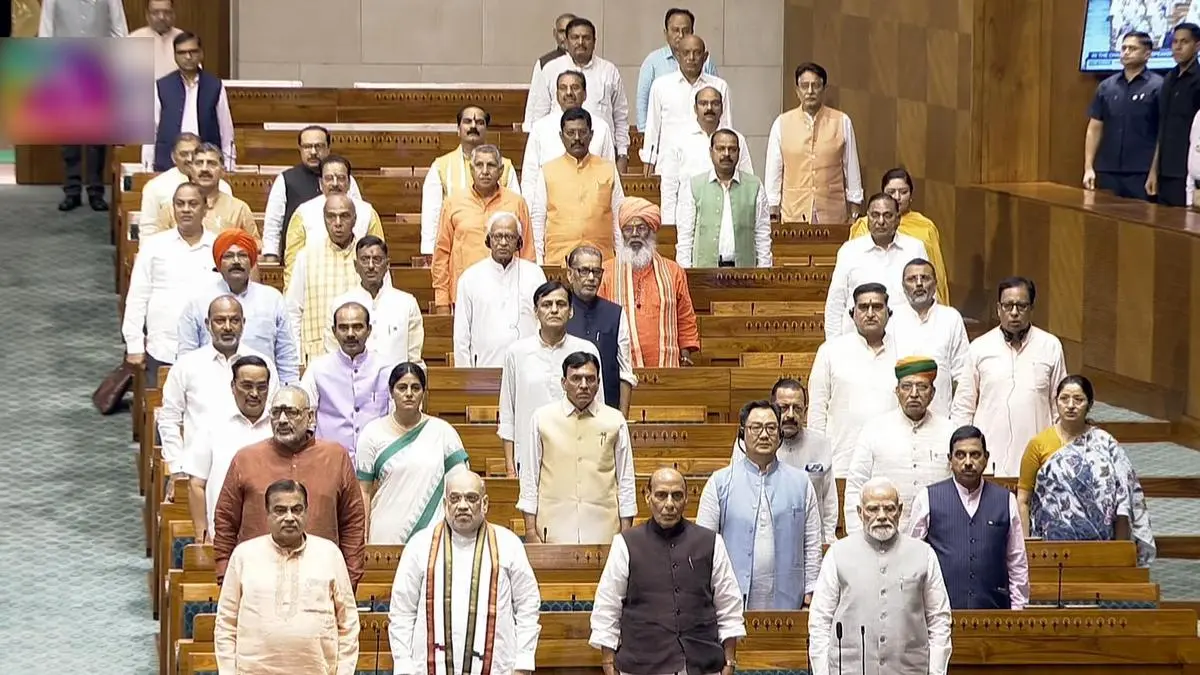
Amid the bedlam in both Houses of Parliament, the government unyieldingly secured the passage of a Bill for inclusion of the “full” national song, Vande Mataram, among the objects and renditions that symbolise “national honour” and whose insult is a punishable offence. This development is unfortunate in a year being commemorated by the government as the 150th anniversary of Vande Mataram, because inclusion of all six stanzas undermines the pluralist foundation of the national movement and Indian nationhood.
Worse, by passing the Prevention of Insults to National Honour (Amendment) Bill, 2026, the government has demeaned the agreed viewpoint of two of India’s tallest thinkers of the pre-Independence era—Mahatma Gandhi and Rabindranath Tagore. The government’s insistence on mowing down their views is extremely ironical as not just the BJP but the entire Sangh Parivar has made a concerted bid over several decades to appropriate these two iconic personalities within their own sparse pantheon of revered individuals.
The sequence of events leading to the brazen passage of the Bill in Parliament begins from November 7, 2025, when the government launched the year-long celebration of the national song at an event where Prime Minister Narendra Modi was the chief guest. A dedicated website was launched (https://www.vandemataram150.in/) and a commemorative stamp and coin released. In his address, Modi drew from the same falsities that have been dished out by the Sangh Parivar over the decades, declaring that Indian pride was “wounded” because only a truncated version of Vande Mataram was deemed the national song. He even indulged in a gross fabrication of the truth, claiming that the “division of Vande Mataram also sowed the seeds of division of the country”.
The next entry in this ideologically driven timeline came in February this year when the government released a set of instructions to States and other government bodies that all six stanzas of Vande Mataram would hereon be sung before the national anthem, Jana Gana Mana, whenever both songs are played at an event. Since January 1950, only the first two stanzas have been sung or played.
Days earlier, on Republic Day, the Ministry of Culture’s tableau—which rolled down what was once Rajpath but is now the pompously renamed Kartavya Path in sync with the numerous Kartavya Bhawans that have mushroomed across the capital’s Central Vista—was on the same theme.
The tableau was immensely objectionable at an event where an avowedly secular nation celebrates the anniversary of becoming a Republic. Not only was a gigantic idol of Goddess Durga its central piece, but a giant scroll in the front quoted the fifth stanza of Vande Mataram, and this even before the above order had been passed. This stanza starts with an invocation to Goddess Durga, “Twam hi Durga, Dasaprahar-dharini [you are indeed the ten-handed Goddess Durga]”, and was one of those stanzas that Gandhi and Tagore said did not merit being part of the national song since it specifically invokes a Hindu deity in a multi-faith land. But the tableau ostentatiously showcased both the fifth and sixth stanzas on Republic Day.

Ministry of Culture’s tableau themed after Vande Mataram, here, featuring the fifth stanza of the song with an invocation to goddess Durga, during the Republic Day Parade in New Delhi on January 26.
| Photo Credit:
ANI via DPR PMO
The actions of the government, which have the complete support of the RSS and its affiliates, are inherently problematic and undo the consensual secular framework of the national movement. Other than Gandhi and Tagore, Jawaharlal Nehru and Subhash Chandra Bose, two other stalwarts of Independence struggle, were part of this significant debate and had accepted the dropping of the stanzas without demur. The decision was endorsed by the entire Constituent Assembly on January 24, 1950, barely 48 hours before India was declared a Republic and the shortened Vande Mataram was declared the national song and Jana Gana Mana the national anthem.
On October 30, 1937, Tagore began a note stating that an “unfortunate controversy is raging around the question of the suitability of Vande Mataram as a national song”, in which he said he had had “the privilege of originally setting its first stanza to tune”. He said that because of the “spirit of tenderness and devotion expressed in its first portion and the emphasis it gave to the beautiful and beneficent aspects of our Motherland”, he “found no difficulty in disassociating it from the rest of the poem and from those of the book of which it is part”.
He went on to assert that the “whole of Bankim [Chandra Chatterjee]’s Vande Mataram poem, read together with its context, is liable to be interpreted in ways that might wound Muslim susceptibilities”. But, he said, a “national song though derived from it, which has spontaneously come to consist only of the first two stanzas of the original poem, need not remind us every time of the whole of it”. For Tagore, the first two stanzas of Vande Mataram had “acquired a separate individuality and an inspiring significance of its own, in which I see nothing to offend any sect or community.”
Tagore’s verdict was unequivocal—the last four stanzas were “inflammatory” but the first two had a life and meaning of their own and were universally embraceable without rancour. He thus clearly believed that only the first two stanzas had a secular and universal tone and functioned purely as a geographical and aesthetic ode to the motherland. His views were endorsed almost word to word by Gandhi in an issue of Harijan in 1939.
Controversies during the freedom struggle
Tagore’s views came after almost a decade of controversies around Vande Mataram from the late 1920s onwards. It was one of the most significant debates around national symbols during the freedom struggle. It highlighted the delicate challenge of balancing patriotic sentiment, religious pluralism, and secular nationalism. From the time of the British decision to partition Bengal Province into two, Vande Mataram became a battle cry in the movement that eventually forced the colonial regime to rescind the division. This was also when the song found resonance within the Swadeshi movement, symbiotically intertwined with the protests against Bengal’s partition. The poem evoked emotive sentiments of patriotic devotion, unyielding resistance against colonial rule, and a sacred, mother-centric vision of the Indian homeland.
By the early 1930s, Vande Mataram started holding different meanings for different people. It had, unfortunately, emerged for some as a war cry against Muslims in a worsening communazadal situation, even while some thought of it only as evocative and universal. With the emergence of the Muslim League and M.A. Jinnah, the use of the song as before led to objections over its other stanzas. It began also to be seen through the prism of the contentious theme of Bankim Chandra Chatterjee’s novel Anandamath, into which he integrated the original poem almost a decade after it was first written.

Mahatma Gandhi, Maulana Abul Kalam Azad, Jawaharlal Nehru, among others, singing Vande Mataram at the All India Congress Committee meet in Wardha in January 1942.
| Photo Credit:
Hindu Photo Archives
The protests snowballed into a major political conflagration in 1937 when, under the Government of India Act, 1935, provincial elections were held in early 1937, leading to the Congress forming governments in 7 of the 11 provinces. In these precursors of today’s States, after Congress ministries assumed office, almost every Legislative Assembly, municipal meeting, and public school routinely opened proceedings with Vande Mataram. The Muslim League charged the Congress of becoming a Hindu hegemon, leading to deliberations among senior Congress leaders.
Against this backdrop, Subhas Chandra Bose, released from jail in March 1937, engaged in an active correspondence with Nehru regarding the Congress’s organisation and policies, including about Vande Mataram and the Muslim mass contact programme. Nehru, also aware of the issue, wrote to Bose shortly before the Congress Working Committee meeting in Calcutta in the last week of October, stating that he had secured an English translation of Anandamath and it did “seem that this background [of the song] is likely to irritate the Muslims”. He added that he would meet Tagore before the meeting. Nehru also acknowledged that the Congress faced a challenge in Bengal as “more and more Muslims are becoming politically awake. The question therefore is how far the Congress can influence these Muslims and bring them within its fold. If we are unable to do so they will strengthen the communal elements”.
Congress’ resolution and consensus in the Assembly
It was within this framework that the Congress adopted the resolution on Vande Mataram and noted that over three decades the song was associated with “innumerable instances of sacrifice” and that “men and women have not hesitated to face death with that cry on their lips”. The resolution added that the two words had simultaneously emerged as an inspirational “slogan of power… and a greeting”. It reiterated Tagore’s views that the first two stanzas “described in tender language the beauty of the motherland and the abundance of her gifts”, and that there was “absolutely nothing in them to which objection could be taken from the religious or any other point of view”. The resolution declared that the two stanzas were an “inseparable part of our national movement and as such they must command our affection and respect.”
Equally, the Congress recognised the “validity of the objection raised by Muslim friends to certain parts of the song” and, as a consequence, it decided that only the first two stanzas should be sung at “national gatherings”. The meeting, with Nehru as Congress president, and attended by prominent leaders including Gandhi, Sardar Vallabhbhai Patel, Bose, Rajendra Prasad, and Maulana Abul Kalam Azad, took the decision after due deliberation and after factoring in Tagore’s opinion. The Congress resolution, moved by Prasad and seconded by Patel, merely made official what was already endorsed collectively by the people—they chanted the two words Vande Mataram during protests and marches and sang just the first two stanzas during important gatherings.
Contrary to what the Sangh Parivar and Modi allege, that the Congress “severed” the song’s soul and that “Vande Mataram was… torn into pieces”, there is actually no ambiguity that it was a conscientious and carefully considered decision taken with widespread deliberation to ensure that the song would have the capacity to unify every Indian, as the Jana Gana Mana did eventually.
In September 2022, the government unveiled a large monolithic statue of Bose beneath the empty iconic canopy near India Gate in furtherance of its “Project Appropriation”, but paradoxically both the government and the Sangh Parivar choose to ignore that it was Patel who seconded the resolution that limited the use of Vande Mataram to the first two stanzas. It is another instance of the Sangh Parivar’s political duplicitousness.
It is not as if the Congress forced the decision on the Constituent Assembly or on the nationalist stalwarts who held one-on-one interactions with the interim government heads. A fortnight before Independence, the maverick nationalist H.V. Kamath, who eventually moved to the Praja Socialist Party, suggested that Vande Mataram be part of the event to be held on August 15, 1947. Within days, Nehru formally wrote to Prasad on the “programme for the 14th night and for the 15th morning sessions of the Constituent Assembly”. Among other suggestions, he mooted that the first stanza of Vande Mataram be sung at the outset. Eventually, the then Member of Constituent Assembly Sucheta Kripalani did the honours and thus formally started the proceedings that historic day.

School students during an event marking 150 years of Vande Mataram, at Tiruchirappalli Junction on November 7, 2025.
| Photo Credit:
M. Moorthy
Syama Prasad Mookerjee, the then Minister in Nehru’s government who later founded the Bharatiya Jana Sangh, raised the matter in June 1948 with regard to the two songs, even as Jana Gana Mana was already being sung as national anthem by then. Nehru promptly replied that he did not think “Vande Mataram at all feasible as a national anthem chiefly because of its tune which does not suit orchestral or band rendering. Our National Anthem has to be played by foreign orchestras all over the world. Jana Gana Mana, on the other hand, has already been greatly appreciated in foreign countries as well as in India and the music of it has a great appeal to people who hear it in India or abroad”. One need not be a music connoisseur to agree with this contention.
The issue kept being raised in the Constituent Assembly until well into 1949, but eventually Prasad’s declaration on January 24, 1950, that the selected stanzas of the two songs would “have equal status” was applauded by all members of the House. Despite the consensual decision across different ideologies within the Assembly after Independence, the Sangh Parivar has not stopped raking up the issue to polarise India on religious grounds and enhance support for the Hindu majoritarian project.
Historical position of RSS and its affiliates
Importantly, the government’s actions since November 2025 have their genesis in the positions of the RSS on Vande Mataram from the early 1930s. These were subsequently reiterated by the Bharatiya Jana Sangh and eventually the BJP. The demand to sing all six stanzas—and the sharp criticism against shortening it—is rooted in the early ideological formulation of Hindutva by K.B. Hedgewar, the founder of the RSS. By the time the RSS was established in 1925, the song—mainly the two words Vande Mataram and the first stanza or, at best, the first two stanzas—was already a widely recognised rallying cry of the freedom movement. But in the Hindu exclusivist fraternity, the entire poem embodied the spiritual core of cultural nationalism, at the centre of which the nation was viewed as a divine mother figure or Bharat Mata.
Hedgewar, in fact, instituted the “Ekatmata Stotra” (and its shorter form, “Pratahsmaran”), which is recited even now in the mornings at RSS training camps (Sangh Shiksha Varga). The stotra shares the thematic reverence for Bharat Mata similar to Vande Mataram and lists sacred rivers, mountains, historical figures, and deities across India to emphasise geographical and cultural integration. The stanza from Vande Mataram used in the Republic Day tableau is considered an ideal within the Sangh. The RSS has also included combinations of the two words Vande and Mataram as chants in other songs sung regularly, even daily, in its shakhas.
Even for the Jana Sangh, from the time of Mookerjee, the full restoration of Vande Mataram was a core agenda. In fact, the demand for the “entire” song has been a recurring ideological campaign across events of its historical milestones. A formal resolution to this effect was passed by the Jana Sangh at its Kanpur session in 1952. At the Rajkot session in 1973, amid the gathering anti-government storm, a resolution advocating the mandatory singing of Vande Mataram in all government schools, state functions, and Legislative Assemblies was passed.
Subsequently, the demand was adopted by the BJP. Crucially, in 1992, when the then BJP president M.M. Joshi embarked on the nationwide “ekta yatra”, the full song was adopted as the primary cultural anthem. One cannot forget that Modi was the coordinator of this rally and this deputation was his stepping stone into national politics.
Later, in 2006, when the United Progressive Alliance government issued a circular suggesting (but not mandating) that schools sing the first two stanzas on September 7, 2006, to mark the 100th anniversary of the adoption of the song of protest at the anti-Partition agitation in Bengal in 1906, the BJP launched a nationwide agitation. The party’s Dehradun session held in August 2006 passed an official resolution demanding that all six stanzas be made mandatory in all educational institutions and government functions.
In Madhya Pradesh that year, the BJP-run State government mandated that State secretariat employees sing Vande Mataram on the first working day of every month. When the BJP lost power, the decision was reversed by the Congress government, but BJP-led protests resulted in the step being recalled. There are numerous other occasions when similar decisions were made and protests were staged by the BJP and its affiliated organisations.
Clearly, the demand for the full song has been important for the Sangh Parivar for close to a century, and the recent passage of the Bill brings closure to an important Hindutva “project”. It remains to be seen just where the BJP, Modi, and the larger Sangh Parivar take the Vande Mataram narrative in an increasingly intrusive and surveillant regime.
Nilanjan Mukhopadhyay is an author and journalist based in Delhi-NCR. His latest book is The Demolition, The Verdict and The Temple: The Definitive Book on the Ram Mandir Project. He is also the author of Narendra Modi: The Man, The Times.
Also Read | Power, people, politics
Also Read | What’s wrong with BJP’s ‘Vande Mataram’ campaign