


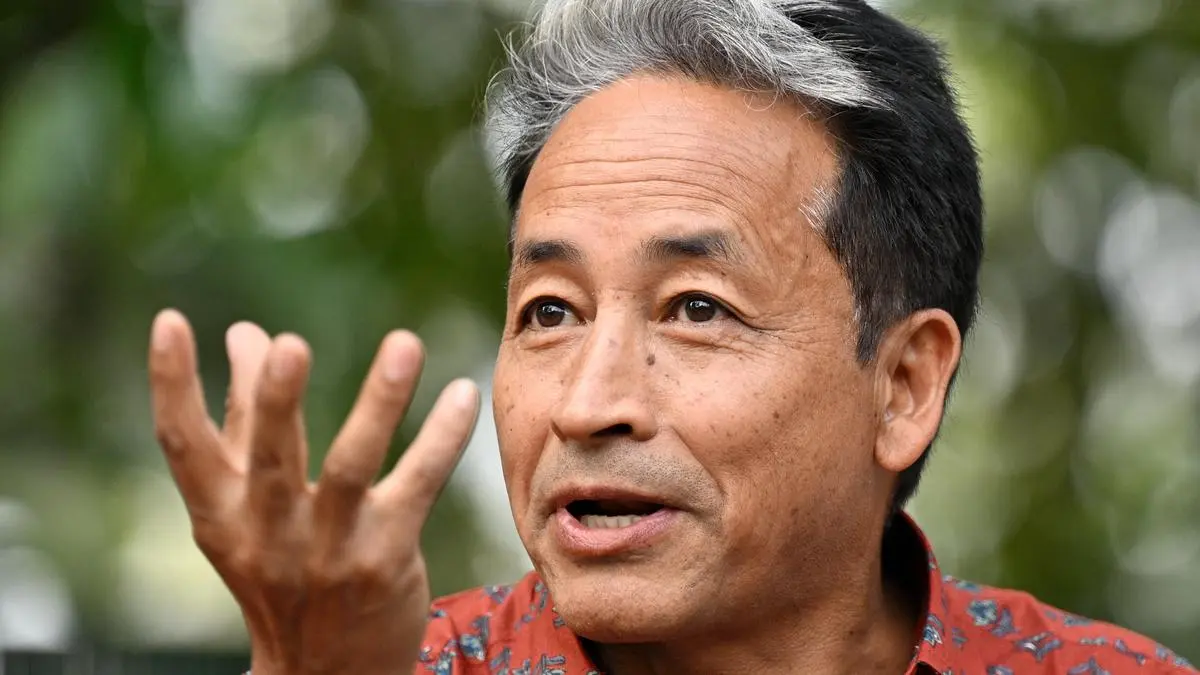
On July 14, 2026, Sonam Wangchuk lay on a makeshift stage at Delhi’s Jantar Mantar, surrounded by medics, his voice reduced to a near-whisper, 17 days into a hunger strike on water alone. He had lost more than 8 kilograms. His blood pressure was recorded at 109/70. A medical team was in attendance around the clock. Around him, a protest that began as a Gen Z social media movement had drawn in opposition politicians, film actors, climate groups, and student unions. The Union government had not responded.
The 59-year-old engineer, education reformer, and climate activist from Ladakh had begun his indefinite fast on June 28, joining a campaign led by the Cockroach Janta Party (CJP), a youth-led satirical movement demanding the resignation of Union Education Minister Dharmendra Pradhan over the leak of the NEET-UG medical entrance examination question paper. As of July 15, 2026—25 days into the CJP’s protest at Jantar Mantar—no Union government official had met the protesters or issued any direct response.
Who is Sonam Wangchuk?
Wangchuk was born on September 1, 1966, in Uleytokpo, a small village in Ladakh with five households and no school. He spent his first nine years learning at home from his mother, a woman he described as “never schooled but highly educated”. At age nine, following his father’s entry into the Jammu and Kashmir government, the family moved to Srinagar. Enrolled in school there for the first time, Wangchuk found teachers who conducted classes entirely in Urdu—a language unfamiliar to him—and who hit students. He left.
He was admitted to a Kendriya Vidyalaya in Delhi, one of the schools set up for tribal and border-area children. He finished his schooling there and went on to study Mechanical Engineering at the National Institute of Technology, Srinagar, financing his own education after his father objected to his choice of subject. He graduated in 1987.
In 1988, at the age of 22, he returned to Ladakh and co-founded the Students’ Educational and Cultural Movement of Ladakh (SECMOL) with his brother and five peers. At the time, roughly 95 per cent of Ladakhi students were failing government examinations. The exams tested knowledge of a world entirely foreign to them: the medium of instruction was Urdu, the curriculum was written in distant cities, and the content had no connection to Ladakhi life.
SECMOL partnered with the local administration to retrain teachers, rewrite textbooks in local languages, and bring parents and communities into school governance through village education committees. The initiative—Operation New Hope, launched in 1994—was adopted as official education policy for Ladakh.
In 2018, Wangchuk received the Ramon Magsaysay Award. The board of trustees cited his “uniquely systematic, collaborative, and community-driven reform of learning systems in remote northern India”.
Outside his contributions to education, Wangchuk invented the ice stupa: a conical artificial glacier, built using winter meltwater channelled through pipes and nozzles, that stores water as a heap of ice and releases it through spring and summer when farmers in Ladakh’s arid high-altitude landscape need irrigation. Six such structures, built by his team, hold roughly 30 million litres of water. The SECMOL campus, built with students using rammed-earth construction and passive solar architecture, runs entirely on solar energy, with no fossil fuels used for heating, cooking, or lighting.
Wangchuk also partly inspired the character of Phunsukh Wangdu in Aamir Khan’s 2009 film 3 Idiots.
What are his demands?
Wangchuk’s first demand is the resignation of Union Education Minister Dharmendra Pradhan, which is the central demand of the CJP. The CJP was founded on May 16, 2026, by Abhijeet Dipke, a political communications strategist who had previously worked with the AAP. The movement’s name came from remarks made on May 15 by Chief Justice of India Surya Kant, who referred to some activists and unemployed youth as “cockroaches” and “parasites of society” in an open court hearing. Dipke registered the name as a satirical response and launched the party online within 24 hours.

(Left) Sonam Wangchuk at Jantar Mantar on June 28, the first day of his hunger strike. Wangchuk on July 14, marking 17 days of his fast.
| Photo Credit:
SHIV KUMAR PUSHPAKAR, Arun Sharma/PTI
The immediate trigger of the demand for Pradhan’s resignation was the NEET-UG 2026 examination. Held on May 3, 2026, for more than 22.8 lakh students seeking admission to undergraduate medical and dental courses, the examination was cancelled on May 12 after investigations confirmed that question papers had been leaked before the examination date. The re-examination was held on June 21. According to media reports, at least eleven students have died by suicide following the paper leak and cancellation. The CJP is also demanding Rs.1 crore in compensation for the families of students who died.
Wangchuk joined the protest on June 28 as an educator with a direct stake in the question of how India’s public examination system treats students. “The students did nothing wrong,” he told The Quint. “The government’s fault was that their papers were leaked. But they were made to suffer.”
Wangchuk’s second demand concerns Ladakh’s constitutional status.
In August 2019, the Modi government revoked Article 370 and bifurcated Jammu and Kashmir into two Union Territories—Jammu and Kashmir and Ladakh. Ladakhi political groups had long demanded separation from the State and initially welcomed the bifurcation.
The BJP’s 2019 Lok Sabha manifesto had listed the implementation of the Sixth Schedule for Ladakh as one of its top three priorities for the region. The same promise was repeated ahead of the 2020 Ladakh Autonomous Hill Development Council elections. The Sixth Schedule of the Constitution provides autonomous legislative, judicial, and financial powers to tribal district councils in specified regions. It currently applies to Assam, Meghalaya, Tripura, and Mizoram.
In 2019, the National Commission for Scheduled Tribes recommended that Ladakh be brought under the Sixth Schedule, noting that more than 97 per cent of the region’s population consists of Scheduled Tribes—the highest such concentration in the country.
By early 2024, Union Home Minister Amit Shah told a Ladakh delegation that neither Sixth Schedule status nor statehood would be granted. The central government’s position, as reported by The Quint and The Diplomat, was that some other constitutional mechanism would be examined instead. Talks between the Leh Apex Body, the Kargil Democratic Alliance, and the Ministry of Home Affairs stalled.
Wangchuk’s demand, as The Wire described it, is “neither secessionist nor radical”. Ladakh currently has no State legislature, no public service commission, and no elected body with legislative powers. Without constitutional safeguards, ecologists and local leaders have argued, land and natural resources in the region are open to acquisition by outside interests, and unregulated mining and large-scale renewable energy projects can proceed without local consent.
A history of fasts and detentions
Wangchuk has used hunger strikes as a form of protest repeatedly over the past several years.
In March 2024, he undertook a 21-day climate fast in Leh demanding Sixth Schedule status. Later that year, he led a nearly 1,000-kilometre march from Leh to Delhi—the “Delhi Chalo Padayatra”—with hundreds of supporters. He and other marchers were detained by Delhi Police at the Singhu border before entering the capital.

Sonam Wangchuk, alongside LAB and KDA leaders, begins a hunger strike demanding statehood and 6th Schedule inclusion for Ladakh on March 6, 2024.
| Photo Credit:
Mohammad Arhaan Archer/ANI
In September 2025, Wangchuk went on another hunger strike in Leh. On September 24, a protest in Leh demanding statehood turned violent; four people were killed in clashes with security forces. Two days later, on September 26, Wangchuk was detained under the National Security Act and transferred to Jodhpur Central Jail. He was held there for 170 days. The Centre revoked his detention on March 14, 2026, citing a need for “constructive and meaningful dialogue” on Ladakh’s future, two days before a scheduled Supreme Court hearing on a habeas corpus petition filed by his wife, Gitanjali Angmo.
He announced the current fast on June 28 with a public statement: “My previous hunger strikes I started at one week, then two weeks, then three weeks. This is the sixth time, and it will be for six weeks or death.”
In a post on X addressing those urging him to end the fast, he wrote: “Thanks for all your messages to break my hunger strike, but that wouldn’t help the 20 students who committed suicide, nor will that help protect the mountains of Ladakh or the rivers of India.”
He told reporters at Jantar Mantar: “I am neither Gandhi nor a hero. I am just an ordinary citizen who has tried to fulfil his responsibilities.”
The government’s response
As of July 15, 2026, the Union government had not responded to the protesters across 25 days of agitation. Pradhan dismissed the CJP and its supporters as a “B-team of disruptive elements” and ruled out his resignation. Reuters, reporting on July 14, noted that Pradhan, his ministry, and the government’s chief spokesperson did not respond to requests for comment.
CJP spokesperson Saurav Das told The South First: “Even the British used to respond to these kinds of hunger strikes in the past. But now, a Ramon Magsaysay Award recipient is sitting on a hunger strike, and his own government is unwilling to hear him out.”
In August 2011, when Anna Hazare fasted for 12 days at Delhi’s Ramlila Maidan demanding a Jan Lokpal Bill, the Congress-led United Progressive Alliance government responded through direct engagement with protesters. The BJP, then in opposition, publicly backed Hazare’s movement and called for government accountability. Hazare ended his fast on August 28 after Parliament passed a “sense of the House” resolution agreeing in principle to three of his key demands.
Who has supported him?
Opposition leaders have called on Wangchuk to end his fast while criticising the government’s silence. Mamata Banerjee (Trinamool Congress), Akhilesh Yadav (Samajwadi Party), Arvind Kejriwal (AAP), and Uddhav Thackeray (Shiv Sena-UBT) have all issued public statements. Thackeray announced full party support for the CJP and urged affiliated parties across States to hold solidarity protests.
Shiv Sena-UBT’s party mouthpiece Saamna ran an editorial drawing a direct comparison between the BJP’s support for Hazare in 2011 and its current silence, calling the latter “pure hypocrisy”.
From the film industry, Omi Vaidya—who played Chatur Ramalingam in 3 Idiots—posted a video saying: “I don’t want Phunsukh Wangdu to die.” Actors Zeenat Aman, Naseeruddin Shah, Ratna Pathak Shah, and Prakash Raj asked the government to open dialogue. Activist-lawyer Prashant Bhushan also expressed support.
CPI(M) MP Subhashini Ali and Shiv Sena-UBT’s Arvind Sawant visited Jantar Mantar and said they would raise the matter in Parliament when the Monsoon Session begins.
What happens now?
The Monsoon Session of Parliament opens on July 20. The CJP has announced a march from Jantar Mantar to the Parliament on that day and has invited MPs from all parties, including the BJP, to visit the protest site and raise the NEET issue on the floor of the Parliament. Wangchuk has said he will participate, health permitting.
In a post on X, he wrote: “If you really want to help, then do a little more than messages from comfy couches; come to Delhi and to Jantar Mantar on July 20, when the monsoon session of Indian Parliament starts. Together, we’ll start a very peaceful march to the Sansad.”
Dipke said, on X: “I feel the government wants Sonam sir and other people on hunger strike to die.”
A fellow faster—a student activist affiliated with the All India Students Association—was hospitalised after fainting at the protest site. The CJP says it has tried repeatedly to persuade Wangchuk to end the fast. He has refused each time.
Also Read | I was labelled anti-national for supporting the nation: Sonam Wangchuk
Also Read | Cockroaches on the march