With just about eight months left for the Punjab State Assembly election, the Punjab Congress appears to be falling into a familar trap. The political undercurrents, for now, appear to be favouring the party, but the Congress lacks the cohesiveness and consistency required to leverage its strengths. Behind the scaffolding that hides the factionalism, the Punjab Congress is a deeply divided house that might not be able to overhaul itself quickly.
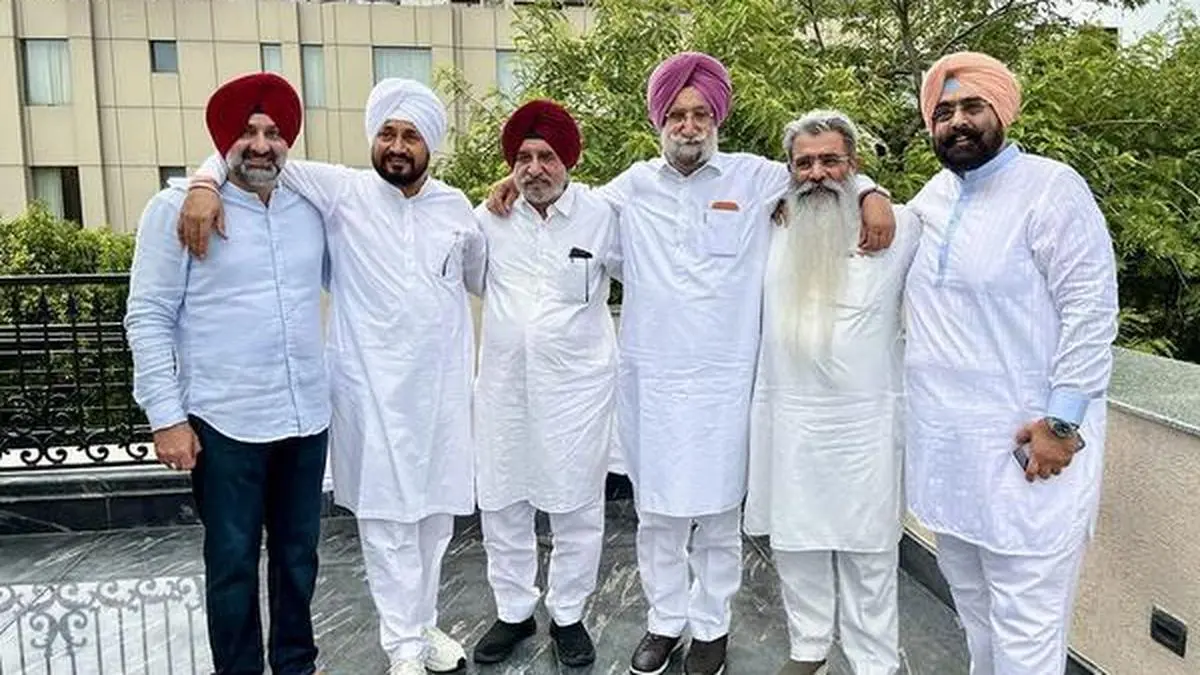
The picture-perfect moments of party leaders shaking hands, exchanging flowers, and reciting unity vows hide the underlying mutual hatred that many of its leaders have for each other. And unless the party resolves the internal strife and leadership issues, which are key to winning the upcoming election, it is likely to falter in areas such as cadre mobilisation and campaign strategy.
However, despite having been in disarray since losing power in 2022 to the AAP, the Congress has a robust foundation and an eminent past in the State’s politics. Punjab has seen numerous Congress Chief Ministers, the most by any political outfit, since the State was reorganised in 1966. (The reorganisation divided the erstwhile region into Punjab, Haryana, and Himachal Pradesh States and established Chandigarh as a Union Territory.) Before the reorganisation, the Congress stalwart Partap Singh Kairon was the party’s longest-serving Chief Minister, completing over eight years in office. Also, the only woman Chief Minister of Punjab since Independence, Rajinder Kaur Bhattal, came from the Congress.
Before reorganisation, the Congress had a firm grip on power for the most part. Ironically, the party seems to have lost all its institutional memory. And the central leadership’s proclivity for delaying decisions on crucial issues has hurt it in the past too. In the recent past, it lost big leaders such as two-term Chief Minister Captain Amarinder Singh and Sunil Jakhar, a suave politician with an unblemished record. Both are now in the BJP. Jakhar, who was Punjab BJP president from 2023 until May 2026, is likely to play a decisive role in the upcoming election.
Following in their footsteps, Ravneet Singh Bittu, grandson of former Chief Minister Beant Singh, was the next to abandon the Congress. In 2024, the three-time Lok Sabha MP left the party citing various reasons and joined the BJP. He became a Rajya Sabha MP and is currently serving as the Union Minister of State for Railways.
As for the former cricketer and ex-MP Navjot Singh Sidhu, he has been jettisoned by the Congress—left to hibernate by the central leadership and his colleagues in the Punjab unit. Meanwhile, his wife and former MLA Navjot Kaur Sidhu has quit the Congress.
The enigmatic Navjot Singh Sidhu’s political future, within the Congress or outside it, remains uncertain. Nevertheless, given the political appeal he possesses, he could prove to be an asset for the party in his stronghold Majha region, which covers 25 of the 117 seats in Punjab. Yet, it is not clear at this point whether the Congress will mend fences with him.
Punjab’s political landscape is fast altering, especially given the strong headwinds faced by the incumbent AAP, which romped home in 2022 by winning 92 of the 117 seats. The AAP is facing challenging times after Chief Minister Bhagwant Mann became embroiled in a controversy involving a viral video and accusations of sacrilege. This has created what is perhaps the most opportune moment for the Congress to revive its fortunes and cover lost ground, given how much Mann’s credibility and probity have been dented.
Leadership issues
The Punjab Congress has serious leadership issues, with too many senior leaders aspiring for the Chief Minister’s chair. A few months ago, Congress leader Rahul Gandhi warned State-level leaders to “fall in line”. Even though the party fancies its chances of a comeback in Punjab, it is imperative that the State leaders get their act together if they want to march towards victory.
The party, however, appears to have already flunked the first litmus test, after the All India Congress Committee (AICC) announced its decision to continue with Amarinder Singh Raja Warring as the Punjab Congress chief ahead of the election. The decision has created heartburn among aspirants and party leaders.
Former Chief Minister Charanjit Singh Channi, who was named chairman of the election campaign committee in the recent reshuffle, is up in arms. Scores of sitting and former MLAs and senior party members gathered at Channi’s residence to express their disapproval in letting Raja Warring continue as the Punjab party chief. This has left the AICC in a pickle.
Also, apparently miffed at being ignored in the entire process, the Congress MP from Chandigarh Manish Tewari, in a discreet post on the social media platform X, underpinned how factionalism has severely hit Punjab. He said: “Maharaja Ranjit Singh died on June 27, 1839. On March 29, 1849, the Sikh Empire was officially dissolved. Established on April 12, 1801, it lasted a mere 48 years. Internal squabbles post the demise of Maharaja Ranjit Singh brought about this ignominious end. Infighting has been the bane of Punjab since times immemorial.”
The ongoing problems in the State Congress come on the heels of the high command taking stock of the political and organisational situation at the ground level. AICC president Mallikarjun Kharge had set up a committee for this purpose with three observers: senior leader Ajay Maken, former MP Meenakshi Natarajan, and veteran leader Bhajan Lal Jatav.
The State’s top-level leadership, such as Partap Singh Bajwa, Channi, Raja Warring, Sukhpal Khaira, Sukhjinder Randhawa, Rana Gurjeet Singh, and Vijay Inder Singla, were consulted before the committee submitted its report, after which the reshuffle was formally announced. The discussions centred around assessing the prospects of the party’s next State chief candidates and the campaign committee chairman, and issues that have plagued the party.
Lok Sabha member Sukhjinder Randhawa has maintained that in the current scenario, given the fact that senior State Congress leaders are not seeing eye to eye, a Congress victory could be in jeopardy.
Days after the reshuffle was announced, Randhawa met Union Home Minister Amit Shah in Delhi, sending the party into a frenzy over speculations of Randhawa joining the BJP. But Randhawa has denied any such possibility. Channi, the party’s Dalit face, and Randhawa, a Jat Sikh, were among the frontrunners for the State chief’s post.
Jat Sikh vs Dalit Sikh
The Congress is mindful of the fact that the Jat Sikh community, which has produced the most number of Chief Ministers in the State, can sway the electoral outcome. Anointing Channi has its advantages and detriments. Punjab has the highest proportion of Dalits as a share of the population (32 per cent) in the country. Their voting pattern often remains segmented. However, the appointment of a non-Jat Sikh might lead to counter-mobilisation of the dominant Jat Sikh and Hindu voters. As per data from the last Assembly election, Jat Sikhs accounted for 29.6 per cent of the electorate.
The acceptability of the new Congress chief will be a touchstone to gauge the party’s prospects in the run-up to the election. Another challenge will be deciding on the Chief Minister if the party does come to power.
Many within the party charge the central leadership of taking flawed decisions that are out of touch with ground reality. For instance, just a few months before the 2022 Assembly election, the party high command had announced a dramatic change in the top leadership. It had unceremoniously removed Amarinder Singh as Chief Minister and replaced him with Channi. The move was an attempt to consolidate Dalit votes but the gamble failed. The timing of the decision was unsound.
The Congress lost badly. It could manage just 23 per cent of the vote share compared with 38.6 per cent in 2017. By axing Amarinder Singh, the Congress in a way admitted to deficiencies, flaws in governance, and ebbing voter support. Amarinder Singh’s long-standing equation with Sonia Gandhi and his association with former Prime Minister Rajiv Gandhi from his Doon School days were disregarded. A chastened Amarinder Singh left the party and joined the BJP to stay relevant.
Equally, despite these setbacks, the Congress has the ability to bounce back, as it has shown time and again. Its poor showing in the 2022 Assembly election brought the tally down from 77 seats in 2017 to just 18 seats. However, two years later, in the 2024 Lok Sabha election, the Congress made a strong comeback, winning 7 of the 13 Lok Sabha seats and garnering 54 per cent of the vote share. This, despite the incumbent AAP’s resilient presence in the State.

Punjab Chief Minister Bhagwant Mann addresses a public meeting at Patran in Patiala on July 1.
| Photo Credit:
X/@BhagwantMann
Assembly elections, however, are a different game, where local issues often dominate. The era of the Congress and Shiromani Akali Dal (SAD) taking turns to form government is a thing of the past. The AAP is a formidable contender and has a sizeable footprint in the State. The SAD under Sukhbir Singh Badal is struggling to find its feet. In the 2022 election, it won just three seats while its vote share fell from 18 per cent to 6.8 per cent. In the 2024 general election, it won just one seat and garnered a vote share of 7.6 per cent.
AAP troubles
The AAP is facing major turbulence with the alleged involvement of Bhagwant Mann in acts of desecration and religious misconduct. The issue could prove to be the AAP’s Achilles’ heel. The Akal Takht, the highest temporal seat of the Sikhs, passed an edict declaring Mann “Guru dokhi” (anti-Sikh Guru) and “Khalsa Panth virodhi” (anti-Sikh religion). The Sikh clergymen have appealed to the community to boycott Mann.
This comes against the backdrop of an Act promulgated by the Punjab Assembly—now under scrutiny and review by the Shiromani Gurdwara Parbandhak Committee and the government—which incorporated stringent punishment for those engaging in acts of sacrilege. By passing the Act, the AAP wanted to project itself as the custodian of the Panth. In doing so, it intended to garner the Panthic votes, which has always formed the core voter base of the SAD.
The BJP has a limited footprint in Punjab. Beyond its positioning on morality and probity, the sacrilege controversy is unlikely to help the saffron party much as it derives much of its strength from urban Hindu voters. The sacrilege row has aroused passions among the majority devout Sikhs who increasingly feel anguished by attempts to hurt their religious sentiments. This could possibly consolidate this large voter base, but they are unlikely to vote for the BJP.
Although the BJP has grown from strength to strength under Jakhar’s leadership, its political fortunes rest on re-establishing an alliance with the Akalis, who broke away from the BJP-led National Democratic Alliance after the Centre enacted three controversial farm laws.
Speaking to Frontline, Jakhar said: “The Congress leadership in Punjab is both uncertain and power-hungry. Its advisers at the helm still [retain] command and control.” The current political environment presents an opportunity for the Congress to re-establish itself as a force to reckon with. But cohesiveness will remain key.
Gautam Dheer has been covering policy and politics in Punjab, Haryana, and Himachal Pradesh for over two decades.
Also Read | Why Punjab’s politicians still bow at the Akal Takht
Also Read | Guarding or gagging?