





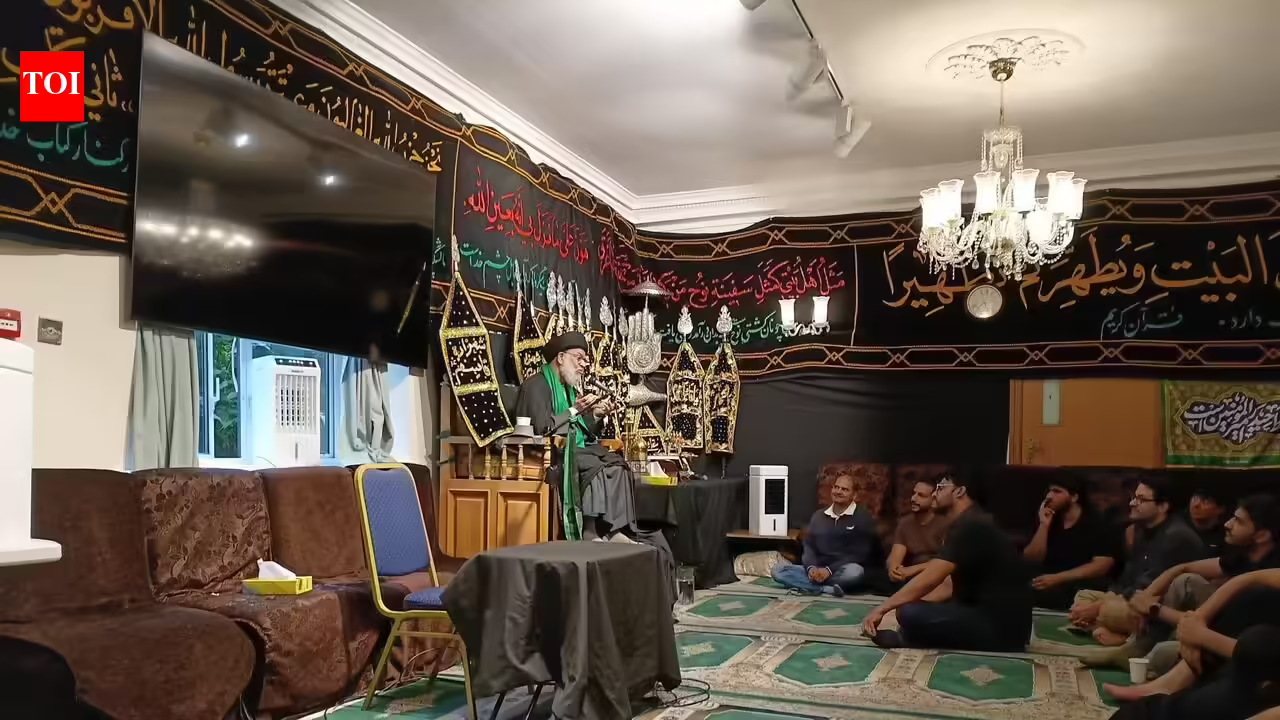
Lucknow: “A tradition of Sham-e-Ghariban, as it is observed in many parts of the world, has its roots in Lucknow and is truly a gift from the city to the world,” said Siraj Jafri, a resident of Lucknow now settled in Dublin, Ireland, highlighting how migrants from the city carried the practice across continents and helped transform it into a global expression of remembrance during Muharram.He said the observance continues to draw participation from people of different faiths and communities, reflecting the universal message of peace, sacrifice and humanity associated with the tragedy of Karbala.On organising the gathering, he said, “Owing to local weather conditions, our programmes are conducted indoors in a large hall rather than in open spaces, but the spirit and atmosphere remain the same.”Another Lucknowite, 65-year-old Syed Zia Haider Zaidi, a retired bank official now settled in London, said that when he arrived in the city 40 years ago, there was no organised Sham-e-Ghariban gathering. “I started the practice, which gradually spread to most imambaras in London,” he said.What began in Lucknow in 1926 as a local mourning observance, Majlis-e-Sham-e-Ghariban, has evolved into a global tradition observed by Shia communities worldwide.Faizi Hussain, a marketing manager settled in Toronto, said, “Majlis are held in several languages, including Urdu, English, Arabic, Persian and Punjabi. For Urdu-speaking communities, Lucknow is regarded as the centre of Azadari, and the same traditions are followed in the Greater Toronto Area.The atmosphere of Sham-e-Ghariban is preserved by dimming the lights and following the traditional sequence of salam, marsiya, majlis and masaib. “The format established in Lucknow, particularly at Imambara Ghufran Ma’ab, continues to serve as the benchmark for observances across the world,” he expressed.What is Shaam-e-GharibanMourning gathering held on the night between the 10th and 11th of Muharram, it marks the martyrdom of Imam Hussain, the grandson of Prophet Muhammad, who was killed along with 72 companions in the Battle of Karbala in 680 AD. Over a century, the observance has grown from a local expression of grief into a deeply emotional global ritual.Through the efforts of Maharaj Kumar Mohammad Hasan Khan of Mahmudabad and poet Fazl Naqvi in the 1930s, All India Radio began broadcasting recordings of the majlis at 10.30pm on Ashura. People across the subcontinent would remain glued to their radio sets to listen to the bayan of Maulana Kalbe Hussain.Gradually, Shia communities began holding similar majalis under the same name in different cities across India. After Partition, the tradition spread to Pakistan and later to other parts of the world.The term Sham-e-Ghariban means “Evening of the Strangers” or “Night of the Homeless”, symbolising the suffering, displacement and loss endured by Imam Hussain’s family after Karbala. One of the most poignant moments of the Muharram mourning cycle, it is marked by solemn gatherings, recitations and quiet remembrance.How It BeganThe tradition of Majlis-e-Sham-e-Ghariban began at Lucknow’s Imambara Ghufran-e-Ma’ab in 1926. After returning from Ashura observances, a group of mourners gathered to remember the suffering of Imam Hussain’s family following the Battle of Karbala. Senior cleric Syed Sibte Mohammad Hadi, popularly known as Kallan Sahab, delivered an emotional narration that left the audience in tears.The following year, the gathering was formally named Majlis-e-Sham-e-Ghariban. Mourners sit on bare ground to symbolise the hardships endured by Karbala’s survivors. The tradition later spread worldwide while retaining its Lucknow roots.Remembrance of the Convoy and TragedyShia cleric Maulana Kalbe Jawwad attributes the beginning of the practice to his grandfather, Mohammad Sahib, who, he says, recited the first such gathering around a past century. Initially, the assembly had no specific title. When it was held again the following year, it came to be known as Sham-e-Ghariban.Explaining its significance, he said the gathering commemorates the night after the Battle of Karbala, when Imam Hussain’s companions had been martyred and the surviving women and children were left without shelter after their tents were set ablaze.“They were left sitting on the bare ground. There were no carpets, no comforts and no light,” he said.According to him, the traditional observance seeks to recreate that atmosphere of loss and deprivation. Mourners sit on the ground, and the emphasis is on silence, reflection and grief rather than outward displays.“Its impact comes from the quietness and solemnity. The gathering is about finding the strength to stand against oppression and endure even after the most brutal acts committed by those in power,” he said.Recalling a childhood memory, Maulana Kalbe Jawwad said he attended a Sham-e-Ghariban gathering when his grandfather, Maulana Kalbe Hussain (Kabban Sahab), was too ill to recite the majlis himself.“He had written the text, but because he was unwell, my uncle, Maulana Kalbe Sadiq, read it aloud while he sat nearby. People were weeping, and the atmosphere was filled with grief,” he recalled.He said the scene left a lasting impression on him, reflecting the deep emotional bond mourners share with the tragedy of Karbala and the suffering remembered on Sham-e-Ghariban.He said the enduring message of Karbala is that people should never submit to oppression or surrender their self-respect. “When the time comes for sacrifice, people inspired by Karbala do not bow before autocracy,” he said.Sentiments on Majlis-e-Ghariban Among LucknowitesKazim Raza, 67, a Shia who has attended the gathering since childhood, said, “Every year the atmosphere moves me in the same way. The bare ground and the silence make you imagine the suffering of Imam Hussain’s family after Karbala.”Zareen, 57, a homemaker, said, “As a woman, the majlis touches me deeply because it recalls the suffering witnessed by the women and children of Imam Hussain’s family and their convoy after Karbala. When the lights are switched off and thousands sit quietly on the ground, one can imagine the loneliness, fear and grief they must have experienced that night. It brings tears to our eyes. At the same time, it gives us strength, patience and the courage to face hardships with dignity.”