


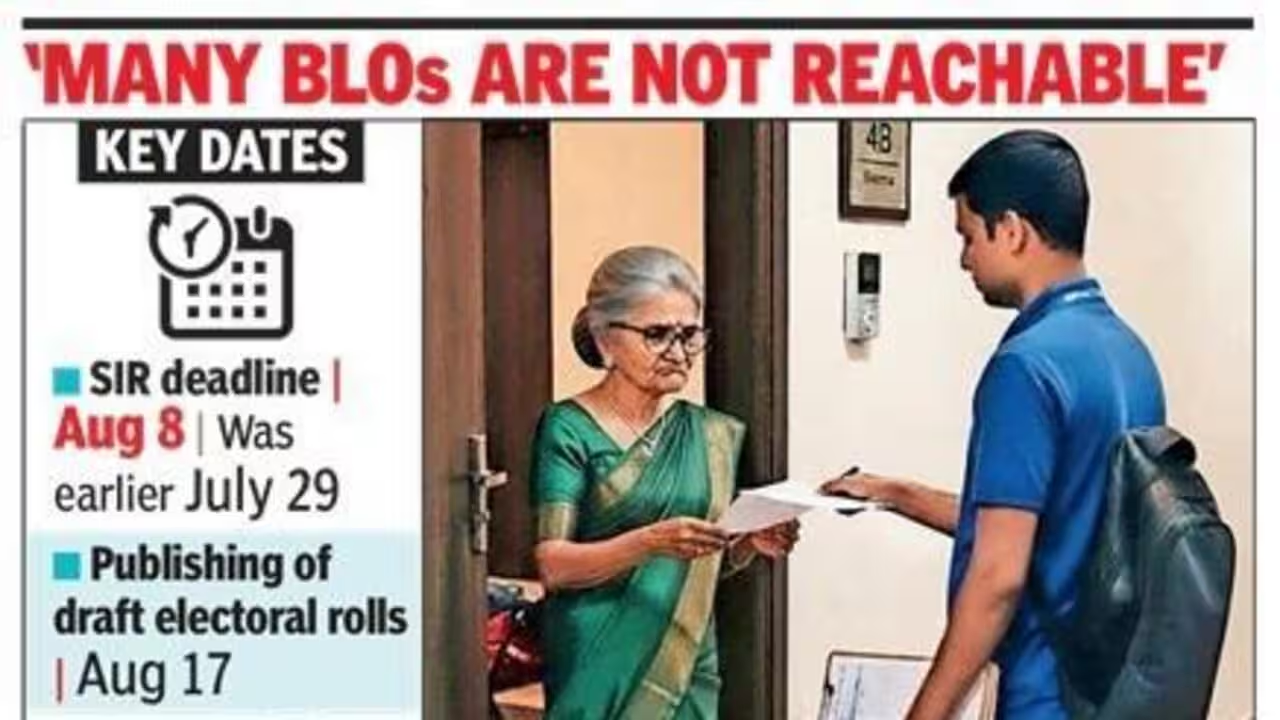
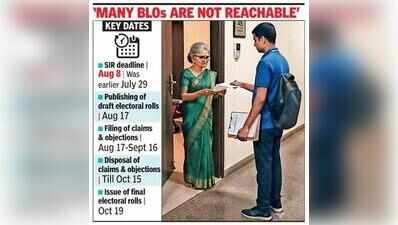
Mumbai: Mumbai’s special intensive revision (SIR) 2026 voter verification drive is producing sharply different experiences across the city as the submission deadline nears, with residents, political representatives and booth-level officers (BLOs) describing an uneven rollout that ranges from smooth doorstep verification to confusion, anxiety and repeated follow-ups.Across several neighbourhoods, residents reported that the process depends heavily on local execution. Some areas saw quick, orderly visits by officials and clear communication, while others described unclear instructions, uncertainty over acceptable documents and difficulty in contacting BLOs. Many citizens said comparatively better-off localities appeared to face fewer disruptions, while dense neighbourhoods with frequent residential movement reported heightened stress and what locals termed a growing “fear psychosis” around possible deletion from the electoral rolls due to paperwork gaps, spelling mismatches or address changes.Political representatives echoed the concern that shifting interpretations of documentation rules are adding to public anxiety. Nadeem Nusrath, vice-president of Mumbai Congress, pointed to confusion around the status of documents, saying a recent controversy over a passport not being treated as proof of citizenship has intensified fear, confusion and stress across class lines.Residents also alleged gaps in geographic coverage. In Bandra West, some said SIR verification was not being conducted at certain Slum Rehabilitation Authority project sites to which beneficiaries have been shifted, including Lalmatti, Shastri Nagar, Maharashtra Nagar and Slaughter House Compound. According to residents, BLOs cited instructions not to conduct verification at these sites for now. For families who have moved into these locations, the reported pause has created uncertainty about where verification will occur and how their records will be updated to reflect their current addresses.In the Kurla assembly constituency, residents described particular difficulties for voters whose names remain linked to older addresses after relocation. Some complained that BLOs were not answering calls or returning them even after callback requests were logged through the EC app. One voter questioned why contact numbers are shared if they remain unreachable, adding that even after visiting the election office, the guidance received was simply to keep trying because the BLO does not answer. The voter said their name was already in the electoral form (EF), yet completing the formalities still required repeated effort, calling it unnecessary inconvenience for genuine voters.Other localities reported technical and procedural hurdles in linking current electoral entries to older rolls, especially where residents have moved across wards, cities or states. At Dheeraj Upvan Society in Borivli East, a large residential complex built around 2000 with many migrants from other parts of Mumbai and outside Maharashtra, residents said the most difficult step was matching current details with the 2002 list through the app. Even so, some residents described strong participation and a willingness to comply despite the paperwork burden. One resident said the effort was creating chaos around arranging documents but argued it would improve security and help eliminate bogus voters.In Kanjurmarg, resident Tasneem B described a prolonged and shifting verification process that left her uncertain about her status. She said she was initially visited during pre-SIR mapping. When officials could not locate her parents—based in Nagpur—on the 2002 list, she downloaded the ward list and searched manually. She said her father’s name contained multiple errors, making it hard to trace, a problem she said is common on voter lists. Although she was initially told mapping was successful, she later received a message from the BLO that she had been flagged as an anomaly due to a “different parent” and was advised to present her father’s documents and her passport to resolve it. After she complied, she said the BLO again informed her that even with documentary proof, BLOs lack the authority to complete verification in such cases and that she would likely need to attend an SIR hearing after receiving a notice. She criticised the dependence on an AI-driven system that can flag anomalies without an easy correction path and said the experience felt especially harsh for voters acting in good faith. She added that the episode revived fears, based on past experiences elsewhere, that minorities may face stricter scrutiny and higher compliance burdens.BLOs, for their part, are described as being under visible pressure as volume increases. At a housing society in Mira Road, residents gathered around a BLO as people sought help identifying their booths and submitting forms. Residents recounted that the BLO appeared overworked and responded sharply to repeated questions, underscoring how crowding and last-minute demands are testing capacity on the ground.In Mira Road and other areas with sizable Muslim populations, residents and local representatives said misinformation, difficulty locating names on older SIR lists, and spelling discrepancies between documents and earlier records are complicating compliance. A long-time voter, Sani Aslam, said he had tried calling for days without response and later realised he had contacted the wrong BLO, illustrating how confusion over BLO jurisdiction can add to delays.Samajwadi Party MLA Rais Shaikh said volunteers were being deployed in Madanpura, Govandi and Bhiwandi to help residents fill forms and locate BLO information. He said many fear that spelling mismatches could lead to deletions from draft lists. Govandi resident advocate Faiyyaz Alam Shaikh described the situation in Mankhurd Shivaji Nagar assembly constituency as “alarming”, citing density, socio-economic vulnerability and many voters being given the “anomaly” status. He called office-based verification impractical and inaccessible for many genuine electors.Some residents reported smooth experiences. In Vashi’s Sector 9A, Kedarnath Rao Ghorpade said four officers from Navi Mumbai Municipal Corporation arrived prepared, conducted verification transparently and followed a structured process, although he noted that documentation was a challenge for some. In Nana Chowk, Chandana Shetye described a positive interaction, saying the BLO waited for her to return from work and accepted alternative details when she opted not to provide her Aadhaar number.


