






Poet-novelist Vikram Seth’s introduction to a new translation of his popular anthology Beastly Tales from Here and There (Penguin Books India, 1992) by Mohini Gupta opens with a memory of a stifling Delhi afternoon.
“Because it was very hot in my house one day and I could not concentrate on my work,” he writes, “I decided to write a summer story involving mangoes and a river.” That story set other creatures stirring, until all 10 of the “beastly tales” were born from fables that travel from India and China to Greece, the Ukraine, and the “Land of Gup”. The collection was an instant classic, a masterclass in mischief and rhyme that generations of Indian schoolchildren have grown up reciting by heart.

Almost two decades later, during another hot summer, Mohini Gupta, then a 15-year-old student, would be unable to get one of those beastly tales, The Frog and the Nightingale, which were part of the CBSE Class 10 English textbook. “I thought it was a perfect poem,” she says. Over the summer break after her board exams, she began to translate it into Hindi, rhyming line after line with no formal training. “I didn’t know anything about translation theory … the words just flowed,” she says.
Daldal desh mein mendhak ek,
karta rehta tarr-tarr tek.
Once upon a time a frog
Croaked away in Bingle Bog
That teenage draft would alter the course of Gupta’s life. Sent to Seth on a whim, it returned with a handwritten letter: “Dear Mohini, a wonderful sense of fun, a great imagination. Thanks, Vikram. Just a few comments, please don’t mind them.” She minded them carefully for over 20 years. Now those first lines and all the poems that followed have found a new home in a bilingual edition from Speaking Tiger Books, titled in Hindi, Idhar Udhar ke Jangli Kisse (2025).
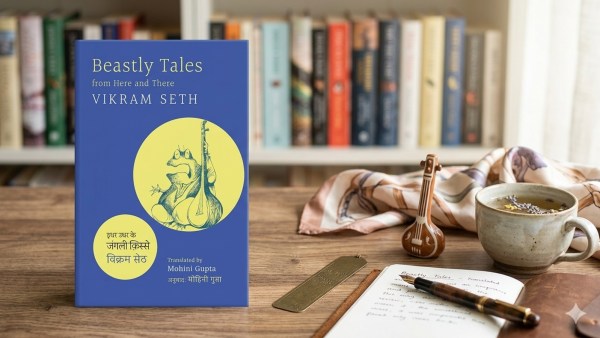 Vikram Seth’s Beastly Tales from Here and There receives a new life in this bilingual edition. (Generated using AI)
At its launch in New Delhi, Seth himself recited a few stanzas his own and those translated. “I admire the way … you have been bold enough to throw out my words but get the gist of the feeling of the thing,” he said. “A great re-creation.”
He cited the following verses as evidence:
Maare patthar, maare dande,
Eent-tamaatar saath mein ande,
Uske josh ko rok na paaye,
Mast mendak wo gaata jaaye.
The original reads as follows:
Neither stones nor prayers nor sticks,
Insults or complaints or bricks
Stilled the frog’s determination
To display his heart’s elation.
Seth was all praise for Gupta for her meticulousness. High praise indeed from Seth. “You take care not to write gaj, like an elephant,” he said, “but gaz (yard). I admire the way you have been very, very particular in all your nukhtas.”
Owl of Sandwich becomes Hazaarpur se hans huzoor
That invention is nowhere more visible than in the poem’s bird-title puns that defy straight-forward translation. Seth’s original gathers an audience of “Owl of Sandwich, Duck of Kent, / Mallard and Milady Trent, / Martin Cardinal Mephisto, / And the Coot of Monte Cristo”.
Story continues below this ad
Gupta’s first instinct was to skip the stanza. “I was an escapist,” she admitted at the launch, laughing. It was poet and translator Sampurna Chattarji, her mentor, who insisted she find a way.
The line in the Hindi reads:
Hazaarpur se hans huzoor,
mor aur morni Mirzapur,
Aligarh se Ababeel Ali,
raunak chaaron or thi phaili.
Swans from Hazaarpur, peacocks from Mirzapur, swallows from Aligarh, retain the rhythmic comedy and imagery alongside the alliteration. She transposes every cultural reference to the source language so Mozart becomes Tansen; BBC becomes the Beastly Broadcast Company. Gupta called it domesticating the verse, to which an audience member objected saying it was “localising, decolonising” rather than “taming.”
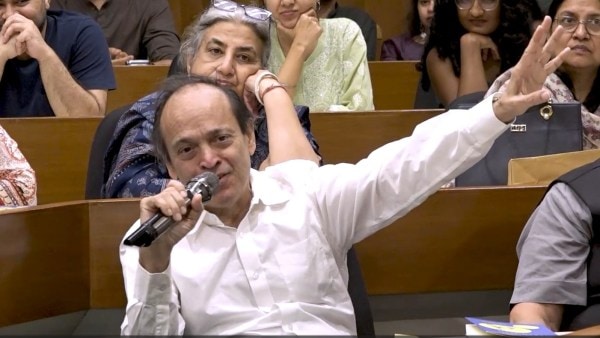 Author Vikram Seth addresses the audience during a live discussion of the bilingual edition of Beastly Tales from Here and There. (Generated using AI)
Gupta’s Hindi moves nimbly across the Hindustani register, drawing freely on Urdu and other colloquial phrasing. “I think I’m really glad that I’ve chosen this kind of a hybrid Hindi, Hindustani, which I feel comes very naturally to the tongue,” she says.
‘When one has riches, why throw it out the window’
The choice echoes Seth’s own philosophy. A multilingual translator himself, Seth dismissed linguistic purism. “I do not believe in this nonsense of dividing our language into, like, ‘Oh, this word is Arabic’,” he said. “Nonsense. You just go with what is most natural. When one has riches, why would one throw it out of the window?”
Story continues below this ad
As poet and translator Arvind Krishna Mehrotra once said, the task is “to translate the weight of a poem from one language to another”. In the hare’s telephone chatter, “Gibble gabble” becomes “gup-shup-gup-shup”; the “empty-headed vole” is a “bedimag musiya”.
The Elephant and the Tragopan, a satire of political corruption that reads as though written for this morning’s headlines, retains its bite through lines such as:
Reporter bhes ke bachre ne likhi
Bingal Jagaran mein sachai,
jiska sabko dar,
khare shabdon mein spasht kar.
The bilingual edition is a homecoming for both author and translator. Seth’s summer of mangoes and a river, and Gupta’s long-ago summer of relentless rhyming, have finally converged between the same covers. The frog’s foghorn may still blare unrivaled through the bog, but now it does so in two languages, with twice the music.
Beastly Tales from Here and There: A Bilingual Edition (Idhar Udhar ke Jangali Kisse) by Vikram Seth, translated into Hindi by Mohini Gupta, is published by Speaking Tiger Books.