



Early this year in Uttarakhand, an incident unfolded that, at first glance, appears as yet another entry in the growing catalogue of everyday communal hostility. A frail, elderly Muslim tailor, Vakil Ahmed, found himself at the mercy of a mob. The crowd’s demand was simple but telling: he must remove the word “Baba” from his shop’s signboard, for it was deemed, quite foolishly, an exclusively Hindu term. In that moment of vulnerability, an unexpected intervention occurred. A Hindu named Deepak Kumar stepped forward to defend him. When challenged by the mob to justify his interference, he replied, with striking immediacy, that his name was Mohammad Deepak.
This response, seemingly spontaneous, invites philosophical reflection of a sustained kind. What is its meaning and significance? Does it tell us something important about us Indians?
But first, a clarification and a distinction. It is now widely acknowledged that human beings do not flourish in isolation. A life of atomised existence, stripped of meaningful social bonds, is inimical even to individual well-being. I wish to extend this idea to propose that a high quality of relations across religious difference is not a peripheral concern but constitutive of social flourishing, for a collective ethic. The ability to live well with religious plurality is not simply a matter of managing conflict; it is intrinsic to the good life of a society. Call this deep interreligious sociability.
This notion must be distinguished from what may be termed a shallow form of sociability, familiar from the liberal constitutional discourse that asks of citizens that they respect one another’s rights, refrain from interference, and coexist peacefully within a shared legal framework. Such an arrangement is necessary. Yet it leaves largely untouched the deeper textures of cultural and religious life.
Deep sociability, by contrast, is more demanding. It presupposes that the boundaries between religious communities are not rigidly sealed but historically porous. It involves forms of life that recognise that individuals are shaped, in part, by traditions other than their own. This is not a call for homogenisation or syncretic fusion in which differences dissolve. On the contrary, it is a call for a reality in which difference persists but is experienced as enabling rather than threatening. One’s identity is not diminished by engagement with the other; it is, in significant ways, constituted and enhanced by it.
Back to Deepak Kumar’s courageous intervention that in my reckoning admits itself to at least four interpretations. The first is humanitarian: he acted on the belief that our shared humanity precedes and outweighs our religious affiliations. The second is civic: he upheld the constitutional ethos of equality and fraternity, placing his identity as a citizen above narrower markers. Both readings are normatively compelling. Yet they leave the domain of religious life untouched. They do not illuminate how religious plurality may be internal to one’s ethical self-understanding.
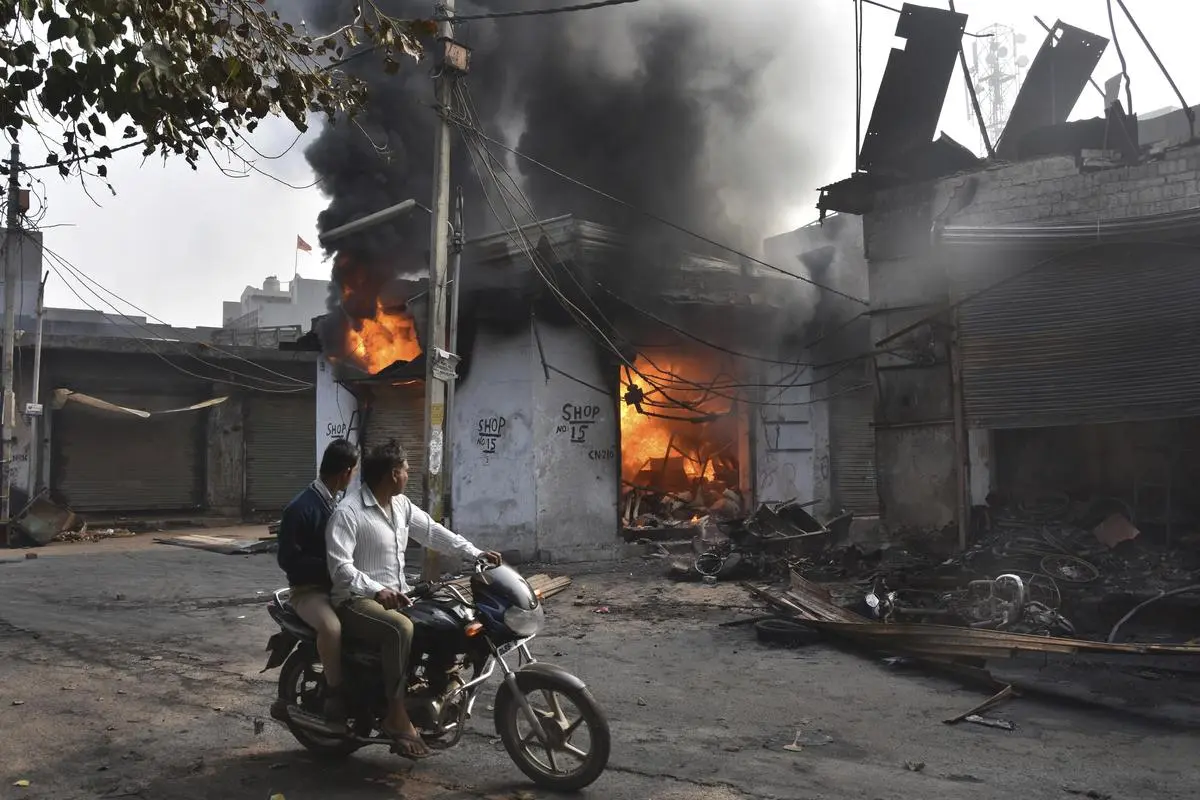
Two men drive past a shop that was set on fire by mobs during the protests against the Citizenship Amendment Act, in New Delhi on February 26, 2020.
| Photo Credit:
Dinesh Joshi/AP
A third interpretation brings us closer to that terrain. It suggests that Deepak recognised, however inarticulately, that religious life is not lived in isolation. To be a good Hindu, it is not enough to be good among other Hindus. What matters is to be a good Hindu among people of other faiths. Likewise, for Muslims, Sikhs, and Christians. Embedded in this interpretation is a demanding and beautiful idea: that living well with those of other religions is not incidental to one’s religious life but intrinsic to it.
Yet, none of these interpretations help us understand why he chose to call himself Mohammad Deepak. This necessitates a fourth interpretation. By spontaneously adopting this hybrid name, he unsettled the widely held presumption that religious identity must be singular, bounded, and exclusive. His response implicitly rejected the demand that one must belong wholly and only to a single tradition. Instead, it affirmed the possibility of multiple, overlapping allegiances. It suggested that identity need not be fixed or static but may be layered, dynamic, and internally plural.
A civilisational inheritance of interreligiosity
Such a conception is not an invention of the present moment. It draws upon a long, although increasingly obscured, civilisational inheritance that has existed across regions and communities in which participation in multiple religious traditions was neither self-conscious nor anomalous. Among the Meos of Mewat, as Shail Mayaram’s work shows, names such as Ram Mohammed or Krishna Khan were once unremarkable. Religious texts such as the Quran, the Mahabharata, and the Ramayan or festivals such as Eid, Holi, and Diwali were not guarded as exclusive but interreligious possessions. These were not instances of confusion or dilution but expressions of a different understanding of being religious.
The resources for such an understanding can be traced, in part, to strands within Hindu thought itself. Philosophical and devotional traditions developed ways of negotiating plurality without insisting on exclusivity. One could be devoted to multiple deities, merge two gods into one—as Vishnu and Siva are combined in the figure of Harihar—or conceive of distinct gods as manifestations of a deeper unity. The Bhakti and Sufi traditions articulated, with admirable clarity, the idea that the divine transcends all attempts at exclusive ownership. In the poetry of Kabir or in the teachings of Guru Nanak and Raidas and Dadu, Ram and Allah are different names but refer to a reality that cannot be confined within the boundaries of any single community.
The groundwork for this sensibility is found in the political imagination of Ashoka. His inscriptions did not merely counsel tolerance in the modern sense of non-interference, or of refraining from denigrating the other; they urged pasandas (religio-philosophical communities) to actively engage with one another, emphasising the personal importance of becoming a Bahushruta: one who listens to many and learns from all. Centuries later, Akbar imagined sulh-i-kul (universal peace) in seeking to institutionalise a form of coexistence grounded in mutual recognition rather than the supremacy of one religion.
In the 20th century, Gandhi gave this inheritance a distinctive ethical and personal form. His insistence that Ishwar and Allah were names for the same divine reality was not a metaphysical claim alone; it was a moral intervention in a time of acute communal tension. Jawaharlal Nehru, though more circumspect about religion, nonetheless recognised that India’s composite culture—formed through centuries of interaction, borrowing, and coexistence—was a vital resource. He understood that communal violence threatened not only immediate human lives but also the deeper reservoir of shared meanings.
It must be clear now what the name Mohammad Deepak signifies. It is not an eccentric improvisation, nor merely a rhetorical device deployed in a moment of crisis. It is a faint but discernible echo of a longer, virtually forgotten tradition in which identities are not confined to mutually exclusive categories. It points to a mode of being in which plurality is internalised rather than merely accommodated.
To acknowledge this is not to deny the realities of conflict, exclusion, and violence that have also marked India’s history. Nor is it to indulge in nostalgia. The point, rather, is to recognise the presence of background cultural conditions, a collective memory that made deep interreligious sociability possible, intelligible, and liveable. These conditions may have been significantly eroded by modern forms of political mobilisation that privilege sharp boundaries and exclusive belonging. Yet, if these possibilities of deep sociability are to be recovered, legal protections and constitutional norms, though essential, will not suffice. What is required is the revitalisation and foregrounding of a cultural ethos in which active engagement across difference is valued, cultivated, and sustained. Only within such an ethos can a name like Mohammad Deepak cease to be an anomaly and instead be recognised as part of a shared inheritance.
Rajeev Bhargava, a political theorist, is honorary professor at CSDS, Delhi, and director of the centre’s Parekh Institute of Indian Thought.