

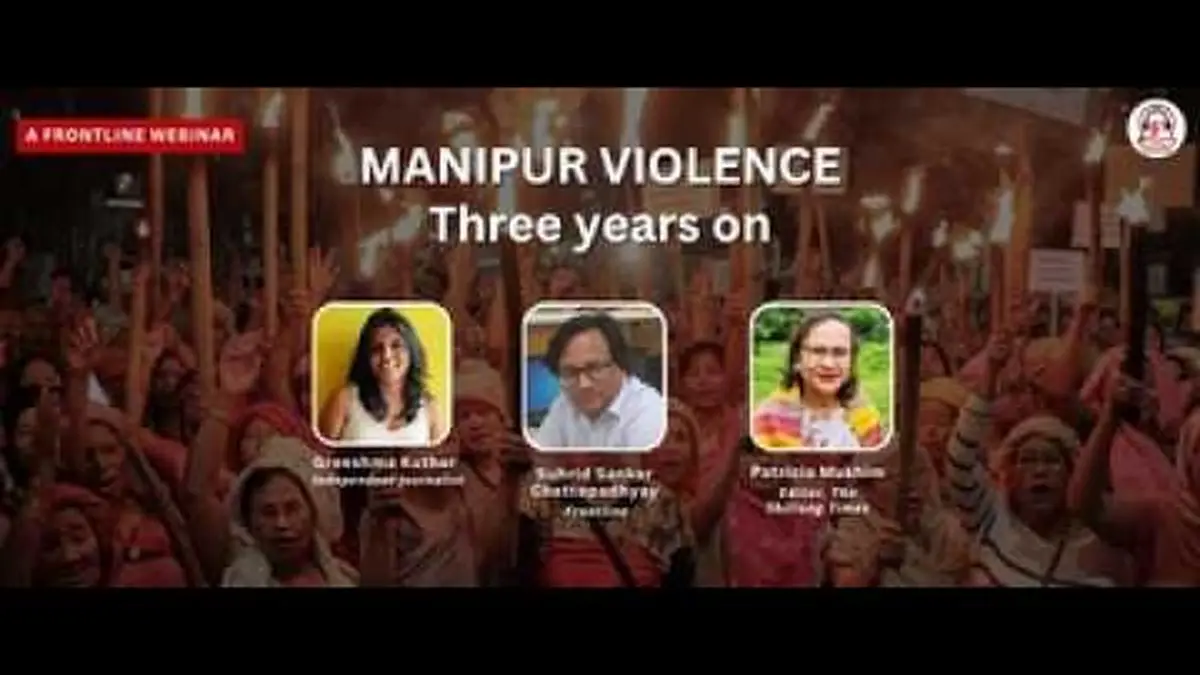
The killing of two children in a bomb blast on April 7, 2026, marks a grim moment in the third year of ongoing violence in Manipur. Since May 3, 2023, clashes between the Meitei and Kuki-Zo communities have resulted in hundreds of deaths and the displacement of tens of thousands. Three years into the conflict, attention has changed from when the violence might end to what it will take to bring it under control, and what role the state is playing in that effort.
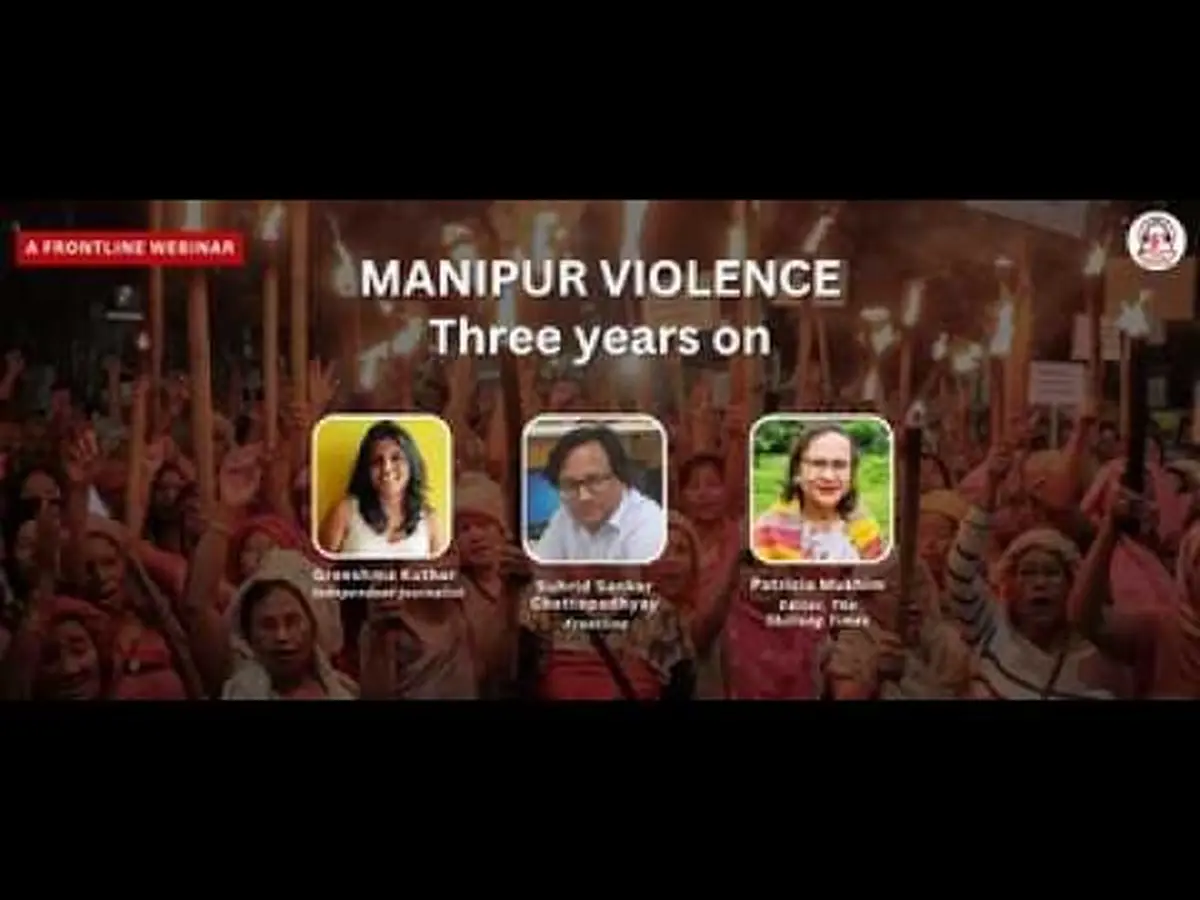
In the latest edition of the webinar, Frontline’s Suhrid Sankar Chattopadhyay discusses the latest developments with Patricia Mukhim, Editor of The Shillong Times and Greeshma Kuthar, independent journalist. The conversation looks into the current situation on the ground and the possible pathways toward restoring peace.
Edited excerpts:
Suhrid Sankar Chattopadhyay: Greeshma, tell us what’s happening right now in Manipur.
Greeshma Kuthar: When 2026 started, it seemed like things would settle a little. The BJP ended President’s Rule and brought in a new Chief Minister, Yumnam Khemchandsingh. People were a little hopeful—from all sides—because the BJP was also strategic in forming the government: They had Nemcha Kipgen, a Kuki-Zo, as Deputy Chief Minister, and Losi Dikho, a Naga Minister too. It seemed like it was their way of pausing the conflict. In 2023, there was violence almost every day; in 2024, spurts every other month. Some people thought that anxiety would ease with the new Chief Minister.
But then April happened. There was an explosion, two kids died, people in protest tried to storm the Central Forces camps, and three more people were shot. After that, there have been protests in the valley; in the hills, people have been showing their resentment, feeling that the most vulnerable, the displaced, are not being cared for. The government keeps telling displaced people to move out of camps, as if giving Rs. 80 per person per day is enough for them to rent houses elsewhere and fend for themselves. But a person displaced from their home is in a new environment, a new town, a new district, where everyone looks at everyone else as an outsider. The government talks about normalcy returning because there’s traffic, markets are open, highways are open. That’s not normalcy, especially when an entire community like the Kukis cannot go to the capital of their own state.
Patricia Mukhim: The problem in Manipur is very difficult to dissect. It’s deeply ethnic, political, and territorial—and there is a geopolitical dimension that nobody wants to address. It’s the elephant in the room. There’s also enormous psychological hurt from three years of camp life. A child born in a relief camp is now two-and-a-half, three years old, asking, ‘When do we go back home?’ When we visited Kangpokpi close to Christmas, children in the camps were asking their parents, ‘When will we have Christmas at home?’
And then think about the people who worked at Manipur University, at RIMS [Regional Institute of Medical Sciences] Imphal, at every government establishment—they are not able to go back. The Central government has essentially kept its distance, believing that empowering State politicians will produce results. The new Chief Minister, the Kuki Deputy Chief Minister—they thought this arrangement would resolve things. But the Deputy Chief Minister hasn’t been able to convince her own people to take the right steps forward. And the right steps themselves are unclear.
What you have now is all the armed outfits operating freely: the Kuki groups that have signed treaties with the Central government but are all up in arms; the Meitei outfits—Meitei Leepun and Arambai Tenggol—roaming with arms; the Naga insurgent outfits, also in talks with Delhi but holding arms and creating terror. Peace-building has not even started. Peace-building can only start if you bring the warring parties together—but every day there are not just physical attacks but verbal attacks. There is deep distrust. And all of this is affecting real families. I was thinking of going back and doing a study of a single family’s life in a relief camp, from morning to night. Do the people of this country really understand what is happening there?
The violence is rooted in inequities. One-tenth of the land is inhabited by 90 per cent of the population; 90 per cent of the land is inhabited by one-tenth. And there’s the question of religion — why should there be such disparity in land distribution because one section are Hindus and therefore no longer considered Scheduled Tribes? Are we going to interrogate that, or just keep talking about normalcy returning? There is no normalcy in Manipur today. Think of Kukis in Churachandpur who need medical treatment outside the State—a nine-hour journey through difficult terrain just to catch a flight from Aizawl. I wish the powers that be would think like humans.
And then there’s the geopolitical situation—those six Ukrainians and one American arrested for bringing in drones, the spillover from Myanmar. Can we really call this a purely internal ethnic conflict?
Suhrid Sankar Chattopadhyay: Has the nature of this violence changed since 2023? Are women and children being targeted more? Are we seeing a convergence of conflicts further complicating things?
Patricia Mukhim: The Nagas were onlookers for a long time, but they’ve now realised they feel trapped between the Meiteis and the Kukis and have started asserting themselves. Assertion, in our region, means you turn violent and draw attention to yourself—that’s how this conflict has always worked.
The instability in Myanmar is a reason for great concern. As long as Myanmar is unstable, there will be refugee flows into Manipur, and those coming across are mostly armed groups. What is the Home Ministry actually doing to restrict those movements? We had the Free Movement Regime—on one hand, the tribes don’t want the border fenced because there are ethnic relations on both sides. But how do you have open borders while preventing illegal immigration from a war zone? These are decisions the central government must take, not Manipur alone.
As for children being targeted, I don’t think those who threw the bomb were that accurate. They targeted a home, and it so happened that two children died.
Greeshma Kuthar: Whether women and children are being targeted—this is factual. In every conflict, they are the most affected, and not just as direct targets of violence. Manipur’s leadership is almost entirely male. Society is deeply patriarchal. Women leaders have told me they are barely allowed to participate in decision-making, even for the welfare of their own communities. The burden of conflict—emotional, financial—falls disproportionately on women, on both sides, in the hills and the valley alike. There’s this whole emphasis on protecting the community, which becomes a hate-driven nationalism that doesn’t centre on what people are actually feeling, what the burden on women has actually multiplied to.
In 2023, tribal Kuki-Zo women were targeted with sexual violence right in the beginning. After that, women and children became targets the way everyone did—because violence continued. In Jiribam, six Meitei people, including women and children, were caught by insurgent groups while an entire village was fleeing, and all six died. The two children in Bishnupur died because people felt emboldened to keep doing this.
What nobody is talking about is how all of this affects all children in Manipur. A professional I spoke to recently said everyone in Manipur has PTSD [Post-traumatic stress disorder] right now. For children, we’ll only understand the true impact 10 or 15 years from now—they are consuming images of violence, consuming the language of hatred from every leader they see. If children were really the priority, this situation wouldn’t be continuing. It clearly isn’t the priority of either the State or the Central government. What I see is that the 2027 elections are coming, and the whole calculation is about retaining power. And power in Manipur is profitable—the border is highly monetised. Timber entering from Myanmar, drugs, contraband of every kind—everyone gains from this business. Keeping the conflict ticking in the background while this trade continues, without thinking about the majority of Manipur that is suffering, that is what is happening.
Also Read | Two young people. Two camps. One dividing line. A story of conflict in Manipur
Suhrid Sankar Chattopadhyay: You mentioned the weariness of people in the camps. And yet there is still so much hatred. After three years, when you’re there, do you see a genuine desire for this to end?
Patricia Mukhim: There are two things happening simultaneously. Of course women want to go back—to their work, to their freedom of movement—but it’s the men who decide how far this goes. And then there is the proliferation of firearms. You cannot imagine how many are coming across the border, apart from drugs. Everyone across all ethnicities is benefiting from the drug trade—let’s not be naive and think it’s only the Kukis.
When I spoke to young men guarding the borders, some in high school, some in college, and asked, ‘Don’t you want to be in school?’— they said, ‘Yes, but we have to guard our borders, otherwise the enemy will come.’ When you are looking at people you’ve lived with for hundreds of years as the enemy, how do you end this conflict? We don’t even seem to have human rights groups coming in to try to build rapprochement. Unless the warring parties talk to each other, there cannot be any resolution. A resolution imposed by the State will not last.
And who is going to bring the long-term solution? Politicians never take long-term decisions. All their decisions are aimed at short-term gains, at getting votes. So who will actually legislate for equitable land distribution?
Riot victims from among the Meiteis at a relief camp in Imphal town on May 18, 2023. Three years after violence began in Manipur, thousands remain displaced in relief camps, with access to housing, healthcare, and education still severely disrupted.
| Photo Credit:
THE HINDU
Suhrid Sankar Chattopadhyay: [Audience question from Sungo Chetia Walling] Can we discuss women’s lived realities in relief camps—lack of privacy, surveillance, trauma, and fear rooted in historical military abuse?
Greeshma Kuthar: In the hills, camps tend to be within communities—Thadous in Thadou areas, Vaipheis in Vaiphei areas, and so on, often in church halls or community halls. In the valley, it’s more spread out, but by now, half these camps have been shut down. The government has been telling people to go back to villages—but only people whose villages fall within their community’s district border have been able to. Nobody has crossed to the other side. Large numbers of people, like the Vaipheis—50 per cent of that tribe is completely displaced, and most Vaiphei villages are close to Meitei villages—cannot go back at all.
As for women’s realities, there is no privacy. Young women who started menstruating in camps have had zero space to navigate that. Some camps don’t have functional toilets—people have to defecate in the open. No clean drinking water, poor sanitation. In the valley, these conditions are somewhat worse; in the hills, there’s marginally more space, but that means greater distance from the nearest town. In Saikul of Kangpokpi district, many pregnant women did not travel for an ultrasound because they couldn’t afford the three-to-four-hour journey out. Women have died in childbirth because that sub-district had no blood bank, no adequate facilities. These are documented cases.
The other reality is that many displaced people—maybe 10 per cent—have managed to leave Manipur entirely to find work, sending money back so their families can pay Rs. 10,000 rent and get out of the camps. They’re living hand to mouth, too. Those still in camps after three years are, without exception, working-class people—daily wage workers, low-to-middle income at best. And children: How can a child study when more than a hundred people are living in one hall? I have interviewed children in my podcast who have passed entrance exams from inside those camps, which only tells you how extraordinary they are, not that conditions are acceptable.
Suhrid Sankar Chattopadhyay: Chief Minister [Yumnam Khemchand] Singh has been assuring people they can go back, and yet they would rather live in these conditions than return. Is there any real political will to end this?
Patricia Mukhim: To his credit, he’s made some overtures. He traveled to Senapati via Kangpokpi, and he has refrained from being as provocative as Biren Singh, who had no empathy for anyone outside his own community. But what is needed right now is not political speeches or performative stances—what is needed is real, solid empathy.
And I have to say: there is now compassion fatigue. When I last visited, people from South India had come with rice and relief materials, but the people there were desperately longing for meat. Their diet has entirely changed, and I’m certain there is serious malnutrition and undernutrition that nobody is studying. In Kangpokpi there is only one mission hospital. Thankfully, some doctors and nurses who had fled from RIMS came back to the hills, but that is nowhere near enough. And how many maternal and infant mortalities have there been in three years? Nobody is recording this. If we don’t, it will be lost to history, and we will go on repeating these conflicts.
I also can’t call this a post-conflict period because the conflict is ongoing. The Meira Paibis are active in the valley, and sometimes I wonder whether their activism is taking into account every suffering soul or only one ethnic community. Then there are the prefabricated homes the Central government funded—about 900 crores’ worth. Some have apparently been built in Imphal Valley, but I’m not sure people have moved in. And what about homes burned in the valley? Some losses can never be compensated. We can talk about them, but they will remain unresolved until the next conflict.
Suhrid Sankar Chattopadhyay: [Audience question from Suhas Kolekar] What about access to public healthcare—antenatal visits, vaccination for children, emergency services?
Greeshma Kuthar: In the initial months of the conflict, vehicles carrying vaccines into the hill districts were burned. But through very difficult means, people ensured vaccination continued, to about seventy to 80 per cent in the valley, less so in the hills. In districts like Tengnoupal, there were shortages of syringes and basic equipment. Healthcare workers went against all odds to keep vaccination going. But I have also documented cases where a newborn who couldn’t be vaccinated in the first six months died of something as simple as measles or diarrhea—diseases that should not be killing children in India.
The number of people who died because they couldn’t access healthcare is equal to the number killed directly in the violence. One medical researcher I interviewed last year said that the number can only grow as months pass. People chose not to travel and died instead because they couldn’t afford a 12-to-15-hour journey out of the state from remote hill districts. That responsibility falls on the government.
In the second year, the concessions that allowed displaced people to access healthcare for free disappeared. Now, people who have no home and no livelihood are being asked to pay for scans and services they cannot afford, so they simply don’t go. Some healthcare workers are still trying, but access is nowhere near what it was before 2023.
Protestors take part in a Meira (torch) rally at Koirengei, organised under the aegis of Coordinating Committee on Manipur Integrity (COCOMI), demanding justice regarding the Tronglaobi killing incident, in Imphal East. Women and children remain among the worst affected, with documented cases of disrupted vaccination, long-distance travel for medical care, and loss of livelihoods since 2023.
| Photo Credit:
ANI
Suhrid Sankar Chattopadhyay: Land has been Central to every conflict in Manipur—Kuki-Naga in the ‘90s, Kuki-Paite in ‘97-‘98, and now 2023. How do we address this obsession with land and territory?
Patricia Mukhim: For us tribes, land is identity, and you are always trying to protect that identity. I’d also say that the Kuki chieftainship system—where a chief is entitled to create new villages—is a little problematic in the present day and age. How many villages do you keep creating? Where do you find the space? And if people are going to be there, you need hospitals, schools, roads.
We also need to interrogate history: every community—Nagas, Meiteis, Kukis—has its own narrative, each asserting they are more indigenous than the next, that the other came later. In the middle of all these conflicting claims and counterclaims, you miss out on the fact that this is a new India that requires education and a technologically driven economy. If we keep having conflicts over land and territory, when are we going to actually improve our lives? And I don’t know if anyone is even amenable to any proposition to resolve this land crisis, because everyone feels someone is encroaching on their territory, and the other side feels the same.
Also Read | Manipur’s abandoned
Suhrid Sankar Chattopadhyay: Arambai Tenggol was officially disbanded in February. Have they really been disbanded, or are they still active?
Greeshma Kuthar: Officials have told me they’ve been told to disband. But that’s not the truth as I’ve seen it on the ground. The dominant voice you hear from the valley is still the Arambai Tenggol voice, or voices of those who speak its narrative—territorial integrity, ‘we will not talk to Kukis because they want to break Manipur apart,’ and so on. The Arambai Tenggol is only a vehicle—it was, it is, and it will probably remain a vehicle of former Chief Minister Biren Singh and others in the valley to create fearmongering, to scapegoat, to build narratives so that ‘we are the victims’ and ‘I have to be in charge.’ Nothing more than that.
They have used this conflict to build their numbers and stay relevant. At a rally I attended, a child was holding a flag and a placard, wearing an Arambai Tenggol t-shirt—that is what they represent now. But the flip side is that there are many voices in Imphal, many women’s organisations, that speak the language of reconciliation—like the group ETA NorthWast—but their voices are never heard. People are scared to speak against Arambai Tenggol because they remain powerful. The change is only cosmetic: before, they would hold a gun on a livestream. Now there’s no gun. That’s the only difference. The provocative, hate-filled language is the same.
Suhrid Sankar Chattopadhyay: Is there any actual political will to end this? Biren Singh should have stepped down long before he did. The Prime Minister didn’t visit until September 2025, and even then addressed separate rallies.
Patricia Mukhim: The BJP government and the Prime Minister are very good at performing. His appearance in Manipur after two years was to show ‘I’ve come to listen’—but he didn’t really listen. People know when you’ve come with a genuine heart to resolve a crisis.
The SoO groups from among the Kukis are talking to the Home Ministry in Delhi, but whether they carry the actual voice of their people is unclear—there have been very few community consultations. Have they conceded their demand for Union Territory status? We don’t know. Do they now want Sixth Schedule status instead? We’re not sure. These basic questions have somehow been forgotten. And who is telling the Kuki-Zo story? All the newspapers are valley-based. The few people podcasting from the hills have limited reach. Even when the conflict started, most journalists who went were based in the valley because going to the hills was difficult. I don’t see this conflict ending anytime soon.
Suhrid Sankar Chattopadhyay: Thank you, Patricia and Greeshma.
This transcript has been edited for length and clarity.