











Manorama Industries makes a type of fat most consumers have never heard of, for products almost everyone consumes.
Its core product, Cocoa Butter Equivalent (CBE), is a vegetable fat that closely mimics cocoa butter and can replace up to 5% of it in chocolate, subject to regulatory limits. The company processes sal seeds sourced from tribal communities in Chhattisgarh and Odisha, alongside shea nuts from West Africa and mango kernels, at its integrated facility in Birkoni, Chhattisgarh.
Its customer list is unusually strong. On the food side: Mondelez, Ferrero, Mars, Hershey, Nestlé, and Barry Callebaut. On the cosmetics side: L’Oréal, The Body Shop, and Lush.
For most of its listed history, Manorama looked like a niche business with average numbers. Then the operating profile changed dramatically.
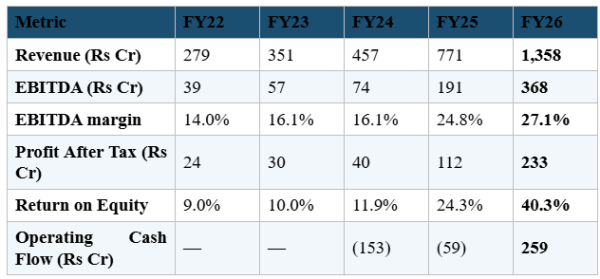
Between FY23 and FY26, revenue grew at 57% CAGR, EBITDA margin expanded from 16% to 27%, and Return on Equity (ROE) increased from 12% to 40%.
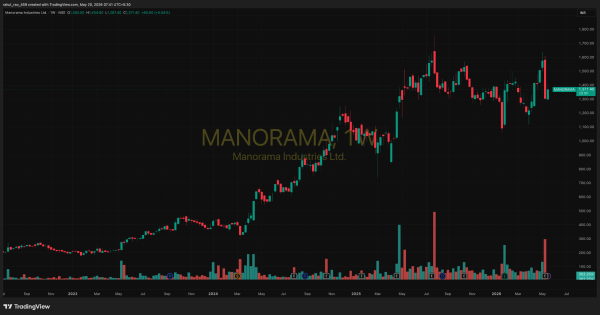
The stock followed. Since March 2024, it has rerated from around Rs 400 to roughly Rs 1,350 per share.
 Source: http://www.tradingview.com
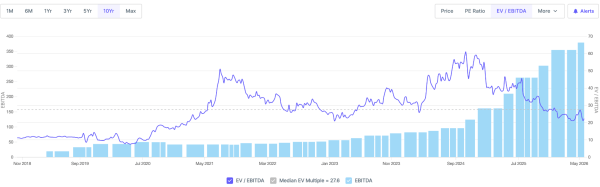
At ~35x trailing earnings and ~11.5x book value, the market is no longer pricing in potential. It is pricing in sustained execution.
Story continues below this ad
So the real question is not whether Manorama has had a strong run. It is whether the next two to three years can justify the valuation already embedded in the stock.
That depends on four variables:
- Can the 27% EBITDA margin hold?
- When does new capacity come online, and how much does it add?
- Can per-tonne pricing sustain?
- Does cash conversion, negative for two years before snapping positive in FY26, hold?
The Numbers
 Source: Q4 FY26 Investor Presentation (5-yr financials); FY25 Annual Report Standalone Cash Flow Statement
The income statement tells a compelling compounding story. Until FY26, the cash flow statement told a much messier story. Here’s what matters most:
Can the 27% EBITDA margin sustain?
The jump from 16% to 27% EBITDA margin over two years came from three drivers.
Story continues below this ad
1) Product mix
Two years ago, CBE contributed only ~10% of revenue. Today, it contributes ~30%. Along with stearin and other value-added derivatives, higher-margin products now make up 70-75% of sales. Management’s target is 90-95%.
2) Capacity utilisation
In July 2024, Manorama commissioned a new 25,000 MTPA solvent fractionation plant, taking total fractionation capacity from 15,000 to 40,000 MTPA. By FY26-end, that plant ran at roughly 85%. Fixed costs got absorbed over a much larger volume base.
3) Pricing power
Manorama operates on a cost-plus model. CBE typically sells at $5,000-6,000 per metric tonne under long-term customer contracts. What stands out is that pricing remained relatively stable even during the 2024 cocoa shortage, when cocoa butter prices briefly spiked to $25,000-30,000 per tonne. Prices also held during the subsequent correction. That suggests Manorama’s products are not treated as commodity substitutes. They are application-specific formulations developed and qualified over the years with customers.
So is 27% the new normal or a peak? Management’s guidance shifted from “25-27% sustainable” early in FY26 to “no downward pressure from current levels” by Q4. Gross margin landed at 45.3% in FY26 versus 48.4% in FY25, so a small step-back is possible.
Story continues below this ad
Put another way, the possibility of margin expansion from current levels is remote.
When does the new capacity come online?
 Source: Q4 FY26 Investor Presentation Slide 27; Q3 FY26 Earnings Call (75,000 MTPA structure)
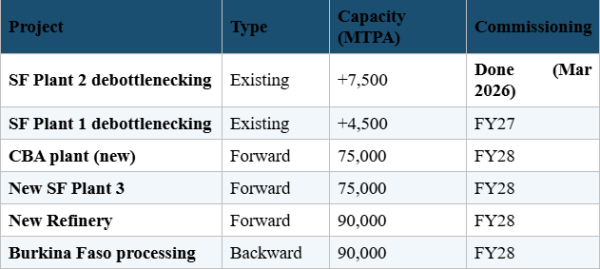
The roadmap has a structure.
Growth in FY27 comes primarily from debottlenecking. Capacity rises 30% (from 40,000 to 52,000 MTPA), while management is targeting 85-90% utilisation plus 5–10% price realisation. That maps to 30-35% revenue growth in FY27.
Two 75,000 MTPA forward integration plants, a 90,000 MTPA refinery, and the Burkina Faso facility are all expected to commission around that period.
Story continues below this ad
Management has guided for 6x asset turnover on the capex, implying roughly Rs 2,800 crore of incremental revenue at full utilisation. Of the Rs 460 crore committed, Rs 52 crore has been spent through Q4 FY26. Land for the Indian plant has been acquired, and Burkina Faso has signed a Memorandum of Understanding, but none of the new facilities are operational yet.
Even if commissioning occurs on schedule in late FY28, meaningful financial contribution likely shifts into FY29.
Can pricing per tonne hold?
This may be the most underappreciated part of the story. Manorama does not compete on price. It competes on irreplaceability.
Once a chocolate manufacturer qualifies a CBE formulation, switching suppliers becomes costly and time-consuming. Trials and process validation can take years. That creates unusually sticky customer relationships.
Story continues below this ad
The pricing data confirms it. CBE contracts sit in a $5,000-6,000 per metric tonne range, and Manorama held this range through both the cocoa spike and the subsequent correction.
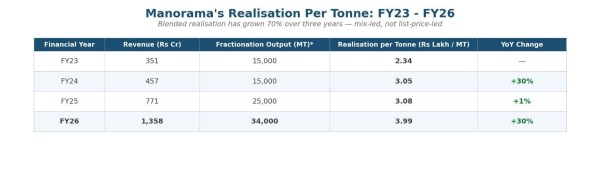
Realisation per tonne (FY23-26)
 Source: FY25 Annual Report Standalone Cash Flow Statement. Q4 FY26 Investor Presentation
The room to expand realisation per ton comes from the mix, not the list price. As CBE rises from 30% toward 40%+ of revenue, and as new application-specific products (filling fats, bakery shortenings, ice cream coatings, the CBA segment from FY28) gain share, blended realisation should rise.
Management confirmed on the Q3 FY26 call that the EBITDA margin has stayed stable through the cocoa price cycle, but declined to share per-tonne numbers because of varying raw-material yields and parities.
Another risk is competitive intensity. Global ingredient companies such as AAK, Bunge Loders Croklaan, Cargill, and Fuji Oil are expanding in specialty fats. Manorama’s defence appears to rest on three advantages:
Story continues below this ad
- A deeply entrenched tribal procurement network
- DSIR-certified R&D centre
- A multi-year approval cycle that locks customers in
The moat looks intact for now.
Why was cash conversion weak?
This is where the story becomes less straightforward.
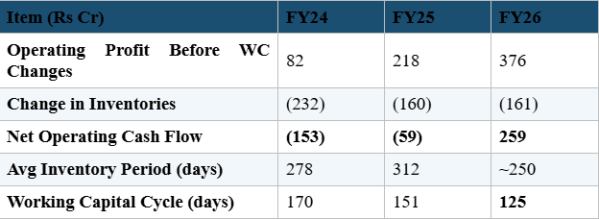
In FY24, PAT was Rs 53 crore, and operating cash flow was negative Rs 153 crore. In FY25, PAT rose to Rs 148 crore, but operating cash flow was still negative at Rs 59 crore.
In FY26, operating cash flow turned positive at Rs 259 crore.
What changed? The answer is inventory.
Cash flow movement (FY24-26)
Story continues below this ad
 Source: FY25 Annual Report Standalone Cash Flow Statement. Q4 FY26 Investor Presentation
The business has inherently seasonal procurement cycles:
Sal seeds: May-June
Mango kernels: May-July
Shea nuts: August-December
Raw materials are procured in concentrated windows, while sales occur year-round.
When Manorama expanded fractionation capacity from 15,000 to 40,000 MTPA in mid-2024, inventory requirements increased almost overnight. FY24 and FY25 effectively became inventory build years ahead of utilisation ramp-up.
By FY26, revenue doubled while inventory growth slowed materially, from Rs 549 crore to Rs 710 crore. The working capital cycle improved from 151 days to 125 days, operating cash flow turned positive, and net debt-to-equity fell from 0.83 to 0.38.
Will lower working capital sustain?
The Burkina Faso facility could improve the cash cycle further. Importing processed butter instead of raw seeds reduces transit time, lowers freight costs, and improves yields. Management has guided for working capital days to eventually fall toward 90-100 days post-commissioning.
But another inventory build cycle may be unavoidable.
Just as FY24-25 saw negative cash flow ahead of the previous expansion, FY27 and early FY28 could see working capital absorb cash before the new facilities begin contributing meaningfully.
And finally, the Qualified Institutional Placement (QIP). In March 2026, the board approved an enabling resolution for a potential Rs 500 crore QIP. Management continues to state that capex is currently funded through internal accruals, but if working capital expands faster than expected, external capital could become necessary.
Valuation
At Rs 1,350 per share and roughly Rs 8,000 crore market capitalisation, Manorama trades at 35 times trailing earnings on FY26 EPS of Rs 39, and roughly 11.5x book value.
 Source: http://www.screener.in
There is no direct listed Indian peer. Global specialty fat players are either unlisted or embedded within larger conglomerates.
The closest anchor is the specialty FMCG ingredients basket at 40-60x earnings for high-ROE businesses.
The forward valuation is where the debate becomes interesting. If FY27 delivers the guided 30-35% revenue growth at 26-27% EBITDA margin, FY27 EPS could land around Rs 51-54, putting the stock at 25-26x FY27 earnings. For FY28, with the new capex commissioning on time, revenue could touch Rs 2,200-2,400 crore, putting forward EPS near Rs 70 and the multiple closer to 19x.
That math works if four things hold.
- Margins stay above 25%
- New capacity commissions on schedule
- Pricing per tonne holds with mix-led gains
- Cash conversion stays positive through the next pre-build cycle
If anything slips, the stock looks fully priced. If all four hold, the valuation may still be reasonable for a business capable of compounding revenue above 30% while sustaining 40% ROE.
The next 12-18 months, with FY27 debottlenecking playing out and capex moving to commissioning, will likely determine which way it goes.
Note: We have relied on data from http://www.Screener.in and http://www.tijorifinance.com throughout this article. Only in cases where the data was not available, have we used an alternate, but widely used and accepted source of information.
Rahul Rao has helped conduct financial literacy programmes for over 1,50,000 investors. He also worked at an AIF, focusing on small and mid-cap opportunities.
Disclosure: The writer or his dependents do not hold shares in the securities/stocks/bonds discussed in the article.
The website managers, its employee(s), and contributors/writers/authors of articles have or may have an outstanding buy or sell position or holding in the securities, options on securities or other related investments of issuers and/or companies discussed therein. The content of the articles and the interpretation of data are solely the personal views of the contributors/writers/authors. Investors must make their own investment decisions based on their specific objectives, resources and only after consulting such independent advisors as may be necessary.


