



Last Updated:
Holding power, while meeting the massive expectations attached to Vijay’s political image, could prove far tougher




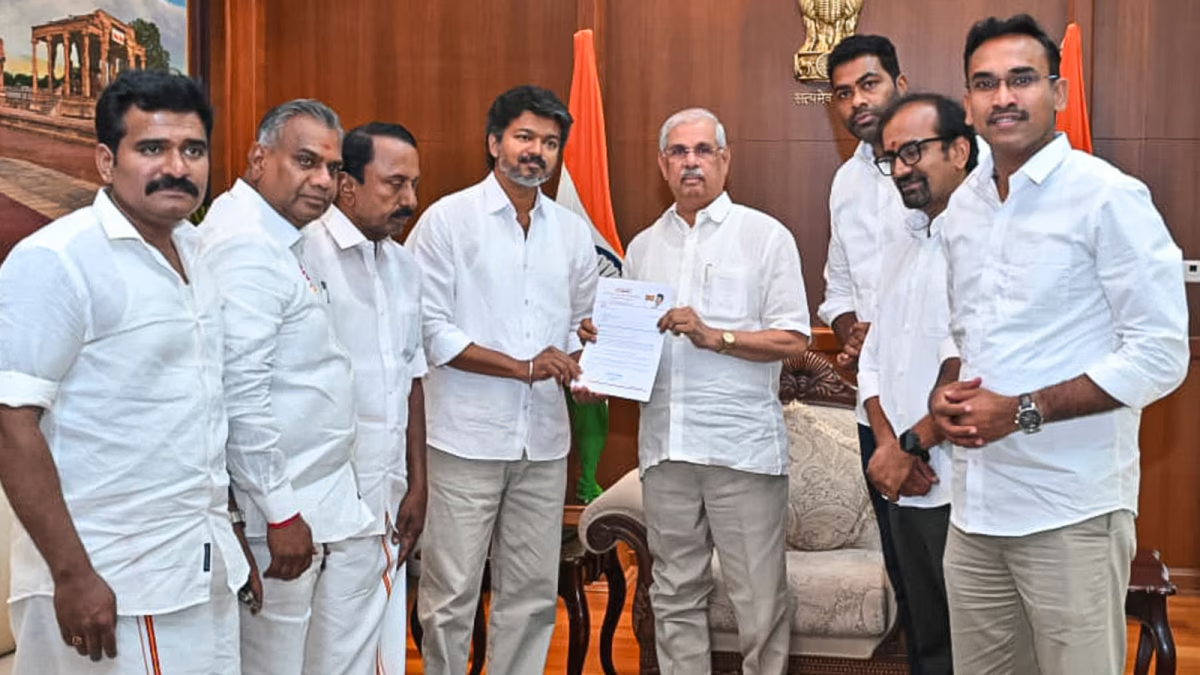
Tamil Nadu Chief Minister Vijay.
Tamil Nadu Chief Minister C. Joseph Vijay’s Tamilaga Vettri Kazhagam (TVK) may have changed the state’s political script by turning celebrity power, public anger and anti-establishment sentiment into a stunning electoral victory, but the real battle begins now.
Winning Fort St George, the administrative centre of Tamil Nadu, which houses the Legislative Assembly, the Fort Museum, and St Mary’s Church, was one challenge. Holding power, while meeting the massive expectations attached to Vijay’s political image, could prove far tougher.
For the Joseph Vijay-led government, the first six months will not simply be about governance — they will be about legitimacy. Vijay’s immediate challenge will be cabinet consolidation, balancing internal interests, appointing trusted bureaucrats, delivering symbolic promises and establishing administrative authority. Tamil Nadu’s deeply entrenched political class — from the DMK to the AIADMK — will be watching closely for any sign that TVK may be electorally disruptive but administratively weak. Vijay’s transition from political outsider to administrator begins here.
Managing public expectations could quickly become TVK’s first major political minefield. Vijay’s rise was powered by extraordinary public enthusiasm, youth support and personal credibility, but that same emotional investment can turn volatile if delivery falters. Voters will expect immediate action — campaign promises fulfilled, visible governance changes, faster welfare delivery, jobs, price control and stronger administration. Unlike traditional parties that often govern with moderated expectations, TVK enters office carrying the burden of hope politics, where even small delays can be seen as betrayal.
FIRST STEPS RIGHT
To Vijay’s credit, his first major actions were clearly designed to project a government of speed, welfare and visible reform. The approval of 200 units of free electricity for all domestic consumers was a direct populist welfare signal aimed at offering immediate household relief. Vijay also announced a specialised Women’s Safety Force and a dedicated helpline, projecting responsiveness on gender security.
The creation of anti-drug task forces across every city and district was framed as a statewide crackdown on narcotics. His call for a white paper on Tamil Nadu’s finances and debt burden signalled both transparency and a politically strategic attempt to frame the fiscal legacy his government inherited. The closure of 717 TASMAC shops near schools and religious institutions added another powerful symbolic move, blending social optics with regulation.
These opening decisions suggested that Vijay wanted TVK to appear welfare-driven, reformist and action-oriented from day one.
Yet even before these moves could fully define his administration, the government stumbled into avoidable controversies that exposed how quickly symbolism can become political damage.
THE CONTROVERSY
The first came with the appointment of astrologer Rickey Radhan Pandit Vettrivel as Officer on Special Duty (Political) to the Chief Minister. What may have been intended as a political gesture quickly became one of TVK’s earliest embarrassments. The backlash was immediate, coming not only from opposition parties but also from allies such as the VCK and the Left. The appointment was challenged before the Madras High Court, with petitioners arguing that elevating an astrologer to a key advisory role violated the constitutional principle of scientific temper.
Just hours after winning the floor test, the government was forced into a hasty retreat and revoked the appointment.
The episode raised larger questions about judgement. Vettrivel’s prominence came largely from his prediction of Vijay’s political “tsunami,” and his past as former Chief Minister J. Jayalalithaa’s astrologer only sharpened scrutiny, particularly given the fallout after his assurances in her disproportionate assets case proved disastrously misplaced.
If the Vettrivel row raised questions about judgement, Vijay’s swearing-in ceremony triggered something even more politically explosive — Tamil identity.
On the day Vijay took oath, controversy erupted after Tamil Thaai Vaazhthu was sung third, after Vande Mataram and Jana Gana Mana.
In Tamil Nadu, this was never going to be dismissed as a procedural issue.
For decades, Tamil Thaai Vaazhthu has traditionally opened state functions, symbolically placing Tamil identity first, while the national anthem concludes proceedings. At Vijay’s swearing-in, that order was disrupted, immediately sparking backlash in a state where language and regional identity are deeply political.
The criticism was swift and politically uncomfortable because it came not only from the DMK but also from parties supporting TVK. CPI’s M. Veerapandian objected strongly, VCK chief Thol Thirumavalavan condemned the move, PMK founder S. Ramadoss demanded protocol be restored, and the DMK aggressively used the controversy to accuse Vijay of ideological drift towards the BJP.
TVK quickly moved into damage control, with Aadhav Arjuna distancing the government from the altered sequence and attributing it to Raj Bhavan acting under a Union government circular.
But politically, the damage had already been done.
For Vijay, these twin controversies — one over superstition, the other over Tamil identity — were early reminders that governance in Tamil Nadu is not just administrative. It is deeply symbolic, emotional and political.
THE CHALLENGES: FINANCES, JOBS, INVESTMENTS & CENTRE
Beyond these symbolic missteps lies an even bigger challenge — Tamil Nadu’s financial reality. The state’s debt burden means Vijay cannot govern on charisma or welfare optics alone. His administration will need to fund welfare schemes, manage subsidies, increase revenue, attract investments and maintain fiscal discipline without triggering public backlash. Fiscal discipline versus populism could become one of the defining contradictions of Vijay’s rule.
Employment and youth aspirations will likely sit at the heart of TVK’s long-term survival. Tamil Nadu’s large educated youth population will demand private-sector jobs, startup opportunities, skill development and better wages. Graduate unemployment or underemployment can quickly become politically explosive. If TVK fails to convert public hope into economic mobility, it risks alienating one of its strongest support bases.
Industrial growth and investment retention will be another major battleground. Tamil Nadu must maintain its position as a manufacturing and industrial hub while competing with Karnataka, Telangana and Gujarat. Vijay’s government will need to protect and expand sectors like EV manufacturing, semiconductors, AI and tech parks, renewable energy and electronics exports. Investor confidence will depend on policy stability, not political charisma.
Water and power management could become one of the most visible governance tests. Tamil Nadu’s recurring issues — water scarcity, monsoon dependency, flooding, irrigation stress and rising electricity demand — cannot be politically dramatised away. Chennai, Coimbatore and Madurai will remain under heavy pressure over infrastructure, flood mitigation, traffic and climate resilience.
Law and order will carry equally high stakes. Administrative reshuffles, allegations of political vendetta, caste tensions, communal sensitivities, misinformation and opposition mobilisation will all test whether TVK can remain a genuine alternative without slipping into the same patterns as the old order.
Centre-state relations may become one of Vijay’s most politically sensitive balancing acts. GST compensation, central funds, infrastructure approvals, NEET, language policy and federal rights will all shape his equation with New Delhi. Vijay will be expected to defend Tamil interests strongly, but excessive confrontation could complicate governance.
The NEET issue remains especially volatile. In Tamil Nadu, it is not merely an education debate but a politically charged question of social justice, rural access and state rights. Vijay will face pressure to move beyond rhetoric and deliver meaningful political action.
Urban infrastructure may become the daily referendum on TVK’s competence. Chennai, Coimbatore and Madurai face growing pressure over traffic, metro expansion, housing, waste management and flood control. While ideological battles dominate headlines, infrastructure shapes everyday voter perception.
Ultimately, the Joseph Vijay-led TVK government is not entering office merely as another elected administration. It enters as a political experiment carrying disruption, symbolism and extraordinary public expectation.
Vijay has sold hope, transformation and change. But Tamil Nadu’s political history is clear — charisma may win power, but governance alone sustains it.
For TVK, defeating the old order was only the beginning. The real challenge now is proving it can govern better. In opposition, popularity creates momentum. In office, performance determines survival.
Read More