





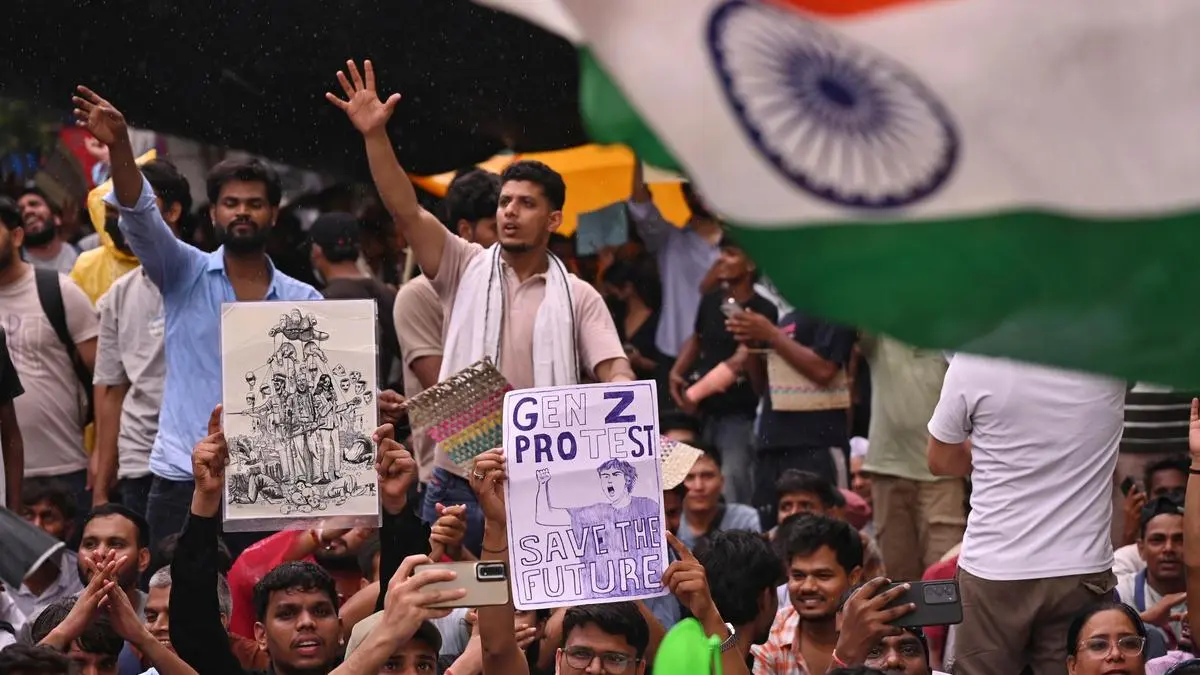
In some respects, when Gen Z (spearheaded by the Cockroach Janta Party) protested India’s corrupt examination system in July, it echoed the US’ Gen Z movement where students protested the Israeli genocide of Palestinians in Gaza. America’s Gen Z protests peaked in April 2024, but their repercussions will be felt in the coming mid-term election in November; US politics is taking an unprecedented anti-Israeli turn, spearheaded by Gen Z. Progressive Abdul El-Sayed’s primary win in Michigan on Tuesday is the latest example of how Gen Z has changed US politics forever. These will take a decade to unfold. If the parallel holds, India’s Gen Z will not only impact the next national election, but the nature of Indian politics in the next decade.
US students have held several well-known movements with national impact. In 1964, students at the University of California, Berkeley, launched a Free Speech Movement in which thousands participated, demanding the right to free speech and academic freedom. It massively impacted campuses and fed the ongoing civil rights disobedience movement of African Americans. Then came the Vietnam War protests of the late 1960s, which peaked with the killing of four students at Kent State University in Ohio, in 1970.
At a smaller scale were the anti-apartheid divestment campaigns in the 1980s; your columnist was arrested in one such protest at the South African embassy in Washington, DC. The Iraq War, launched in 2003, became so unpopular that protests erupted on campuses. The history of anti-war campuses is probably what keeps President Donald Trump from a ground invasion of Iran.
India‘s student protests started before Independence, with the Quit India movement. In 1977, anti-Congress students and workers protests made the then Prime Minister Indira Gandhi self-damagingly impose Emergency rule. Though Dalit students have mostly had localised protests, the one sparked by Rohith Vemula’s death by suicide in 2016 galvanised national attention. In 2018, a Bharat Bandh was held against the BJP’s attempts to subvert caste discrimination on campuses through the SC/ST (Prevention of Atrocities) Act.
The US Gen Z’s anti-genocide protest began, ironically, with student vigils for the Israeli victims of the Hamas attack in 2023. These changed with Israeli military response and the high casualties, especially of children. Pro-Palestine students organised rallies, marches, teach-ins, sit-ins, walkouts, and petitions demanding a ceasefire. Free Speech again became a controversy with Ivy League institutions such as Harvard University and the University of Pennsylvania facing all-round criticism.
By early 2024, US Gen Z became more organised and sought institutional change: they demanded that universities disclose investments connected with Israel, divest from companies supplying the Israeli military, suspend academic partnerships with Israeli institutions, protect students from retaliation, and support a permanent ceasefire.
Incidentally, India shipped 2,596 consignments of weapons, ammunition, and military components to Israel between October 2023 and November 2025, according to an Al Jazeera report that quoted Israeli Tax Authority import records. These included 5,64,970 explosive ammunition components. India’s Gen Z has not touched on Gaza, so unfortunately this arming-of-genocide is not their issue.
The brutal July 20, 2026, lathi-charge of Gen Z marching to Parliament echoed the turning point of the US Gen Z protests on April 17, 2024. Students at Columbia University in New York established a “Gaza Solidarity Encampment” on campus; the university called in the NY police department, and 100 protesters were arrested. The university was in for a surprise, as the incident inspired copycat protests across the US.
Within days, universities in the Northeast (like Yale, NYU, MIT, Harvard, Brown, and Princeton), the Midwest (like Northwestern University and University of Michigan), the West Coast (UC Berkeley and UCLA) and even in the South (University of Texas at Austin), joined in the protests with similar encampments. All said, 140 educational institutions across 45 (of 50) states saw such protests over the following three weeks. The most dramatic was at UCLA where violence broke out between pro-Palestinian and pro-Israeli groups; police had to dismantle the encampment. This form of protest spread to Canada, Europe, and Australia.
The politics beyond protest
Though the encampments disappeared, the movement did not. The debate has continued, as have disciplinary disputes and political scrutiny. It has sharpened Gen Z’s antipathy for the traditional bipartisan American political support for Israel. The political class, typified by the late Senator Lindsay Graham, an Iran War hawk who advocated dropping a nuclear bomb on Gaza, used to liberally open America’s purse for Israeli military purchases.
The US Gen Z frustration has been channelled by the Democratic Socialists of America (DSA), which is pulling the Democratic Party to the Left, and whose leading figures include New York City Mayor Zohran Mamdani. DSA candidates have lately won primaries in NY and Denver; on Tuesday, they politically changed the map in Michigan, in America’s heartland. Gen Z has also impacted the American right; commentators like Tucker Carlson podcast regularly against US support for Israel. He may run for president in 2028.
So, will Gen Z have a major impact on Indian national elections? Optimists may point to Prashant Kishor‘s triumph over the BJP (against the governmental machinery of both the Centre and Bihar) in a constituency that was BJP president Nitin Nabin’s pocket borough. Pessimists may counterpoint that with the total control of election machinery, bureaucracy and judiciary, the regime can afford to lose by-polls so long as they win the States.
However, once the students are angered, whether it be in the US or India or Nepal or Bangladesh or Sri Lanka, you cannot assuage them without real change. In India, Gen Z is absurdly accused of abusing leaders; in the US, Gen Z is irrelevantly accused of anti-Semitism. November is already predicted to be an anti-incumbent mid-term election in the US, which will diminish Trump’s power. We will wait and see what happens in Uttar Pradesh, the heart of the BJP support and ideology, when Assembly elections take place next spring. And we can all agree, as The Who sang back in 1965: “The Kids are Alright”.
Aditya Sinha is a writer living on the outskirts of Delhi.
Also Read | The sound of two democracies
Also Read | The rupee wakes up as a cockroach