





If we trace the arc of Indian politics over the last couple of decades, there is a playbook that emerges. What voters want, particularly the urban middle class, it appears, is a kind of cinematic catharsis. A righteous crusader who finally cleans up the system. We saw its modern genesis with the AAP, born from a televised street movement that promised to replace politics as usual with absolute moral purity. We watched it deployed on a national scale by the incumbent BJP, with candidate Narendra Modi even promising to credit the recovered “loot” to individual bank accounts of citizens. And today, this script has reached its most viral apex in Tamil Nadu.
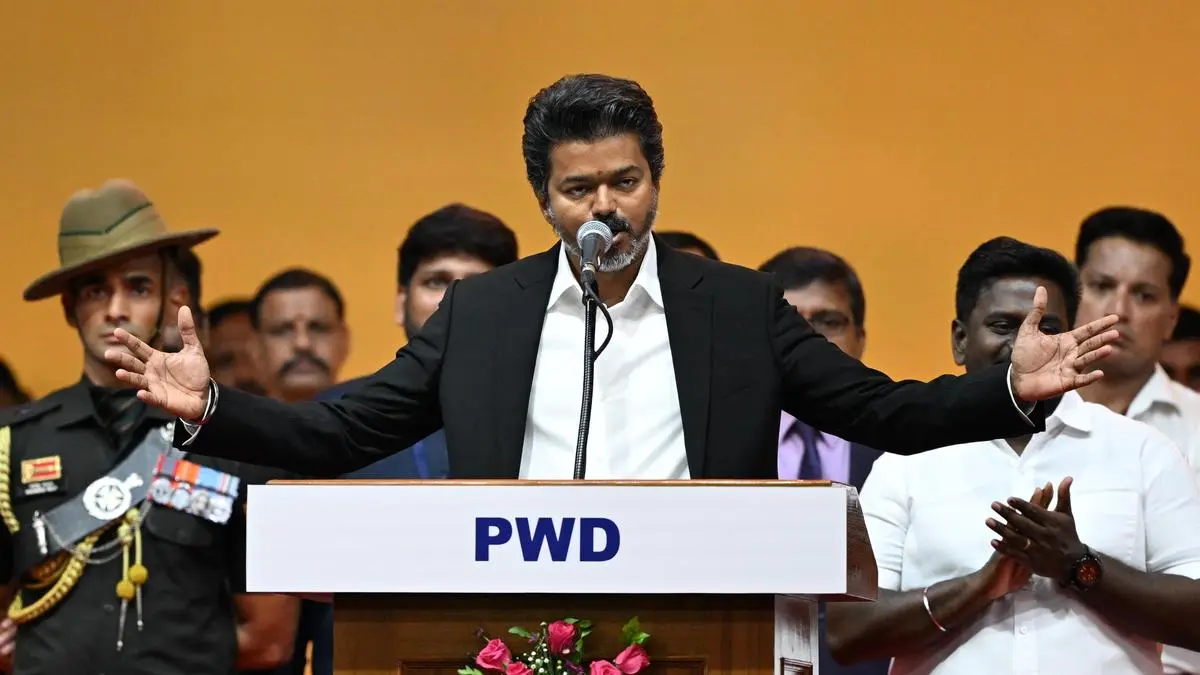
The Tamilaga Vettri Kazhagam (TVK), after its unexpected victory in the recent Assembly election, has quickly moved from promising a future to building the perception of now. If one spends any time in the corners of Tamil social media, almost everyone, it would seem, has a personal anecdote on how the entrenched commission culture in the public works, highways, and registration departments of Tamil Nadu has been decimated. WhatsApp feeds are flooded with stories on how contractors are now executing government tenders without handing over a single rupee in kickbacks. The Chief Minister himself has told people to refuse to pay a bribe. And take his name while doing so! The overarching narrative is as ubiquitous as it is intoxicating: the dark era of politicians skimming off the top of public contracts and services has been wiped clean, replaced overnight by an ethically upright administration.
And given the fact that the TVK rode to power on the provocative potential of Instagram reels, this performative virtue display has become mainstream. There is a daily deluge of viral content engineered by enthusiastic cadres and amplified by the public. There are the ubiquitous shaky-camera videos of low-level bureaucrats being publicly berated by self-styled TVK vigilantes for allegedly demanding a 500-rupee bribe for a patta transfer or some other basic function. There are press briefings where newly minted Ministers spend more time boasting about their refusal to use official convoys than they do outlining their policy vision or explaining departmental budgetary choices.
A political discourse hijacked by personal virtue cult
What is clear, regardless of whether what is being said is true, is that the political discourse has been completely hijacked by a kind of personal virtue cult. When a representative’s primary qualification is a loudly broadcast refusal to partake in the traditional spoils of power, governance itself is transformed into a daily reality television show of moral hygiene. The electorate, exhausted by decades of systemic graft, consumes this not as administrative strategy but as a form of spiritual redemption.
AAP leader Arvind Kejriwal in a December 2013 photograph. He had appeared to be a righteous crusader who would clean up the system when he emerged as an anti-corruption leader in the agitation that spelt doom for the Congress regime.
| Photo Credit:
Raveendran/AFP
Beneath the intoxicating theatre of viral reels as governance lies a dangerous trap. By reducing the sprawling, complex machinery of administering a relatively prosperous State of 80 million people to a simple purity test, we run the risk of becoming prudish without a purpose. This anti-corruption framing assumes that the primary problem of governance is a moral one, that if we simply replace “bad, greedy men” with “good, honest men”, the State will magically transform into a great one.
When “anti-corruption” is elevated from a tool of institutional accountability to a winning campaign promise, it poisons politics. The surest way to keep corruption burning as an unresolved problem is for people to vote on it as the sole issue, operating under the delusion that we are choosing a good person over an evil one. Such clear-cut moral distinctions belong to movie scripts and simply do not exist in reality. It also betrays a foundational assumption of liberal democracy: the radical premise that nobody is fundamentally better or more inherently virtuous than anybody else.
The entire premise of democratic institutions was built specifically to manage human fallibility among equals, not to elevate messiahs. Reasonable adults know that. Or so we would assume. We also know deep in our hearts that you and I are just as susceptible to corruption as every politician who has ever been elected to office. All you need to do is remember how many people you know have paid a bribe to get ahead in some line, and how many times you have. More importantly, an election is a fundamentally inadequate instrument for judging an individual’s moral character, even if that character is somehow superior. A ballot box is designed to aggregate preferences on policy direction, not to canonise saints.
When the “solution” is worse than the problem
When a politician who contests elections on such an anti-corruption platform actually wins, we end up with a problem far worse than the one we were trying to solve. An agenda built entirely on this illusion of moral hygiene cannot survive the rigorous friction of actual policy debates. In such a scenario, the incumbent is forced into a corner: they must continuously manufacture the presence of a corrupt villain to justify their continued existence. Elections, then, cease to be arguments about state capacity and instead degenerate into a performative theatre of criminalising the opponent. When this happens, democratic norms collapse under a two-pronged assault.
First, the rule of law is actively weaponised; the state apparatus is deployed to target, raid, and neuter the opposition using any means necessary, all under the high-minded guise of cleaning the system. Second, once the opposition is successfully jailed or politically liquidated, the democratic guard rails disappear entirely.
The incumbent is left with an unchecked monopoly on state power, eventually turning the weapon of anti-corruption outwards against dissidents, journalists, or any ordinary citizen who dares to dissent. The crusade that promised to liberate citizens from the corrupt politician ends up delivering them into the hands of an unaccountable autocrat.
As the BJP’s prime ministerial candidate ahead of the 2014 general election, Narendra Modi even promised to credit recovered “loot” to individual bank accounts. Here, arriving for a BJP conference in New Delhi in December 2013.
| Photo Credit:
Prakash Singh/AFP
History offers a grim, repetitive confirmation of this trajectory. When Maximilien Robespierre instituted the Reign of Terror during the French Revolution, he did not do so in the name of tyranny; he did so to establish a Republic of Virtue. That he ended up weaponising moral purity to send his political rivals to the guillotine is a downstream consequence of that original intent which sought to sidestep what we would now call liberal norms. The most ruthless autocracies are born not from malice but from such a maniacal crusade to cleanse the state of corruption.
Examples plenty in modern India
We do not need to look into history that is 250 years old or to Europe to see this exact script in motion. In contemporary India, the incumbent BJP government at the Centre has mastered this playbook, systematically neutering regional opposition by deploying Central investigative agencies like the Enforcement Directorate under the relentless, high-minded aesthetic of eradicating graft. Political rivals are no longer defeated in a debate over economic policy; they are bogged down in raids, their credibility liquidated by a supposedly righteous state apparatus.
Similarly, in the US, President Donald Trump’s political machinery relies heavily on the rhetoric of retribution and draining the swamp, openly attempting to weaponise the justice system to investigate and jail political opponents pre-emptively branded as corrupt. Whether in 18th century Paris, modern New Delhi, or Washington, DC, the anti-corruption aesthetic serves the same structural purpose: it provides the moral cover to dismantle democratic opposition and consolidate unchecked power.
This trajectory is, above all, profoundly illiberal. By substituting institutional rules with moral purges and transforming political rivals into state enemies, it poses a direct, existential threat to the very survival of liberal democracy.
Beyond the erosion of democratic norms, this moral panic actively hollows out state capacity. The immediate casualty of a government operating in a perpetual state of performative vigilance is administrative courage. When the ultimate metric of success is the absence of a corruption scandal, the safest action for a bureaucrat is inaction. We should measure a state and its governance by benchmarking regional development indicators, for instance. In the Indian context, those are achieved by expanding welfare or executing large-scale industrial capital expenditure. These are aspects that inherently demand friction, iteration, and a margin of error.
If every delayed tender or renegotiated contract or policy error is instantly framed by enthusiastic vigilantes as a conspiracy to loot the exchequer, the bureaucracy simply stops taking risks. We then end up in an absurd situation where the crusade to save the public purse from a 5 per cent leak ends up costing the state 100 per cent of a project’s developmental value.
This hollowing out extends all the way down to the street level as well. The mechanics of how state capacity actually functions at the last mile in a developing society requires one to stop pretending to be the protagonist of one’s own viral reel. To the middle-class crusader, for example, the local Regional Transport Office (RTO) inspector or the traffic constable who takes a bribe is the ultimate symbol of a rotting state. But consider the reality of that transaction in a system where the formal rule of law is tenuous and officials receive no institutional recognition for actually doing their job well.
President Donald Trump in the Oval Office. Trump’s political machinery relies heavily on the rhetoric of retribution, openly attempting to weaponise the justice system to target political opponents.
| Photo Credit:
Julia Demaree Nikhinson/AP
When an RTO official meticulously administers a driving test and legitimately fails an incompetent driver, he is exercising the friction of his duty. If a fraction of those failed applicants then attempt to bribe their way out, and the official accepts the money from some to issue licences, he is, in a perverse but very real sense, taking responsibility for his little domain. He has engaged with the process, exerted scrutiny, and extracted a transactional premium for moving his thresholds of testing.
Contrast this with the alternative that a state of moral panic frequently produces: completely indifferent officials, given the reward structure has not changed. Terrified of a viral sting operation, or simply starved of any systemic validation for doing their job well, these officials choose the path of least resistance. They mechanically approve every application, pass every driver, and rubber-stamp every file without a second glance. They take no money from anyone, but they also take no responsibility. They are officially clean, but the system they oversee becomes lethally incompetent.
This micro-dynamic helps explain a structural paradox that often baffles observers: why States like Tamil Nadu and Karnataka, despite their historically entrenched and well-documented commission cultures, have consistently outperformed other regions. In these States, low-level graft often functioned as an informal, transactional validation for an administrative machine that was actually moving forward.
Officials extracted their rent but ensured the work was done. When we eradicate that transactional agency through the brute force of moral terror, without first building a robust, transparent system to replace it, we do not get better governance. We just get a bureaucracy that completely stops caring.
Actual governance and the anti-corruption aesthetic
This brings us to the inevitable collapse of the anti-corruption aesthetic once it collides with actual governance. We see this play out in the structural compromises of the TVK administration as it quietly inducts the very opposition legislators it once branded as fundamentally evil to achieve a legislative majority. But this is the inevitable destiny of every moral crusade, across the entire political spectrum.
The AAP, born out of a massive anti-corruption movement that vilified the established order, quickly pivoted to forming strategic alliances with those exact traditional parties to survive in power. Similarly, the BJP campaigns on a high-minded platform of eradicating systemic corruption, yet it routinely welcomes heavily tainted opposition leaders into its fold the moment it needs to secure an electoral victory in some corner of the country where it is not organically strong.
The supposedly corrupt opponent is suddenly transformed into a necessary partner, proving that the original premise was always a farce designed for the campaign trail rather than the Assembly floor.
The fantasy of “clean” politicians
Ultimately, we must abandon the adolescent fantasy of the clean politician and return to reality. Governance is not a spiritual retreat; it is the heavy, friction-filled machinery of managing a complex and often low-trust society. If we want better outcomes, we cannot rely on the fleeting performative asceticism of a Chief Minister who refuses a convoy or a vigilant public hunting for an official who seeks a 500-rupee bribe. We must build an apparatus that accepts the messy, self-interested nature of human actors and constrains them not with moral terror but with systemic transparency.
The true antidote to this moral and administrative trap is not finding a saviour. The solution is dismantling the need for one. And we can achieve that only through extreme decentralisation. When political and budgeting power is concentrated at the top, it becomes a single point of failure, easily captured by an autocrat masquerading as a reformer. But when power and capital are radically devolved to local municipalities, town panchayats, city councils, and citizen boards, the system fractures in a healthy way. This creates a natural ecosystem of pushes and pulls.
Consider the construction of a new local flyover. In a highly centralised system, it is a top-down edict. Because local stakeholders are never consulted, any disruption, delay, or cost revision is immediately perceived as malicious and branded by the virtue cult as graft. The cry of corruption simply becomes the only available language for a community that has been structurally excluded from the decision-making process. But in a truly decentralised system, those local stakeholders, acting through effective local governments and citizen councils, hold a veto over such projects. The ward councillor representing shopkeepers facing displacement, or residents demanding safe pedestrian access to a municipal school, will have the institutional power to halt construction.
A 2017 photograph of Sudip Bandopadhyay, then a Trinamool Congress MP, being taken to Bhubaneswar by the CBI for inquiries in connection with the Rose Valley chit fund scam. Bandopadhyay switched to the NCPI along with 19 other Trinamool MPs, and now supports the BJP.
| Photo Credit:
PTI
When a community is granted a genuine veto, it is forced to learn how to use it thoughtfully. Its members quickly realise that blindly opposing everything means they get no infrastructure at all. Crucially, because these competing interests must be resolved publicly, the decision-making process becomes inherently transparent. When citizens witness at first hand why a design was altered or why costs were revised to accommodate a community demand, this transparency acts as a natural safeguard against random, thoughtless accusations of corruption. The project becomes a site of intense, pragmatic negotiation where competing local forces act against each other, naturally finding an equilibrium based on material needs rather than ideological purity.
Public budgeting
To make this a reality, we must not only demand greater financial autonomy for local governments but also unshackle our legislators. The anti-defection law, which binds individual representatives entirely to the whims of party bosses, is one of the greatest impediments to this. It forces legislators to perform as cheerleaders for a centralised virtue cult, rather than negotiating on their constituents’ behalf. And additionally, we should probably go down the path of public budgeting—or at least one where the public gets to vote on budgets at the local level for projects that impact them. Several local governments around the world—in places as distinct as Brazil and Belgium—have tried this with success. When the decision-making onus is placed on people, they stop using corruption as a catch-all phrase for governance failures.
For this equilibrium to hold, the mechanism of vigilance must also undergo the exact same process of radical decentralisation. Accountability cannot be a weapon wielded selectively by the executive through captive investigative agencies. It must be transformed into a distributed, transparent operation driven by institutionalised public access. What this means in practice is stripping away the administrative secrecy of the state machinery through open, granular data.
Imagine a scenario where a primary health centre is severely underperforming or a regional highway extension is stalled. Instead of relying on the shaky-camera footage of a partisan vigilante berating a junior engineer on Instagram, citizens or local journalists should be able to log into a real-time public ledger. They should be able to track the exact tender amount, view the milestone disbursement schedule, and instantly benchmark that contractor’s track record against similar projects in neighbouring districts. They should be able to correlate this capital expenditure directly with actual outcomes. They should be able to track contractors and the expenditure line items. They should also be able to compare local health metrics or industrial growth figures with their own past and their peers in other regions using hard, downloadable data.
The job of the executive, in such a system, moves from signing opaque tenders to uploading data and maintaining transparency; citizens perform the job of both sanctioning the project and tracking its viability. This systemic and radical transparency completely neutralises the performative theatre of the politician. It strips the incumbent of their ability to selectively target opponents under the guise of moral cleansing because the actual friction of governance—where the money is, who is holding it up, and what it achieved—is visible to everyone. When vigilance is decentralised into an open-data framework rather than a weaponised criminal investigation, we finally stop asking our politicians to be saints. We simply build an apparatus where it is structurally impossible for them to play god.
Self-government, which is what the purpose of a liberal democracy is, is not the theatrical punishment of vice. It is supposed to be a structural harnessing of self-interest. If we accept that we are governed by incentives rather than inherent goodness, we can stop waiting for an uncorrupted saviour to deliver us. Instead, we can do the quiet, unglamorous work of building systems that survive our collective imperfections.
R.S. Nilakantan is a data scientist and the author of South vs North: India’s Great Divide.
Also Read | Political party as content creator
Also Read | Stop treating your MLA like a municipal contractor