





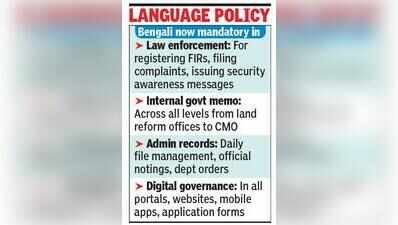
Kolkata: Chief minister Suvendu Adhikari announced on Monday that Bengali will become mandatory for all official work in the state from Sept 1, a day after Union home minister Amit Shah suggested the move in a letter to him.“From Sept 1, 2026, the use of Bengali will be compulsory in govt work at all levels. The govt will make the necessary arrangements, including appointing translators and putting other related mechanisms in place, during this period,” the CM said in the Assembly.Files, notings and remarks must be in Bengali, he said. Routine correspondence, directives and office orders, too, will be issued in that language. Application forms and public service documents will be made available in Bengali, which will also be the language for FIRs, govt newspaper advertisements and training materials.Adhikari clarified that while Bengali will be the language of internal govt work, all communication with the Centre will be bilingual, with official correspondence issued in both Bengali and Hindi.Article 345 of the Constitution empowers state legislatures to adopt any language spoken in the state as its official language. Since the States Reorganisation Act, 1956, came into force and state borders were redrawn along linguistic lines, the states have been using their native tongues for govt work.Bengali was designated as the state’s official language decades ago under the West Bengal Official Language Act, 1961. The short title of the Act read, “An Act to provide for the adoption of the Bengali language as the language to be used for the official purposes of the State of West Bengal, including purposes of legislation.”The original Act had two parts — while Bengali and Nepalese were declared the official languages in the hills, only Bengali was accorded that status in the rest of the state.The West Bengal Official Language Act was amended in 2012 and again in 2018. The West Bengal Official Language (Second Amendment) Act, 2018, along with previous amendments, allowed for localised use of Kamtapuri, Rajbanshi, Kurmali, Nepalese, Urdu, Hindi, Santhali, Odia and Punjabi in official work.The West Bengal Official Language Act was amended in 2012 and 2018. The amended law allows for localised use of Kamtapuri, Rajbanshi, Kurmali, Nepalese, Urdu, Hindi, Santhali, Odia and Punjabi in official work.English, however, remains the predominant language for regular administrative work, while use of Bengali is optional.In his letter to Suvendu Adhikari, which the CM read out in the Assembly, Union home minister Shah wrote, “This year marks the 125th birth anniversary of educationist Syama Prasad Mookerjee. Mookerjee supported the preservation, development and application of Indian languages, and Indian languages should get their place.“It is essential to ensure that from the land reforms office up to the CMO, file management, noting, correspondence and orders at every level of administration be done in the Bengali language. Priority should be given to the application of Bengali across citizen services, digital governance systems, application forms, certificates, portals, websites, mobile apps, training materials, indicators, press releases and forms of official communication.“In citizen services related to the police and law and order — such as FIRs, registration of complaints, citizen information and safety messages — the use of Bengali will strengthen the participation between the administration and the public. In the case of correspondence with the Govt of India, instead of a foreign language, Bengali and Hindi can be used.”The CM concluded: “Collectively for govt sectors in this state, we have announced the decision of the Bengal govt to accept the advice of the home minister… from Sept 1, 2026.”