






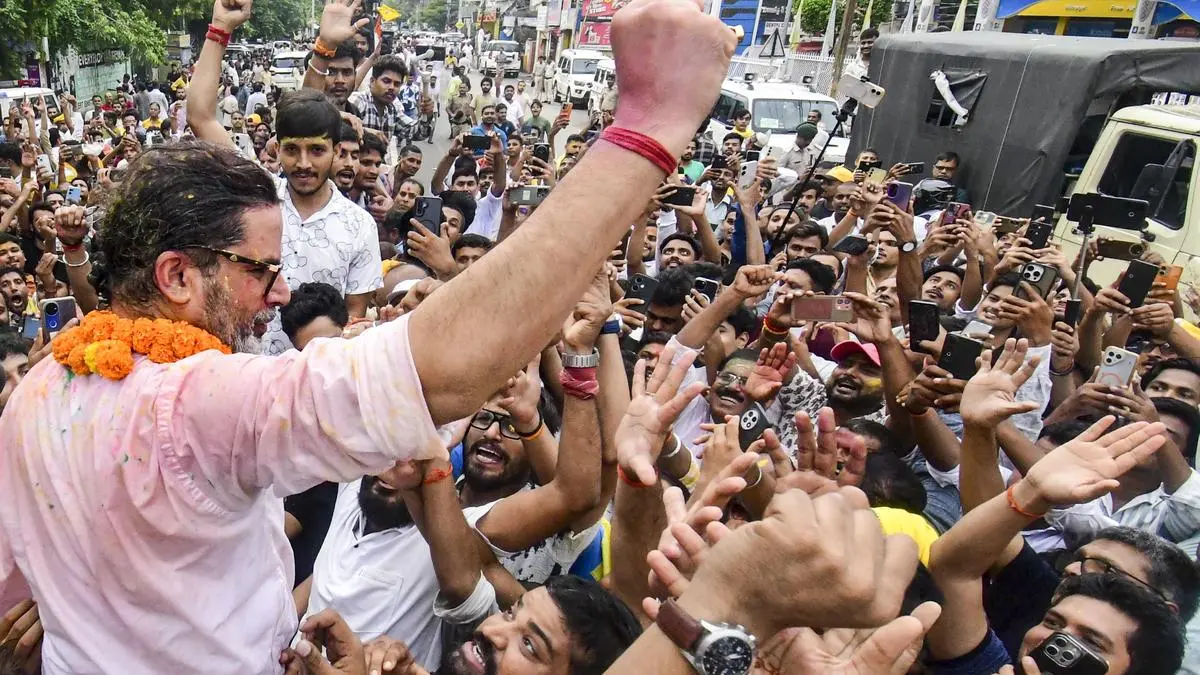
The earth, it turns out, is not a flat undulating landscape of eternal public worship for the Supreme Leader NAMO. It is a more interesting space of heights and troughs, and the political deities of the land have just slipped and fallen in this pitted landscape. In the two weeks between July 20, when the police cracked down on thousands of protesters pouring into the national capital, and August 3, when the BJP was defeated in an Assembly byelection in Bankipur in Bihar (a seat it has not lost for three decades), the earth shifted on its axis and political possibilities appeared to open up. Meanwhile, the Prime Minister has made some Instagram reels, and at the time of writing, two weeks into the monsoon session of Parliament, Union Home Minister Amit Shah has still not appeared on the floor of the House.
The BJP had not lost the Bankipur seat, earlier known as Patna West, for 31 years. The byelection took place since the seat was vacated by Nitin Nabin when he became the BJP national president.
From the BJP’s perspective, the loss rings multiple alarm bells. Bankipur is the rare 100 per cent urban seat in Bihar. Since 1995, it has been held continuously by the Nabin family. Nitin Nabin won the last five times; his father, Nabin Kishore Prasad Sinha, won four times before that.
All the characteristics that make a seat a BJP bastion are ticked here—it is urban, with a large upper-caste population, and high per capita income. The seat stayed with the BJP during the coalition Vajpayee era (1998 to 2004), the subsequent United Progressive Alliance (UPA) decade, and then the entire Narendra Modi era starting in 2014. That ended this year. The huge protests in Bihar, especially in Patna, held in sync with the Cockroach movement that had its epicentre in Delhi, also contributed to the defeat.
Prashant Kishor, who has now won his first election as a party leader, after many successes as a party consultant, knows every nook and corner of the constituency. His staying power after the disappointing debut of his Jan Suraaj Party in the 2025 State election made him an appealing figure to voters and elevated him to the change-maker status. Every section of society voted for him, even the upper-caste constituency of the BJP. And he seems to have swept nearly 90 per cent of the minority vote that might have been expected to back the Rashtriya Janata Dal (RJD)—although the latter did not expect to win anyway.
Kishor has had quite a political journey. I first met him when he arrived in Delhi in 2014 with the team that helped Gujarat Chief Minister Narendra Modi become India’s Prime Minister. The meeting took place at a publisher’s residence. No book ever materialised, but I would acquire a lot of political insights. Kishor would soon part ways with Modi and the BJP. Our next interaction took place in the office he had in the Patna home of Bihar Chief Minister Nitish Kumar, who had parted with the BJP and joined Lalu Prasad Yadav’s RJD. The Lalu-Nitish duo swept the State that year (2015), and Kishor played his part in coordinating the campaigns of the two stalwarts. I remember how methodical he was, overseeing every detail. It is a strange irony that, just a decade later, both former Chief Ministers have faded away and their consultant is emerging as a politician.
I again met Kishor, this time in Hyderabad where he was helping Jagan Reddy bring the YSR Congress to power. In Delhi, in 2020, we met again when Kishor worked with the AAP and Arvind Kejriwal. We also met during the 2021 Assembly election in West Bengal, where Kishor oversaw the successful Trinamool Congress campaign. A critique of his consultancy company I-PAC, which he has stepped away from, is that it hollows out the political parties it serves by taking over the cadre work of block and booth management.
Kishor’s task ahead
There is little doubt that Kishor is sharp, highly intelligent, and works round the clock on any project he takes up. Now his task will be to strike roots in Bihar, one of India’s poorest States, but one that has also been a harbinger of political change. Today, all political movements, from the socialism of the JP era to the social justice of the Mandal era, have receded. The last Assembly poll saw many candidates from the powerful Bhumihar and Thakur castes return to power, marking a significant reversal from the social justice era.
Kishor himself is Brahmin. But Bankipur had an unusually caste-agnostic election and people appear to have voted for the candidate and not his caste. Still, caste will continue to be the first calling card in Bihar’s interiors, and it remains to be seen if Kishor has managed to make a landing that makes him bigger than his social origin. He represents the aspiration for a better life and has the persona of a new brand. He understands marketing and branding, but I also recall the importance he gave to ground campaigns and padayatras when advising clients. For Bihar, Kishor began rigorous ground journeys in May 2022, over four years ago.
Policemen trying to disperse protesters in Patna on July 25.
| Photo Credit:
Sonu Kishan/REUTERS
Kishor has undoubtedly upset the traditional political powers in Bihar, both ruling and opposition. There are four years to the next State election, but Kishor can certainly field candidates for the Lok Sabha election in 2029. He will now be creating a party structure for himself and not his clients.
In terms of performance, Kishor is likely to bring higher quality to the job than either Samrat Chaudhary, the incumbent Chief Minister with a criminal record, or Tejashwi Yadav, who is the Leader of the Opposition but is no Lalu Prasad Yadav. In the last Assembly election, the RJD lost chunks of its Muslim vote to the All India Majlis-e-Ittehadul Muslimeen, a loss that repeated itself in this byelection.
It can also be argued that the BJP has been punished for playing a trick on the people of the State. It went into the 2025 election promising another term of Nitish Kumar. After a questionable campaign—during which the controversial special intensive revision of electoral rolls began abruptly in Bihar, and money was transferred to women voters shortly before polling, in violation of all norms—the BJP-JD(U) alliance swept the election. Nitish was hailed as the face of the victory. Yet, he was soon sidelined and replaced with Samrat Chaudhary, and thus was direct BJP rule firmly established.
The JD(U) is now a force in decline. The RJD, too, is in poor shape and is not viewed even by its traditional voters as a fighting force. It will be interesting to see which party’s candidates and voters head towards the Jan Suraaj. The BJP may be in power, and it has diminished the other organic forces in Bihar, but it does not have any impressive leaders. Moreover, it is just not as rooted in the soil of Bihar as it would like to be.
Saba Naqvi is a Delhi-based journalist and author of four books who writes on politics and identity issues.
Also Read | Why the BJP lost Bankipur and Datia
Also Read | Development, democracy, and dissent