







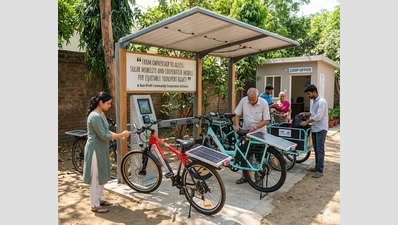
SLUG: World Environment DayVadodara/Anand: What transformed India’s dairy sector through the Amul movement could now help reshape urban mobility. In Anand, the birthplace of the cooperative revolution, researchers have unveiled an ambitious solar bicycle cooperative model that combines clean energy, shared ownership and sustainable transport to tackle the growing challenge of last-mile connectivity.On World Environment Day, the Centre for Apparent Energy Research (CAER), the research and development arm of Baroda Electric Meters Ltd (BEM), unveiled an innovative Solar Micro-Mobility Cooperative model that blends bicycle sharing, solar-powered charging infrastructure and Gujarat’s celebrated cooperative movement.Drawing inspiration from the Anand Pattern that revolutionised India’s dairy sector through Amul, the initiative aims to address a persistent challenge in public transport systems: the “last-mile connectivity” gap that often discourages commuters from using buses and trains.The proposed model allows local residents to become members of a bicycle cooperative by purchasing a share worth Rs 2,000 and paying a nominal daily fee. In return, members gain access to solar-assisted bicycles and charging facilities, while gradually building ownership of a bicycle through their participation in the cooperative.At the heart of the project is BEM’s solar bicycle technology, which combines solar energy with conventional pedalling, making cycling easier and less physically demanding. The technology has previously been recognized by the India Smart Grid Forum and featured in the World Intellectual Property Organization’s Green Book for sustainable innovations.The framework has already been soft-launched at Anand Agricultural University and will initially be piloted at educational institutions and government offices across Anand district, including the collectorate and police department. Students from institutions such as Tribhuvan Sahkari University and the Institute of Rural Management Anand (IRMA) are expected to play a key role in setting up and managing the cooperatives, giving them hands-on experience in cooperative governance and management.According to CAER, the initiative is not merely about replacing petrol with electricity. Instead, it seeks to create a community-owned mobility ecosystem where resources are shared and citizens collectively benefit from sustainable transport solutions.The proposed structure envisions bicycle cooperatives at the campus, neighbourhood and ward levels, supported by district transport unions and state-level federations. Besides managing bicycle fleets, these cooperatives could eventually operate solar-powered charging hubs for electric vehicles, creating a broader ecosystem for clean mobility.CAER has outlined an ambitious long-term vision of establishing micro-mobility cooperatives across the country. The organisation believes wider adoption of bicycles and solar-assisted transport can significantly reduce fuel consumption, cut carbon emissions and strengthen energy security.Beyond its environmental goals, the initiative is also designed to improve mobility access for women, students and underserved communities by offering affordable and accessible transport options.“Solar mobility is not just about changing the fuel; it is about changing the system,” said Vithal Kamat, head of CAER. “The goal is to move towards shared, community-driven and sustainable transport solutions that are affordable and accessible to everyone.”