









“We were told it was a DDA flat, 3BHK + kitchen. But what we found was sunlight – more than we had, anywhere else.”

So writes the husband, a gentleman from Lucknow who has lived all over the city. His most memorable pad was his Hauz Khas village studio, centrifugal to other gentlemen like him who spent their evenings listening to jazz, frequenting little bars, and retiring over a pint or two in addas of debauchery. He is the kind of gentleman who would gift a one-year-old child books like Ulysses by James Joyce, already building their library with monuments of modernist literature.
His wife runs the Terrible Drawing Club. She makes art through her days – by the park bench, in her studio, with kites in her hands and ink on her fingers. She reads books, zines, art books, experiments with form and material the way some experiment with language, always searching for the edge of what a thing can be. They fell in love, married at Piano Man, and live a life that feels like jazz.
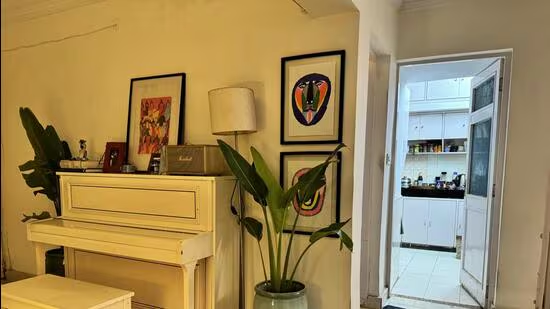
What the flat actually contains, beyond its government-designated three bedrooms, is harder to classify. There is an observation deck that the wife quickly claimed as her studio, turned now toward light and weather and the slow seasonal theatre of Delhi’s sky. There is what the husband calls a library, with a tree outside the window acting as librarian, knocking on the glass to remind them to be still. There is a room large enough to store the darkness away. And there is a drawing and dining room that holds it all together with such harmony that they had to get a piano to play along.
The piano has a story. It belongs to a Delhi musician who moved cities, and nobody in the flat knows how to play it, though the husband calls in a professional every Christmas. The piano is not an ornament; it is memorabilia of something he once organised with friends – a Book Hop, where authors took the stage to read from their own work while a jazz band improvised in response. When the musician later left town, the instrument already had a caretaker. That is how certain beautiful things find their way to where they belong.
This is how artists live. Francis Bacon worked in a studio so chaotic that the Tate Modern eventually preserved its entire floor as an artwork in itself. Georgia O’Keeffe lived in the New Mexico desert in a house so precisely aligned with her inner life that visitors described walking into a painting. Joseph Cornell haunted flea markets across New York, collecting ephemera from which he built his extraordinary shadow boxes. Artists do not live in spaces the way most people understand living; they enter into a conversation with them, and over time the space begins to speak back.
The wife’s studio in the reclaimed observation deck is exactly this kind of space. The paint-stained table at its centre is unmistakably the centre of gravity – the codex for her mind. Bookshelves carry volumes gathered from bookstores with histories of their own: Hockney, Indian art, comics, zines from small presses. Supply racks organised in the way only artists understand – a dried-out, sludgy, faithful mess where everything has a logic visible only to the person who built it. Collectibles arranged by first impulse, which is always the truest arrangement.
When the wife was commissioned by the Jodhpur Arts Week, she decided to make kites. She found a kite master who came from a family of kite people but had branched toward something more personal: academic craft kites, handmade paper, a signature built into the bamboo work itself. These two people came to the flat in Vasant Kunj to make four kites: two in indigo in the classic large kite design, one as a star, and one as a square – not for flying but as a totem, meant to centre people. When they worked, glue and colour and paper were everywhere, filling the air with the particular spell of making.
While the wife takes over the house as her studio when the husband is at work, he identifies his role more as a reader. When asked how a man keeping such a busy day finds time for books, his answer is immediate: he does not drive, so he carries two paperbacks in his bag at all times –one for the journey to work and another for the journey back. Hardbacks, he is clear, are for home reading only, for his study, where he can lose himself to literature.
Two bedrooms still remain in the flat: one for the couple and one for whichever of the mothers happens to be visiting. The kitchen remains the original DDA composition, with little to no added amenities, a deliberate choice, no microwave, food heated in only one way, over fire. As an archiver of Delhi houses, I have observed with some consistency that houses with fewer amenities come in your way in fewer ways, and this kitchen is evidence of that understanding made domestic.
The house, much like its kitchen, has been largely left alone. It lives in its original identity, little eroded by the couple, mostly its own person. It feels, in the end, less like a place the couple inhabits and more like a place that lives alongside them – independent in its being, self-contained in its world. The standard DDA flat continues to be a blank canvas for young couples in Delhi.
Anica Mann works on archaeology and contemporary art in Delhi. The views expressed are personal