









- Pilots suggest serious malfunction before aircraft became airborne.
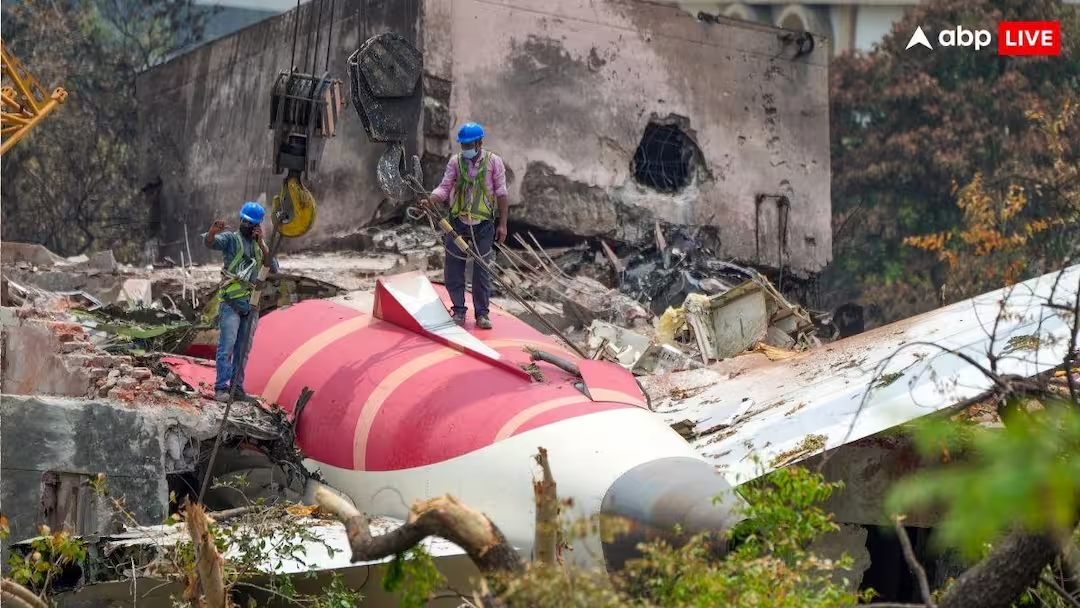
A year after the Air India AI-171 crash near Ahmedabad, fresh questions have been raised over the official investigation. The Federation of Indian Pilots (FIP) has written to the Aircraft Accident Investigation Bureau (AAIB), claiming that key findings in the probe may not accurately reflect what happened in the moments before the aircraft went down. The pilots’ body has pointed to discrepancies involving the aircraft’s emergency power system and has called for additional simulator testing, arguing that the timing recorded in the investigation report does not match independent assessments.
RAT Timing Questioned
At the centre of the dispute is the aircraft’s Ram Air Turbine (RAT), an emergency power device that automatically deploys to provide electricity in the event of a major power loss.
According to the investigation report, the RAT became operational within four to five seconds of fuel supply interruption. However, the FIP claims that tests conducted by a team of US lawyers on a Boeing 787 simulator showed the process takes closer to 18 seconds.
The pilots’ body argues that if the timeline mentioned in the report is accurate, it could indicate that the RAT had deployed even before any action was taken by the pilots. Such a scenario would suggest that a serious malfunction may have begun while the aircraft was still on the runway or even before take-off.
The organisation has also cited video footage which allegedly shows the RAT already deployed before the aircraft became airborne.
Earlier Warning Signs
The FIP has further claimed that the aircraft’s systems began generating fault messages around 14 minutes before take-off.
According to the letter, these alerts were transmitted through the Aircraft Communications Addressing and Reporting System (ACARS) and related to electrical systems, hydraulics and flight controls.
The pilots’ body also referred to the account of the sole surviving passenger, who reportedly described hearing a loud noise and noticing cabin lights dimming shortly before the crash.
Also Read: Trump Says US-Iran Deal Will Be Signed In ‘Few Hours’ Despite Beirut Strike
Fresh Demands
The FIP has asked the AAIB to conduct its own Boeing 787 simulator tests and allow a representative of the pilots’ body to observe the exercise.
It has also sought access to the complete CCTV footage from Ahmedabad airport and questioned why Air India allegedly did not provide simulator-related information to investigators despite having access to its own training facilities.
Copies of the letter have been sent to the Civil Aviation Ministry, the Prime Minister’s Office and the DGCA. Neither the AAIB nor Air India has issued an official response to the latest concerns.
Also Read: Swiss Voters Reject Proposal To Cap Population At 10 Million By 2050
Dehradun Murder: Police Deploy Heavy Security After Violent Protests in Vikasnagar