


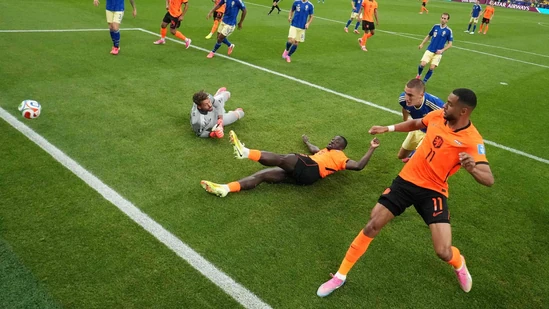
When the Netherlands forward Cody Gakpo scored against Sweden on Saturday night for his side’s third goal, the ongoing football World Cup reached a major milestone. It became the second fastest edition in terms of 100 goals scored. For the first time in 68 years, it has taken 33 games to see 100 goals.

The fastest to date happened in the 1954 World Cup when the first 100 goals came in just 20 matches. In 2014, in Brazil, it had taken 36 games. In 1982, it was the same. Four years before, in 1978 in Argentina and then in 1994 in the United States, it took 38 games.
Also Read: Netherlands thump Sweden in Houston to get World Cup liftoff
More than 3 goals per match is a big number. There could be several factors contributing to it. One could be the ball. Adidas’ Trionda ball is being used in the ongoing edition, and it has troubled goalkeepers so far with its flight. More than 10 goals have been scored from outside the box. Keepers’ fumbles in the box have contributed to the tally, too.
“There are one or two occasions where this football has not necessarily behaved as you would expect it to. It is something to keep an eye on,” former England goalkeeper Paul Robinson, who is working at the World Cup for BBC Sport, said. In the 2010 edition in South Africa, the Jabulani ball had come in for a lot of criticism. England goalkeeper at the time, David James, said: “The ball is dreadful. It’s horrible, but it’s horrible for everyone.”
Some of the high-scoring matches so far are: Germany beating Curacao 7-1, Canada beating Qatar 6-0, and the Netherlands beating Sweden 5-1. The Dutch’s opening game against Japan was also a four-goal affair. “Probably the most compact and tactically tight game I’ve seen so far was Netherlands versus Japan – and even that had four goals,” England’s Euro 2022 winner Ellen White told BBC Sport.
The number of inexperienced teams a factor?
Another factor could also be the fact a lot of new teams or non-regulars are playing this time around. It’s a 48-team tournament — biggest to date –, and many new teams or non-regulars are still getting their bearings, leading to high-scoring contests against seasoned sides. “Of course, having more teams and lower-ranked sides has had a small impact in terms of quality. But aside from a few matches, like Germany against Curacao, where the game eventually got away from them, not that many sides have been blown away so far,” said former Brentford and Tottenham boss Thomas Frank.