



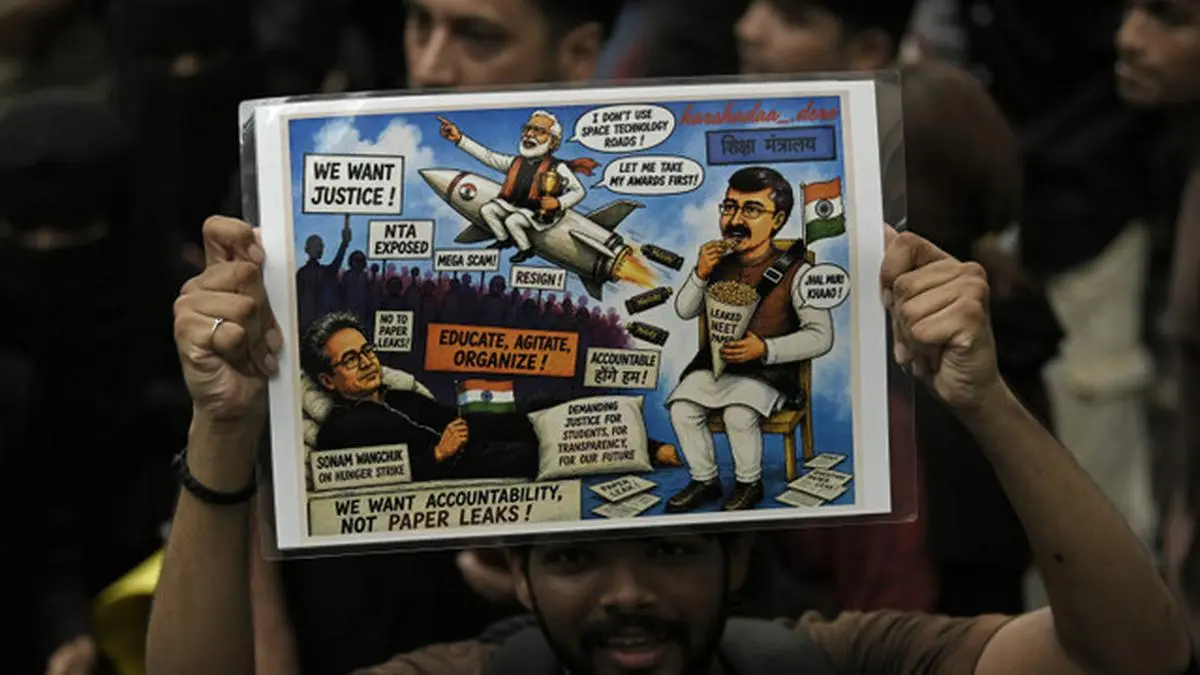
On July 25, Union Education Minister Dharmendra Pradhan announced his resignation, meeting a key demand of protesters who had gathered under the banner of the Cockroach Janata Party (CJP) at Jantar Mantar for 36 days. It was not the first time the Narendra Modi government had bowed to street pressure.
It was the third such climbdown. The first came over the contentious land ordinance the government pushed for months after coming to power in 2014, before withdrawing it in the face of nationwide agitation. The second came in 2021, when months of farmer protests forced the government to repeal three contentious farm laws.
In his resignation letter on July 25, Pradhan wrote that stepping down was “not a matter of personal prestige” and that he was doing so, “saddened” by developments over the preceding ten days, to deny “anti-national forces” room to exploit the situation. Soon after, CJP representatives, at a joint press conference with Union Ministers Jitendra Singh and J.P. Nadda, declared an end to the agitation at Jantar Mantar, saying all their demands had been met.
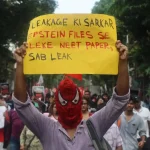
In the days before that, anger had poured into the streets of India—from the roads leading to Parliament in New Delhi and the financial hub of Mumbai to Chennai, the seat of Dravidian politics, and the by-lanes of Bihar, where unemployment and migration for work are the rule rather than the exception.
When the CJP, which had begun protesting at Jantar Mantar over a month earlier, gave a call for nationwide protests in every district on July 24, the government moved quickly. Prime Minister Modi announced a fast-track court and a stricter law against paper leaks, and officials including the Education Secretary were reshuffled. Pradhan’s resignation was the last step.
Also Read | The end of immunity?
It came a day after the CJP called for a nationwide protest march on July 24 in solidarity with students who had faced a police lathi-charge during the Sansad Chalo March on July 20. Activist Sonam Wangchuk, a key face of the agitation, had ended his 26-day hunger strike on July 23, having lost 11 kg. “I am still alive,” he said. Wangchuk had earlier been removed from the Jantar Mantar protest site on July 18, two days before the march to Parliament.
As the protest intensified after the July 20 crackdown and continued to swell even after Wangchuk broke his fast, the government appeared to conclude that an unresolved standoff could spread further and erode its support among voters across age groups and communities.
‘Casualness and callousness’
Manoj Kumar Jha, Rajya Sabha MP from the Rashtriya Janata Dal (RJD), told Frontline that the government’s initial response to the protests by students and young people was marked by “an unfortunate combination of casualness and callousness”.
“Instead of recognising the movement as an authentic expression of anxiety over their future, it chose to dismiss it as politically orchestrated. Conspiracy theories were amplified through sections of the pliant media, while the protesters themselves were portrayed as misguided or manipulated,” Jha said. “Such a response neither addressed the substantive concerns of the youth nor acknowledged the legitimacy of their democratic aspirations. History repeatedly reminds us that when governments substitute empathy with arrogance and dialogue with denial, they often end up strengthening the very movements they seek to contain.”
The RJD leader said the movement, which began in a few urban centres, had steadily travelled to towns, district headquarters, university campuses, and peripheral regions that had initially been only passive observers.

Union Minister J.P. Nadda with Minister of State Jitendra Singh and CJP spokespersons Saurav Das and Ashutosh Ranka during a joint press conference after Education Minister Dharmendra Pradhan resigned from the Union Cabinet at the Constitution Club of India in New Delhi, on July 25, 2026.
| Photo Credit:
PTI
“The movement was not only confined to a single examination, institution, or locality; it evolved into a wider expression of accumulated frustration over unemployment, insecurity, and the perceived erosion of fairness in public institutions,” Jha said. “Every attempt to delegitimise the protests only expanded their moral appeal. By refusing to listen when the movement was localised, the government inadvertently transformed it into a broader democratic awakening, carried forward by a generation that increasingly sees its own future reflected in the struggle of others.”
A nationwide trend
Thousands of protesters gathered in central Mumbai’s Dadar area for a “Tiranga March” organised by the Uddhav Thackeray-led Shiv Sena (UBT) this week. In Hyderabad, Bharat Rashtra Samithi (BRS) Working President K.T. Rama Rao led a protest; in Nagpur, the mother of a NEET aspirant who died in May addressed demonstrators.
The protest’s echo was heard in the business hub of Surat, the IT hub of Hyderabad, and the coastal belt of Kerala.
In Bihar, Gandhi Maidan turned into a protest site on July 22. In Karnataka, Congress workers demonstrated in Bengaluru and other cities demanding Pradhan’s resignation, and staged a protest outside the State BJP office.
Videos on social media showed a youth at Jantar Mantar refusing to run from a police baton charge, while in Patna, protesting students were seen asking the police for tear gas and water cannons.
Bihar had earlier seen large protests over an alleged paper leak in the Bihar Public Service Commission’s 70th Combined Competitive Examination in December 2024, and violent protests against the Centre’s Agnipath scheme in June 2022, including the torching of train compartments in Chhapra, Samastipur, and Lakhisarai districts.
In Patna, BJP MLAs Vinay Bihari and Rohit Pandey were among those attacked as students protested on July 22 against the lathi-charge during the Sansad Chalo March in Delhi two days earlier.
As the Patna police mounted a crackdown, registering multiple FIRs and arresting scores of people, the issue triggered a heated exchange between the ruling National Democratic Alliance (NDA) and the Opposition INDIA bloc in the State Assembly on July 23 and 24. The Bihar government sounded a high alert across the State ahead of a bandh call for July 25 by Left-wing student bodies.
Rajaram Singh, Communist Party of India (Marxist–Leninist) Liberation Lok Sabha MP from Karakat in Bihar, told Frontline: “Bihar already suffers from a huge unemployment problem, and people migrate to other cities, including metros, for jobs. There is hardly any private industry in the State, and students prepare for years to crack competitive exams to get into jobs. Such paper leak incidents fuel the fear that whatever little opportunities they have to improve their life by cracking these exams are also being compromised.”
Singh noted that Bihar’s political awareness runs back to the pre-Independence era, when farmers of Champaran invited Mahatma Gandhi to lead an agitation against indigo farming, and that the State had played a key role in the anti-Emergency movement of the 1970s. The echo of the Jantar Mantar protests, he said, would ring loud in a State that has repeatedly been a catalyst for change.
Timing and precedent
The government’s truce with the protesters, secured by Pradhan’s resignation, comes as Uttar Pradesh and Punjab prepare to go to the polls next year.
The sweeping agricultural reform laws were introduced in 2020. In protest, the Shiromani Akali Dal, then an NDA ally from Punjab, withdrew from the government, and its leader, Union Minister Harsimrat Kaur Badal, quit the Council of Ministers.
As the farmer agitation grew, the government withdrew the three contentious farm laws in November 2021, after a year of protest. Opposition parties argued at the time that the Centre acted after suffering losses in Assembly byelections during that period, and did not want to repeat the pattern in the agrarian States of Uttar Pradesh, Punjab, and Uttarakhand, which went to the polls months later in 2022.
As with Pradhan’s resignation letter, the government had invoked national interest when it withdrew the farm laws, after months of criticism of the agitating farmers, with some leaders alleging an anti-national hand behind the protests, which were then concentrated at the borders of Punjab and Haryana with Delhi.
After coming to power in 2014, one of the Modi government’s first major moves was a controversial ordinance seeking to change nine key provisions of the UPA’s 2013 Land Acquisition Act, including the consent clause, the social impact assessment, and the replacement of the term “private company” with “private entity”. Massive protests followed.

Farmers shout slogans as they block a road during a daylong strike demanding guaranteed crop prices, on the outskirts of Amritsar on December 30, 2024.
| Photo Credit:
AP
In February 2015, social activist Anna Hazare and Narmada Bachao Andolan activist Medha Patkar launched a two-day agitation against the ordinance, accusing the government of “antipathy” towards farmers. The Congress was already mobilising party workers against it in several States.
The government held its position for months before withdrawing six of the nine amendments through a parliamentary panel headed by BJP MP S.S. Ahluwalia, eight months later. That climbdown came months before Assembly polls in Bihar, but it did not translate into gains for the party there: a united Lalu Prasad-Nitish Kumar-Congress alliance defeated the BJP.
In 2024, the Modi government moved to open lateral entry into the bureaucratic civil services but suspended the plan amid friction over reservation norms, with NDA ally Chirag Paswan, of the Lok Janshakti Party, among those who raised concerns.
Union Minister M.J. Akbar’s resignation in 2018, after months of outrage during the #MeToo movement, was the first resignation of a Union Minister under public pressure. Pradhan’s resignation follows protests by a youth constituency the BJP had considered one of its strongest support bases. The resignation of the then Union Health Minister, Harsh Vardhan, in July 2021, following criticism of his handling of the COVID-19 pandemic, was folded into a larger Cabinet reshuffle.
One reason the government moved faster this time, compared with the year-long farmer protest or the eight-month agitation against the land ordinance, was that young people had come out onto the streets. Alongside Wangchuk’s hunger strike, which built moral pressure, the street protests threatened to disrupt governance and normal life, making it harder for the government to dismiss the movement as the work of a fringe group whose votes it could afford to ignore.
In Uttar Pradesh, the former IIT professor G.D. Agrawal, also known as Swami Gyan Swaroop Sanand, died in 2018 after a 111-day fast demanding a clean Ganga. There was no comparable street mobilisation to back that agitation.
Opposition reaction
Leader of the Opposition Rahul Gandhi called Pradhan’s resignation a major step towards overhauling the country’s education system, and demanded accountability for the violence against students.
Also Read | Dharmendra Pradhan’s resignation: A reckoning for India and its silent corporate elite
“This is a warning from the students of India that you cannot run India the way you have been running it. If you continue down this path, what has happened today will unfold on a scale ten times greater,” he said.
Congress general secretary Priyanka Gandhi, speaking in Wayanad, Kerala, welcomed Pradhan’s resignation. “The government had to bend to their will. This is a lesson for every ruler of this country. In a democracy, the will of the people is paramount. No leader, no dictator, and no force can stop the will of the people,” she said.
She said people had begun reclaiming their country from those who sought to undermine the Constitution and suppress their voices. “Students and young people have demonstrated the strength of non-violent protest despite facing pellet guns, tear gas, and lathi-charge,” she said.


