



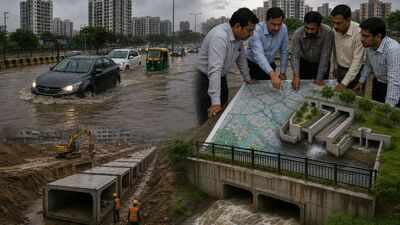
AHMEDABAD: Heavy rain has once again inundated roads and residential areas for residents of Bopal, Ghuma, Ambli and nearby parts of western Ahmedabad. This year, it has reached such a stage that Union home minister Amit Shah has sought a permanent solution from Gujarat’s government and Ahmedabad’s civic authorities.But the more important question is not why the latest shower of rain caused water logging. That is why a rapidly growing part of Ahmedabad continues to have the same problem.The Ahmedabad Municipal Corporation has now prepared a zone-wise storm water drainage master plan for Ambli, Bopal, Ghuma and Shela after conducting a hydrological survey of the area. The proposed approach is to design drainage networks in places where suitable systems are not present, install new stormwater lines, and improve interconnections and provide suitable outfalls to carry rainwater away more rapidly.The problem is very close to the change of the area. Ambli, Bopal, Ghuma and the adjoining areas have developed fast with new housing societies, roads and commercial development. The area was incorporated into the AMC in 2021, while its storm water infrastructure has not kept pace with urbanization.That mismatch is the root of the problem. A city can build roads and buildings much faster than it can redesign the drainage system beneath it. Stormwater capacity can be overwhelmed by heavy rainfall when natural watercourses are disturbed or urban areas are developed without proper stormwater capacity.The civic body’s latest plan is to look at the wider drainage geography, including Gota-Godhavi canal and Sabarmati river, instead of treating every flooded road as an isolated problem.But for the residents, the real test will be the next big downpour.This exercise may provide a long-term solution, but that’s a plan, not proof the flooding problem has been solved. The challenge for Ahmedabad now is to translate a hydrological study and drainage blueprint into infrastructure that can keep up with the city’s growth.