









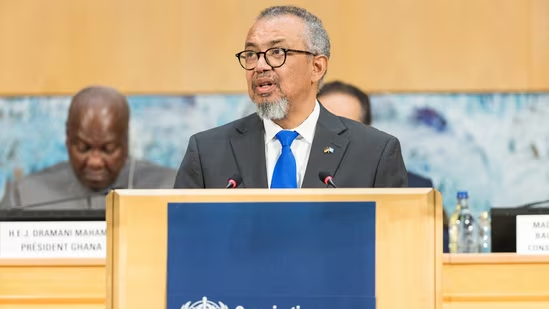
The head of the World Health Organization on Tuesday expressed concern over the “scale and speed” of an outbreak of a rare type of Ebola in eastern Congo, where authorities reported the suspected death toll had risen to 134, with more than 500 suspected cases.

The virus spread undetected for weeks after the first known death as authorities tested for a more common type of Ebola and came up negative, health experts and aid workers said. The Bundibugyo virus has no approved medicines or vaccines.
In Bunia, the site of the first known death, health workers in protective gear moved among residents wearing fabric masks. “I know the consequences of Ebola, I know what it’s like,” said a worried resident, Noëla Lumo.
Congo was expecting shipments from the United States and Britain of an experimental vaccine for different types of Ebola, developed by researchers at Oxford, said Jean-Jaques Muyembe, a virus expert at the National Institute of Bio-Medical Research.
“We will administer the vaccine and see who develops the disease,” he said. But experts said such efforts would take time.
WHO Director-General Tedros Adhanom Ghebreyesus said he was “deeply concerned about the scale and speed of the epidemic,” and pointed to the emergence of cases in urban areas, the deaths of healthcare workers and significant population movement.
In Congo, 30 cases have been confirmed, Tedros later told a meeting of the U.N. health agency’s emergency committee. He said neighboring Uganda has informed the WHO of two confirmed cases including a death in its capital, Kampala, among people who had traveled from Congo.
WHO expects the outbreak to last for weeks at least
WHO has declared the Ebola outbreak a public health emergency of international concern, requiring a coordinated response. Resources were being rushed to two affected provinces near Uganda. Parts of eastern Congo are in the hands of armed rebels.
The head of the WHO team in Congo said authorities haven’t identified “patient zero.”
Dr. Anne Ancia also said the Ervebo vaccine, used against a different type of Ebola, was among those considered for possible use, but anything approved would take two months to become available.
“I don’t see that in two months we will be done with this outbreak,” she said.
For now, Ancia said, neither the U.S. Centers for Disease Control and Prevention nor the Africa Centers for Disease Control were on the ground, but others were, including Doctors Without Borders and the Red Cross.
The UNICEF office in Bunia said it had been sent an initial 16 tons of relief supplies, mainly disinfectants and soaps, personal protective equipment and water purification tablets and water tanks.
Hela Skhiri, UNICEF’s Bunia bureau chief, said that the relief supplies would be distributed according to need across three treatment centers in Ituri province.
Cases have been confirmed in the capital of Congo’s Ituri province, Bunia; North Kivu’s rebel-held capital, Goma; and the localities of Mongbwalu, Nyakunde and Butembo — home to well over a million people in all.
Dr. Peter Stafford, an American doctor, is among the Bunia cases, said Serge, the Christian organization he works for. He had been treating patients at a hospital.
Tedros said an American had tested positive and been transferred to Germany.
There is growing panic among some residents
Ebola is highly contagious and can be contracted via bodily fluids such as vomit, blood or semen. The disease it causes is rare but severe and often fatal. Symptoms include fever, headache, muscle pain, weakness, diarrhea, vomiting, stomach pain and unexplained bleeding or bruising.
During an outbreak more than a decade ago that killed more than 11,000 people, many were infected while washing bodies for funerals.
“Ebola is very much a disease of compassion in that it impacts the people who are more likely to be taking care of sick folks,” said Dr. Craig Spencer, an associate professor at the Brown University School of Public Health who survived Ebola more than a decade ago after contracting it in Guinea.
There was growing panic in Bunia neighborhoods. Local authorities urged people to remain calm and adhere to preventive measures including practicing good hygiene and exercising caution during funerals.
“It’s truly sad and painful because we’ve already been through a security crisis, and now Ebola is here too,” said Justin Ndasi, a resident of Bunia. “We have to protect ourselves to avoid this epidemic.”
The most important challenge is breaking the virus transmission chain, Muyembe said, adding that most of Congo’s previous Ebola outbreaks “were brought under control simply by applying public health measures.”
False negative tests delayed response
Congo has said the first person died from the virus on April 24 in Bunia, and the body was repatriated to the Mongbwalu health zone, a mining area with a large population.
“That caused the Ebola outbreak to escalate,” said Congo’s health minister, Samuel Roger Kamba.
When another person fell ill on April 26, samples were sent to Congo’s capital, Kinshasa, for testing, according to the Africa CDC. Bunia is more than 1,000 kilometers (620 miles) away in a country with some of the world’s worst infrastructure.
Samples from Bunia were initially tested for the more common type of Ebola, Zaire, Congolese officials said. They came back negative, said Dr. Richard Kitenge, the health ministry incident manager for Ebola.
On May 5, WHO was alerted of about 50 deaths in Mongbwalu, including four health workers. The first confirmation of Ebola came on May 14.
“Our surveillance system didn’t work,” Muyembe said. “The Bunia laboratory … should have continued searching and sent the samples to the national laboratory. Something went wrong there. That’s why we ended up in this catastrophic situation.”
Only laboratories in Kinshasa and Goma, which is now controlled by the Rwanda-backed M23 rebel group, have the capacity to test for the Bundibugyo type of Ebola.
Benjamin Mbonimpa, M23’s permanent secretary, has said the rebel government established entry and exit points in Goma and would take responsibility for funeral services if the virus spreads.
“Our priority is to protect the population within our jurisdiction, and we urge people to resume their daily activities,” he said.
Matthew M. Kavanagh, director of the Georgetown University Center for Global Health Policy and Politics, has criticized the Trump administration’s earlier decision to withdraw from WHO and make deep cuts in foreign aid — “the exact surveillance system meant to catch these viruses early.”
The U.S. State Department has said it has provided $13 million for the response.