
Last Updated:
For over three decades, every ruling party in Karnataka that changed its leader midway through a legislative term has been completely wiped out in the subsequent assembly polls




Congress leaders believe merely replacing the chief minister will not be enough to counter anti-incumbency ahead of 2028. The party is now considering a major organisational and cabinet overhaul inspired by the “Kamaraj Plan.”
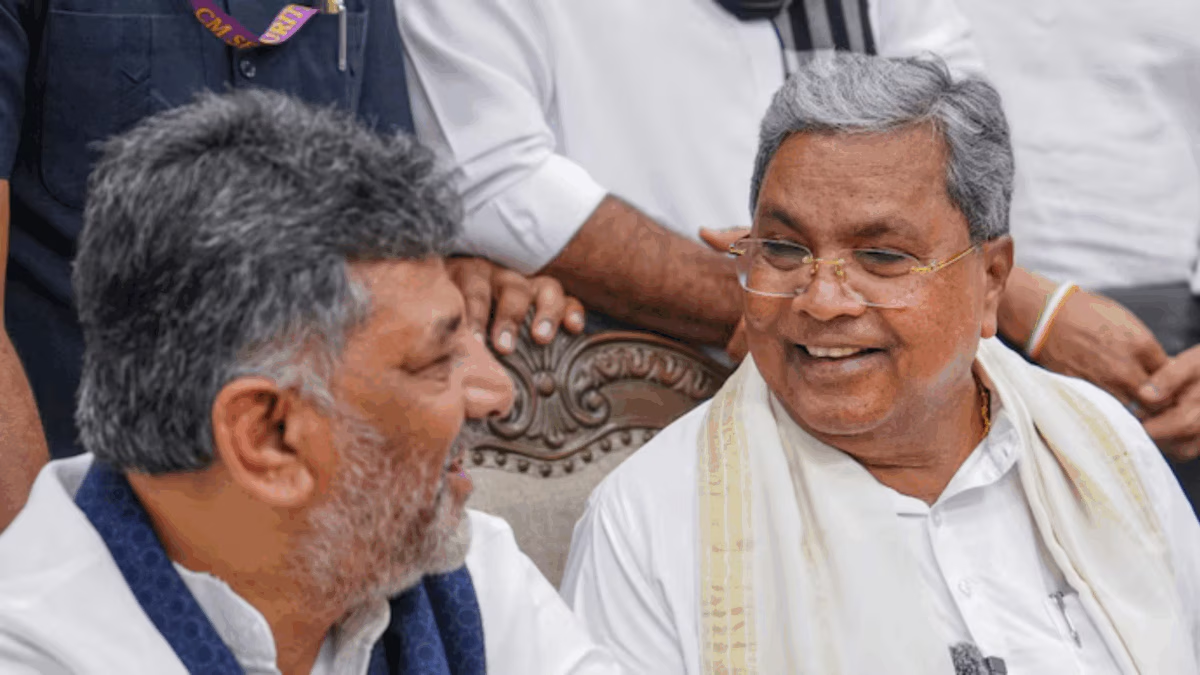
As D K Shivakumar prepares to take the oath as Karnataka’s next Chief Minister following Siddaramaiah’s resignation, the Congress party faces an invisible but brutal historical adversary: the state’s infamous midterm CM jinx. For over three decades, every ruling party in Karnataka that changed its leader midway through a legislative term has been completely wiped out in the subsequent assembly polls—a daunting political curse that the high command now hopes to shatter using a highly calculated balance of Vokkaliga consolidation and welfare governance.
The leadership switch marks a bold political gamble for the Congress. But the BJP has successfully changed chief ministers mid-term in states like Gujarat and Uttarakhand to blunt anti-incumbency and retain power. However, Karnataka’s political history tells a far harsher story.
What Is Karnataka Mid-Term CM Jinx?
Karnataka’s electoral history shows a striking pattern: parties attempting to stabilise governments through mid-term leadership changes have consistently suffered defeats in the following election.
The trend began in 1980 when Congress leader R Gundu Rao took over after the resignation of D Devaraj Urs amid internal turmoil. Congress lost power in the 1983 elections, leading to Karnataka’s first non-Congress government under Ramakrishna Hegde.
The Janata Party later faced a similar fate. After Hegde resigned in 1988 over a phone-tapping controversy, S R Bommai inherited a divided government. Within a year, the party was routed in the 1989 polls as Congress stormed back to power.
Congress itself faced severe voter backlash during the unstable 1989–1994 period. Veerendra Patil was removed in 1990, followed by successive chief ministers S Bangarappa and M Veerappa Moily. The political instability badly damaged the party’s image, and Congress was reduced to just 34 seats in the 1994 election.
The Janata Dal suffered the same outcome after J H Patel took over in 1996, when H D Deve Gowda became Prime Minister. Internal rebellion and factionalism weakened the government, and the party lost heavily in the 1999 elections.
In more recent years, the BJP has repeatedly fallen victim to the same pattern. After B S Yediyurappa resigned in 2011 amid corruption allegations, the BJP rotated through D V Sadananda Gowda and Jagadish Shettar before suffering a crushing defeat in 2013.
History repeated itself in 2021 when the BJP replaced Yediyurappa with Basavaraj Bommai in an attempt to control anti-incumbency. The strategy failed, and Congress returned to power with a decisive victory in 2023.
The only exceptions came in Karnataka’s early political years under Congress when leadership transitions in 1956 and 1962 were short, carefully managed administrative arrangements rather than politically forced power struggles.
Congress’s ‘Kamaraj Plan’ For 2028
Congress leaders believe merely replacing the chief minister will not be enough to counter anti-incumbency ahead of 2028. The party is now considering a major organisational and cabinet overhaul inspired by the “Kamaraj Plan.”
Karnataka Legislative Council Chief Whip Saleem Ahmed recently indicated that nearly 50 per cent of the cabinet could see new faces.
“We intend to implement a Kamaraj Plan model, particularly as we prepare for the 2028 elections,” Ahmed said, while adding that the final decision would rest with the Congress high command.
The original Kamaraj Plan was proposed in the 1960s by veteran Congress leader K Kamaraj, who suggested that senior ministers resign from government posts to focus on rebuilding and strengthening the organisation.
Four Deputy CMs To Balance Caste Equation
Alongside the leadership transition, Congress is also exploring a broad caste-balancing strategy by reportedly considering four deputy chief ministers from different communities.
While Shivakumar represents the influential Vokkaliga community, the party is looking at additional representation from Dalit, OBC, minority and Lingayat groups.
Siddaramaiah’s political strength has long been anchored in the AHINDA social coalition — minorities, backward classes and Dalits. Accommodating leaders linked to this influential support base, potentially including Siddaramaiah’s son Yathindra Siddaramaiah in a deputy chief ministerial role, could help the Congress retain the outgoing chief minister’s core voter base ahead of the 2028 elections.
Karnataka’s Four-Decade Anti-Incumbency Pattern
Karnataka remains one of India’s toughest states for incumbent governments. Since 1985, no ruling party has managed to win consecutive assembly elections in the state.
The last government to successfully retain power was Ramakrishna Hegde’s Janata Party in 1985 after the assembly was dissolved early and fresh elections were called. Since then, Karnataka voters have consistently alternated between parties in every election cycle.
Even leaders who completed full terms with strong welfare programmes — including S M Krishna and Siddaramaiah — failed to secure re-election for their parties. The BJP too could not retain power after forming governments in 2008 and 2019.
This history explains why DK Shivakumar faces one of the toughest political assignments in Karnataka’s recent history — not just becoming chief minister, but helping Congress achieve what no ruling party has managed in the state for nearly 40 years.
Read More