







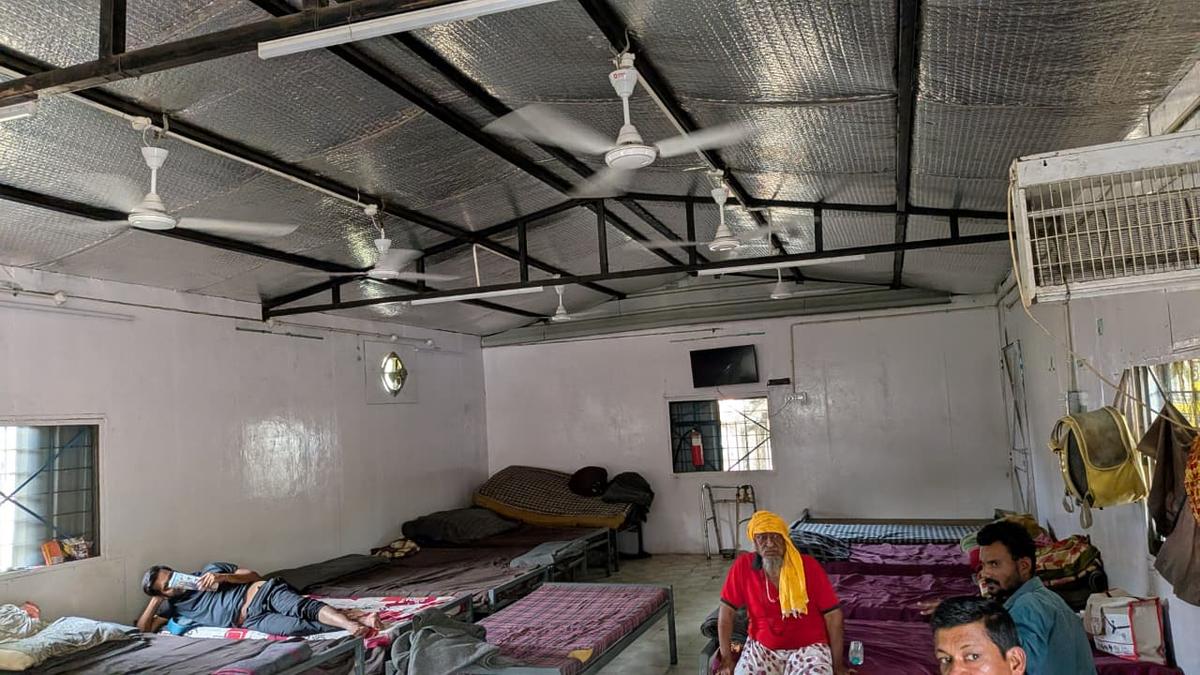
Residents say water scarcity, inadequate cooling infrastructure and heat-trapping tin sheds worsen summer conditions.
| Photo Credit: Shubhangi Kshitizia Saurav/Mahima Rao
Behind the main compound of Gurudwara Bangla Sahib in central Delhi, a narrow lane past a small kiosk leads to a women’s shelter run by the Delhi Urban Shelter Improvement Board (DUSIB). Inside the tin-roofed structure, several women remain indoors through the afternoon, lying beneath ceiling fans and desert coolers as temperatures outside climb past 40°C.
Across shelter homes in the city, residents say water scarcity, inadequate cooling infrastructure and heat-trapping tin sheds are worsening summer conditions, even as DUSIB officials claim intensified measures to tackle the heat. A recent field survey by the Centre for Holistic Development (CHD), conducted across 24 night shelters, found widespread gaps in cooling infrastructure, irregular water supply, shortage of ORS packets and weak emergency response systems. The report, submitted to DUSIB earlier this month, noted that nearly 50% of cooling units were non-functional and several shelters depended on erratic tanker supply.
Insects in food
At the Bangla Sahib shelter, residents said tin roofs trap heat during the day, making conditions difficult to bear. Pooja Chawla, 26, who moved to Delhi five years ago in search of work, said water scarcity had become routine. “Sometimes the tanker comes twice a week; sometimes it does not come for two weeks,” she said. She alleged that food distributed hours after delivery often spoils in the heat. “Food that comes at 2 p.m. is sometimes given at 8 p.m. By then it smells, and occasionally there are insects in it,” she claimed.
She also alleged that stagnant wastewater discharged nearby had led to mosquito breeding inside the compound. Jaya Devi, 30, who has lived at the shelter for nearly eight years, said residents were often unaware of provisions such as ORS packets and sanitary pad vending machines mandated under summer guidelines. She alleged that complaints about dirty water tanks and irregular supply frequently went unaddressed. “The shelters are made of tin sheets, which trap heat during the day,” she said.
Similar concerns were raised by residents at a shelter in Kashmere Gate, who said irregular water supply often left them dehydrated and unable to bathe daily. Many reported falling ill during the summer and said tin roofs significantly increase indoor temperatures.
Defunct coolers
Another resident, Rajeev, said several cooling units were not working. “The cooler is not working, and it becomes unbearable in this heat,” he said. Last week, DUSIB officials said shelters had been equipped with water dispensers, coolers, ceiling fans, exhaust systems and mosquito repellents. However, residents said access to water remained dependent on tanker supply.
A senior DUSIB official said water cooler filters had recently been replaced and that the situation was being regularly monitored. “We will look into the issues flagged at these shelters immediately,” the official said. On water supply, the official said officers had been assigned to coordinate with the Delhi Jal Board to ensure regular availability. On food quality, the official said, “Food is prepared fresh. However, in the absence of refrigeration, it may spoil if consumed late.”
The official added that a summer action plan had been introduced this year, including daily distribution of ORS packets, awareness posters on heatwave precautions and details of nearby hospitals and ambulance services. Temporary shelters have also been set up near four major hospitals to accommodate patients and their families.
(Mahima Rao contributed to this report)
Published – May 19, 2026 12:30 am IST


