







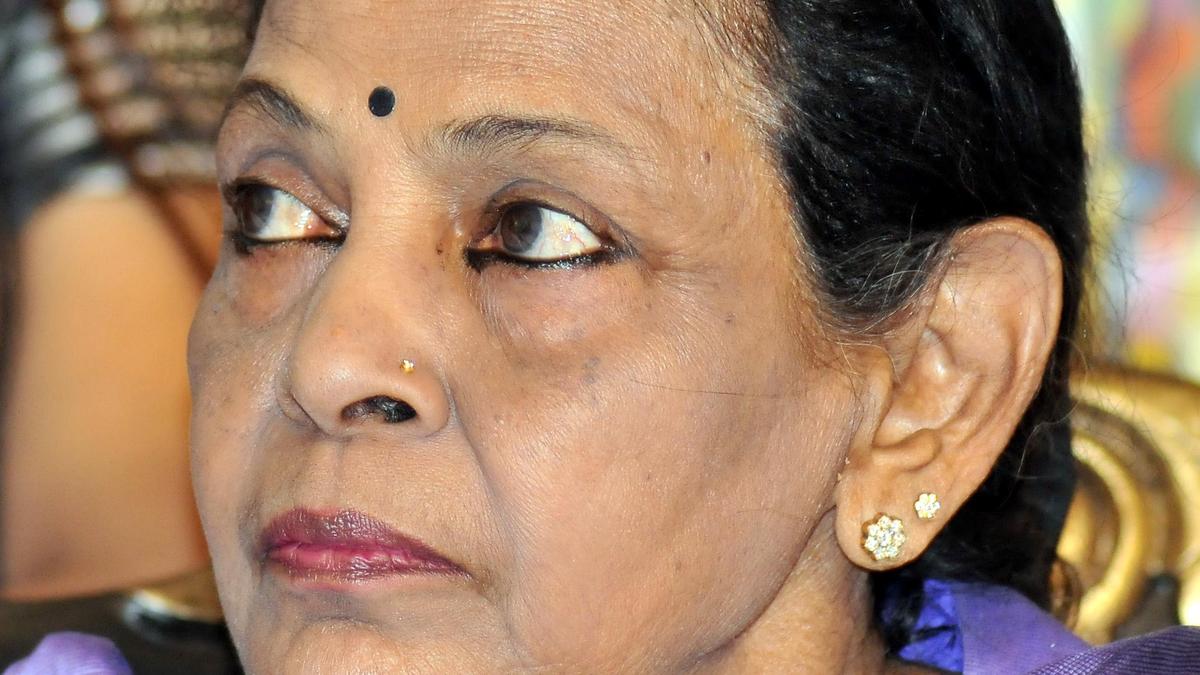

Jamuna Rani. File
| Photo Credit: The Hindu
Veteran playback singer Jamuna Rani, whose distinctive voice earned her a special place in South Indian cinema, died in Bengaluru on Thursday (July 30, 2026). She was 88 and was renowned for rendering thousands of songs in Tamil, Telugu, and even Sinhalese films during a career spanning several decades.
“She possessed a vocal range that could effortlessly match T.M. Soundararajan’s in the song Yaaradi Nee Mohini from the Sivaji Ganesan-starrer Uthama Puthiran. Composed in a Western style, it became a hugely popular number,” playback singer Mano, who performed with her in stage shows during the 1980s, told The Hindu.
Mr. Mano said Jamuna Rani’s voice combined a folk flavour, native idiom, and rhythmic vitality, allowing her to excel whenever she was given the opportunity. She worked with music directors G. Ramanathan, Viswanathan-Ramamurthy, V. Kumar, and other Telugu music directors. Her voice suited perfectly for well-known actors such as M.N. Rajam, Sowcar Janaki, and a lot of others who were not so popular.
Songs such as Kaalai Vayasu Kattana Manasu from Deivapiravi exemplified these qualities. While T.R. Mahalingam’s rendition of Senthamizh Thenmozhiyal became an enduring classic, Jamuna Rani was entrusted with singing its poignant version in the same film. Paattondru Ketten, Paravasam Aanen from Pasamalar, enriched by its chorus and humming, remains another unforgettable number. Her duet with comedian-singer J.P. Chandrababu, Kungumapoove Konjum Purave, continues to find new listeners among younger generations, while Mama Mama Mama is still celebrated for its infectious rhythm and folk flavour. Hers is one of the four voices in the song Athikai Kai Kai Alankai Vennilave. Aathimanithan Kathalukkupin that she sang with P.B. Srinivas is another memorable love duet.
Debut at age 7
Jamuna Rani made her playback debut at the age of seven with a song in the Telugu film Tyagayya. She also sang the child version of the popular song O Devadas in Devadas.
She entered the film industry at a time when playback singing was dominated by Jikki, P. Leela, M.L. Vasanthakumari, M.S. Rajeswari and A.P. Komala. Nevertheless, she carved out a niche for herself by rendering numerous songs for the celebrated Travancore Sisters, Lalitha and Padmini, besides singing duets with leading playback singers, including T.M. Soundararajan and J.P. Chandrababu.
Her career gained further momentum after she joined Modern Theatres. Blessed with a distinctive vocal timbre and remarkable versatility, Jamuna Rani remained one of the most recognisable playback singers of the 1950s and 1960s, and she continued to record a few songs into the 1980s. When composer Ilaiyaraaja conceived Naan Sirithal Deepavali for a nautch girl in Nayakan, starring Kamal Haasan, he chose Jamuna Rani and M.S. Rajeswari to render the song.
Although she entered the industry before P. Susheela, Jamuna Rani eventually found herself overshadowed by a new generation of playback singers. Yet her influence endured. In the expressive singing style of L.R. Eswari, one could discern echoes of Jamuna Rani’s vocal approach. She belonged to a remarkable era of Tamil cinema when melody and the expressive power of the human voice defined film music, and her songs remain an enduring testament to that golden age.
Published – July 31, 2026 11:16 am IST