










Last Updated:
Europe heatwave melts roads and traffic lights, strains hospitals and power grids, halts trams in Leipzig, and pushes war-hit Ukraine to restrict energy use.




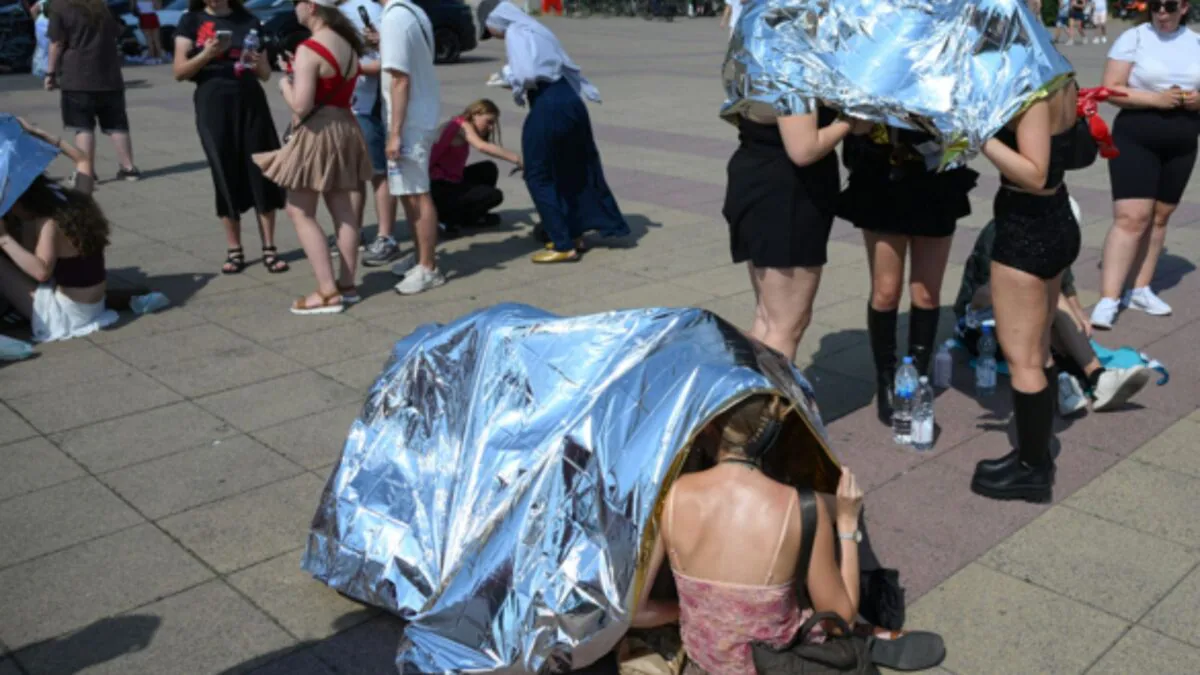
People use emergency blankets to protect them from the heat in Berlin. (Image: AFP)
As the heatwave in Europe continues to roast several parts of the continent, both citizens and their infrastructure are struggling to survive the scorching heat as videos have emerged of roads and traffic lights melting.
According to AFP, the heatwave has sent mercury to record highs and straining hospitals, transport networks and power grids on a continent where infrastructure was not built to withstand the punishing temperatures and where air conditioning is not widespread.
While the Berlin police resorted to water cannon to help residents cool off, the country’s transport network bore the brunt of the extreme heat.
In France, the asphalt is melting in the heat. A “heat dome” has been hanging over Europe for a week, and forecasters say temperatures will exceed 40°C in the shade in the coming days. pic.twitter.com/LMhZKbBjUY— распад и неуважение (@VictorKvert2008) June 24, 2026
According to DPA News, a section of the A2 motorway, which connects Berlin with western Germany, broke. “The A2 is continuing to break apart,” a police spokesman said on Saturday. “As a result, one interchange after another has to be closed.”
🇪🇺 – A record-breaking heatwave — which scientists call the worst ever recorded in Europe — is straining infrastructure across the continent as it pushes east into Germany and Poland.In the eastern German city of Leipzig, the transport authority suspended all tram service until… pic.twitter.com/fOuUczfLlR
— 🔥🗞The Informant (@theinformant_x) June 28, 2026
The German media also reported that some sections of the motorway in the Ziesar area, located in the eastern state of Brandenburg, have deteriorated so severely that vehicles can no longer travel safely across the surface.
📌 It’s so hot in Germany the Autobahn literally burst open at the seamsTemperatures have reached a record 42°C, causing tram tracks to buckle and forcing a complete suspension of tram services in Leipzig. Parts of the city’s bus network have also been affected by the intense… pic.twitter.com/dgGfe4CzuP
— Context 360 (@NewsContext360) June 28, 2026
In Germany’s Leipzig, the tram operations have been stopped as extreme temperatures affected asphalt and bitumen surfaces.
🇩🇪 Berlin found a use for its water cannons that doesn’t involve a protest.As the city baked through record heat, police rolled two of them out in front of the Brandenburg Gate, the same vehicles normally used to break up crowds, and turned them on the public as a giant cooling…
— Mario Nawfal (@MarioNawfal) June 29, 2026
In France, the heatwave has also affected critical infrastructure as reports emerged of melting roads, power outages and train delays disrupting daily life, according to France 24.
Several videos have also emerged of traffic lights, in Italy and Germany, melting.
Increasing Temperatures In Europe
Meanwhile, the United Nations health agency has reported that over 1,300 excess deaths were recorded in Europe since June 21. France has recorded 74 deaths due to drowning since June 18 and 17 drowned in Poland on Sunday alone.
According to AFP, the Balkans on Monday braced for temperatures of up to 40C, with firefighters in Bosnia battling blazes sparked during the heat.
Interestingly, Denmark, which had “plenty of grid capacity”, is also struggling. “Historically, Denmark has had plenty of grid capacity. That is no longer the case,” the climate, energy and utilities ministry said.
“In several areas, capacity is close to full use and demand for grid connections is growing faster than the planned expansion can keep up with,” it added.
War-Ridden Ukraine Now Battles Heatwave
Meanwhile, the heatwave that first smothered western Europe last week has now entered Ukraine, which is already struggling to survive amid war with Russia.
According to AFP, grid operators in at least five regions — from Ivano-Frankivsk in the west to Zaporizhzhia on the front line in the south — announced temporary restrictions on energy usage would be in force during parts of Tuesday.
“The heat is also a serious test for equipment that has been operating under wartime conditions for more than four years and has withstood numerous attacks,” Sergii Kovalenko, CEO of the Yasno energy company said over the weekend.
Read More