






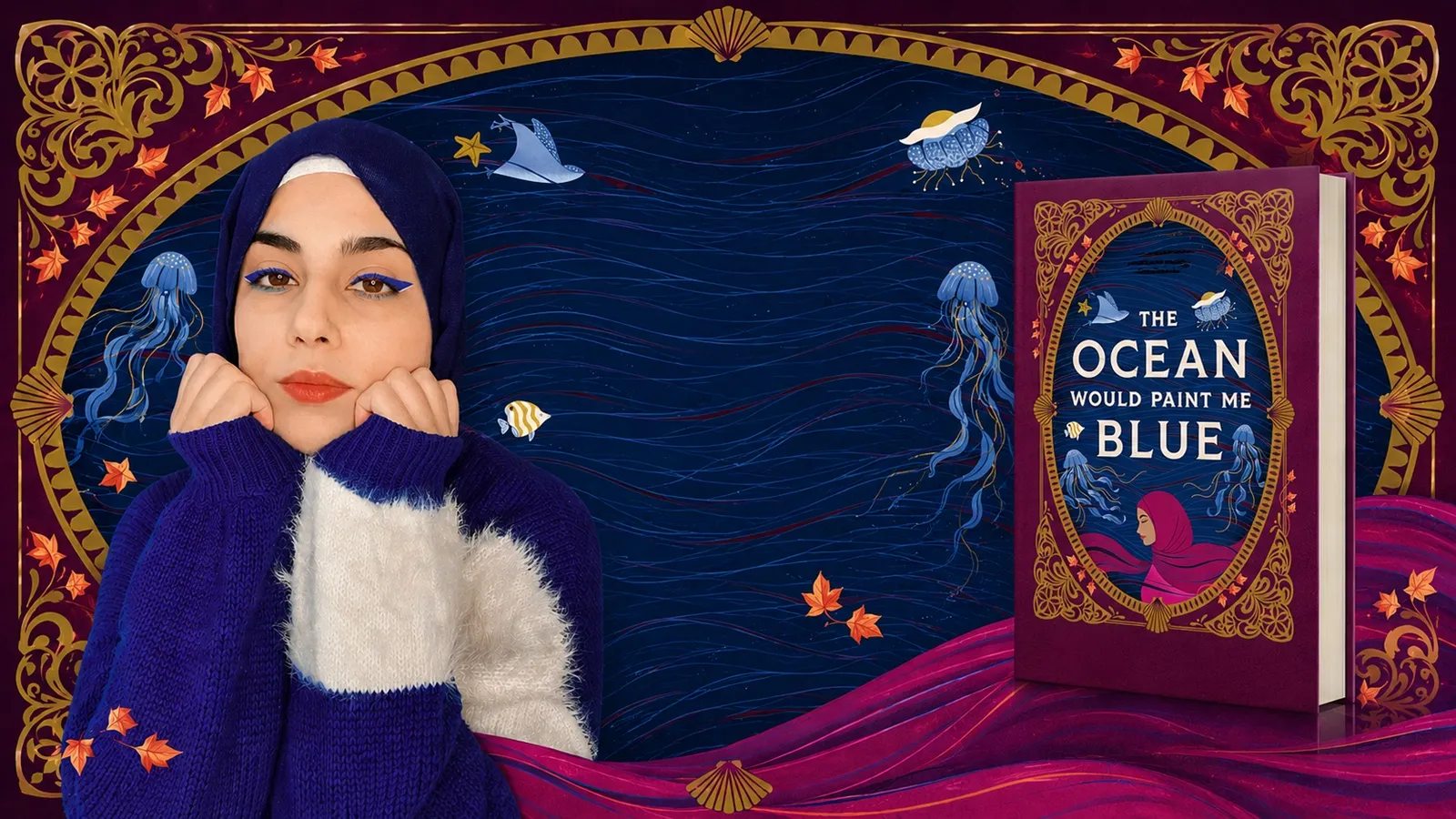
Zoulfa Katouh, a trilingual Canadian-Syrian pharmacist, never planned to become an author. She began writing stories as a way to push back against what she perceived as one-dimensional narratives pervasive about her community. Her debut novel, As Long As the Lemon Trees Grow, drew on the Syrian revolution to show the humanity behind the headlines. Now, with her second book, The Ocean Would Paint Me Blue (Bloomsbury YA, Rs 370), she sets a hijabi teenager named Jihad at the centre of an American prep school story. In a video conversation with indianexpress.com, Katouh, who was speaking from her home in Switzerland, talks about why fiction is as important as non-fictional accounts:
Your new protagonist is named Jihad, a word with a fraught reputation. Why did you make that choice?
The whole book exists because of this word. It came from a tweet I posted in 2019: “Why aren’t there more characters named Jihad?” In Arabic, this word has a beautiful meaning. It means to strive to be better, to exceed through hardship. Whenever we go through hardships, we are actually exercising jihad, that is just a human thing. I really wanted to show that meaning embodied in a 17-year-old girl.

So many of our Arabic words have been used against us and vilified in the media, and that creates a shame that shouldn’t exist in Muslims or Arabs. That is not fair, because that is not their meaning. Because in the end, the misunderstanding harms Muslims, but it also harms non-Muslims. We all live in these societies. We all want our countries to be the best they can be, and that means coming together and dispelling the hate that tries to tear us apart. So the book was always going to be about Jihad, her name was always going to be that.
Why do you think this particular word became synonymous with something dangerous in non-Muslim nations?
A lot has happened that blew this word out of proportion. Because of 9/11, which was obviously a horrible thing, the consequence was that
millions of Iraqis are dead. In the end, everybody has suffered, and 20 years later, we cannot really pinpoint a blame. But we can make it
better with books, with people speaking up. I’m really happy that (Zohran) Mamdani is mayor of New York…there are strides being made, and I think that’s what we should focus on. It is not me against you. We are all in this together, we all want to be happy, we all want our society to be the best. It is about opening our hearts and our minds to other people, other cultures, other ideas. You don’t have to accept all the information you are given, you can question things and grow from it.
You have said writing these books often comes from a personal need. What did The Ocean Would Paint Me Blue need to heal?
I really wanted to write it to heal the 15-year-old inside of me who never felt represented, or if I was, it was in the worst, most stereotypical way, where they take a small portion of the worst in our society and amplify it until it seems like everyone is like that. That is not fair. You have to show everyone in society. Obviously we have bad things, but we also have good things, and you should show both.
When you are always under attack, you grow up feeling apologetic. For a very long time, I felt like an apologetic Muslim, and was trying to make myself smaller in this world. It was only in my 20s that I thought: what am I doing? How can I live like this? I’m not hurting anyone. So with Ocean, I wanted to write for Muslim children who feel like they are skewing toward that same apologetic path and to tell them, no, you never have to feel like that. And for non-Muslim children, too, to feel proud of who they are.
The idea also came from BTS, they are a South Korean group who show so much of their culture and tradition in their music and how they dress.
Story continues below this ad
The title is optimistic and does not reflect the angst. How did you land on it?
I always like my titles to be a line from the book itself. Lemon Trees was a line in that book, and The Ocean Would Paint Me Blue is a line in a passage where my protagonist is reminiscing, dreaming of a future where she is not in the same place she is right now. It is very difficult to condense a whole book into a title. At first it was going to be called Colour Me Brave, but my editors came back and said that “colour” and “brave” are mostly associated with middle age, we needed something with more of a YA (young adult) feel. We were going back through the book, and one of my editors found the line “the ocean would paint me blue” and said, what about that? It just summarises the entire story. Even though it is a sad story, it is still a hopeful one as there is still happiness and hope in it. And that’s what I wanted the title to capture.
You trained as a scientist. Does that shape how you write?
Very much. I think a lot of people assume there is a big difference between the arts and the sciences. I disagree. I took one course in university called Arts and Medicine, where we analysed paintings and portraits and how physics and math played into them. It’s beautiful to think about creativity within the sciences, or within the body itself. You can think of your own body as a story: when you get sick, the virus is the antagonist, your body is the protagonist, and your white blood cells are fighting against it. There is a whole universe within yourself. There is a lot of common ground between the two.
How did a pharmacist end up becoming an author?
I had been dabbling in writing fanfiction and poetry. I never planned to be an author as I thought one had to study English literature. It did not really click for me until I moved to Switzerland and was learning German. People would introduce themselves in class, and I’d say I’m Canadian, I’m also Syrian, and I’m here for university. And then they would ask me if I was a refugee, because a lot of people there didn’t know what was going on in Syria, they were only seeing the consequences of the refugee crisis. So it was this very big difference in people’s awareness. For so long, Muslims were never really represented, and if they were, it was in the worst way. I was thinking about how to bring awareness. I wanted to write fiction because stories are the quickest way to get to people’s hearts.