








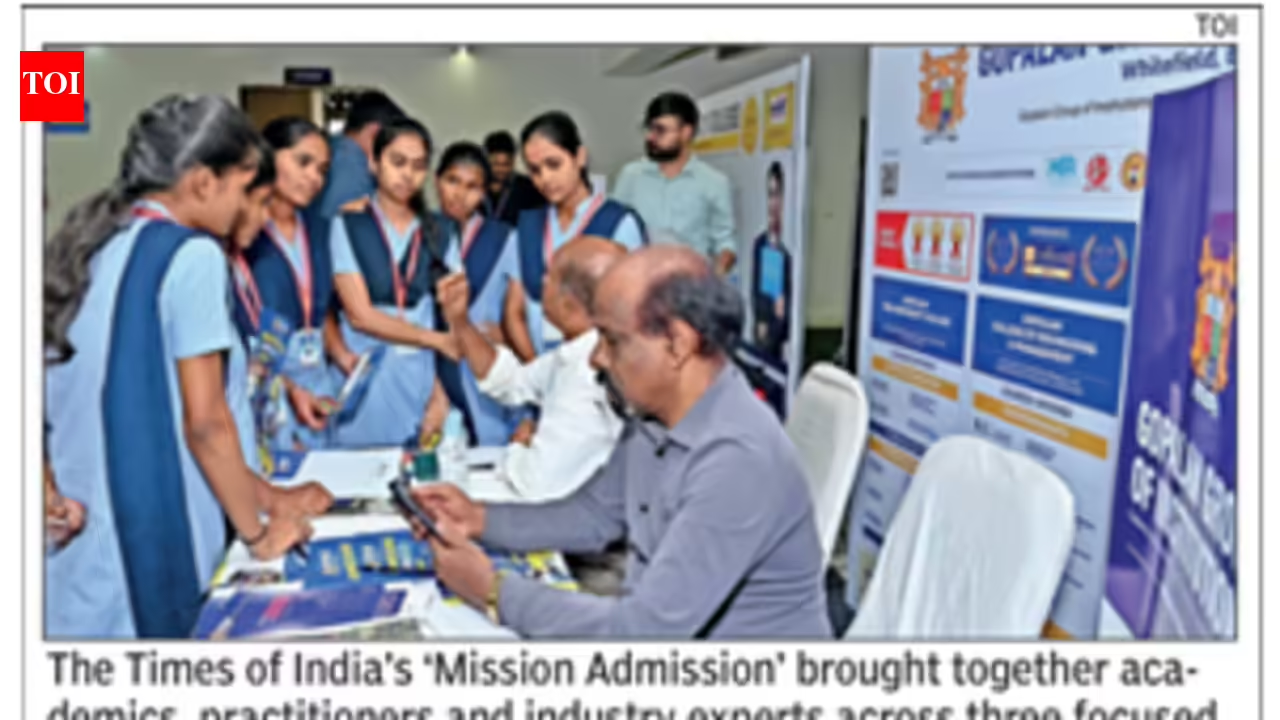
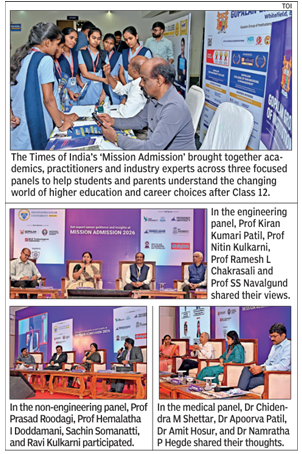
Hubballi: The Times of India’s ‘Mission Admission’ brought together academics, practitioners and industry experts across three focused panels to help students and parents navigate the changing landscape of higher education and career choices after Class 12.From engineering in the AI era to non-engineering streams and medical and allied health sciences, the sessions offered a practical roadmap for students to choose courses based on aptitude, opportunities and long-term career relevance.The engineering panel, moderated by Prof SS Navalgund, senior academic and research leader, examined ‘Engineering Education in the AI Era’. Prof Kiran Kumari Patil, director innovation and deputy director, School of Engineering and Technology, CMR University, Bengaluru, said employers now look beyond academic scores. “They ask what students have built and how they overcame challenges. In the AI era, physical distance between Hubballi and Bengaluru no longer matters as students have access to knowledge and opportunities everywhere,” she said.Prof Nitin Kulkarni, director, Student Hub for Innovation and Entrepreneurship, C-SHInE, KLE Technological University, urged students to collaborate with AI rather than fear it. “Students should pursue branches they are passionate about and integrate AI skills into their learning. AI is an enabler that helps solve real-world challenges and demonstrate productivity,” he added.Prof Ramesh L Chakrasali, principal, SDM College of Engineering and Technology, Dharwad, said exposure was no longer limited to metros. “In today’s ICT-enabled world, regional colleges offer strong infrastructure, labs and faculty, enabling students to compete confidently with peers anywhere,” he noted.The non-engineering panel, moderated by management faculty Ravi Kulkarni, focused on ‘Top Non-Engineering Courses for Future-Ready Careers’. Prof Prasad Roodagi, founder and director, Bright Business School, said engineering is now one among many options. “Bright students earlier gravitated mainly towards engineering, but today commerce, business studies and science streams also require strong talent,” he said.Prof Hemalatha I Doddamani, HOD, fashion and apparel design, KLE Technological University, said fashion careers have evolved beyond garments. “Today’s professionals are innovators and entrepreneurs working across product development, textiles, technology and sustainability. With AI, 3D design, smart textiles and e-commerce reshaping the sector, students have diverse career paths,” she explained.Sachin Somanatti, chief centre officer, Frameboxx, highlighted the expanding scope of animation, visual effects, gaming and comics (AVGC). “This sector now influences education, healthcare, marketing and design. With emerging tools like virtual production and digital twins, the future belongs to creative and innovative thinkers,” he said.The medical panel, moderated by Dr Namratha P Hegde, WeTiE convenor, TiE Hubli, explored ‘Medical and Allied Health Sciences Careers’. Dr Chidendra M Shettar, Registrar, SDM University, said medicine demands commitment and continuous learning. “Students should understand the reality of medical practice before choosing it,” he advised.Dr Apoorva Patil, consultant radiologist, said healthcare is a collaborative ecosystem. “Students should choose careers based on aptitude and purpose. Diagnostics plays a crucial role in improving patient outcomes,” she said.Dr Amit Hosur, consultant sports physiotherapist, said not securing MBBS or BDS does not end healthcare career prospects. “Allied health sciences offer meaningful and globally relevant opportunities in rehabilitation, diagnostics and patient care,” he said.Students and parents appreciated the seminar and also interacted directly with institutions at an expo featuring 13 universities and colleges.