










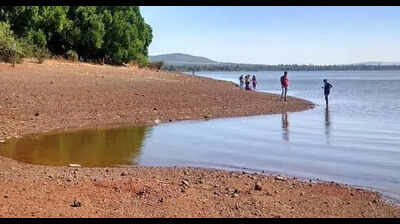
Belagavi: Rapidly depleting water sources across the district have raised concerns of an impending drinking water crisis, with rural areas already facing shortages due to the delayed monsoon. Water levels in key sources supplying Belagavi city and the surrounding regions have dropped sharply. The Rakaskop reservoir, the city’s main drinking water source with a capacity of 0.5 tmc ft, has storage to last barely 10 to 15 days.Belagavi city, with a population of around seven lakh, requires about 130-135 million litres per day (MLD) of water, sourced mainly from two reservoirs. Rising evaporation due to intense heat has accelerated depletion in Rakaskop and Hidkal reservoirs, raising concerns over supply sustainability.Rakaskop reservoir, with a capacity of 0.5 tmcft, currently holds less than 0.05 tmcft of water. Hidkal reservoir has about 6.8 tmcft, compared to 10 tmcft available during the same period last year.The water level in the Malaprabha reservoir at Savadatti has also been declining rapidly. The usable storage is about 5.9 tmcft. Water from Malaprabha caters to more than 40 villages in Savadatti and Ramdurg taluks, apart from Hubballi-Dharwad.Tanker water in rural areasWith sources drying up, tanker supply has become a lifeline in rural Belagavi. In several villages, especially in Athani and Ramdurg taluks, residents depend on daily tanker deliveries.Over 60 villages in the district are facing water shortages and are being supplied water from private borewells. The situation is severe in more than 30 villages across Bailhongal, Savadatti, Ramdurg and Khanapur taluks. Tankers and private borewells are supplying water to villages in 20 gram panchayats of Athani and Raibag taluks.Challenge before authoritiesEfficient management of the remaining water in the Malaprabha reservoir has emerged as a major challenge. An irrigation department official said a meeting will be held soon under the regional commissioner to decide on water distribution and drinking water management.Zilla panchayat CEO Rahul Shinde said helplines will be set up in every taluk and steps will be taken to ensure water supply based on local demand. Kiran Ghorpade, AEO of the rural drinking water and sanitation department, said alternative arrangements are being made to supply water to affected rural areas.TableReservoir Capacity Current level (as on May 31) Rakaskop 0.5 tmcft Less than 0.05 tmc ftHidkal 51 tmcft 6.8 tmc ftMalaprabha 37.73 tmcft 5.9 tmc ft