






Last Updated:
A bagless bin at an Aqua Line station sparked outrage — and exposed a city, and a country, that still can’t figure out what goes in the green bin versus the blue.




A colour-coded Metro bin with no bags inside — rendering its entire segregation system pointless — is Mumbai’s latest viral moment.
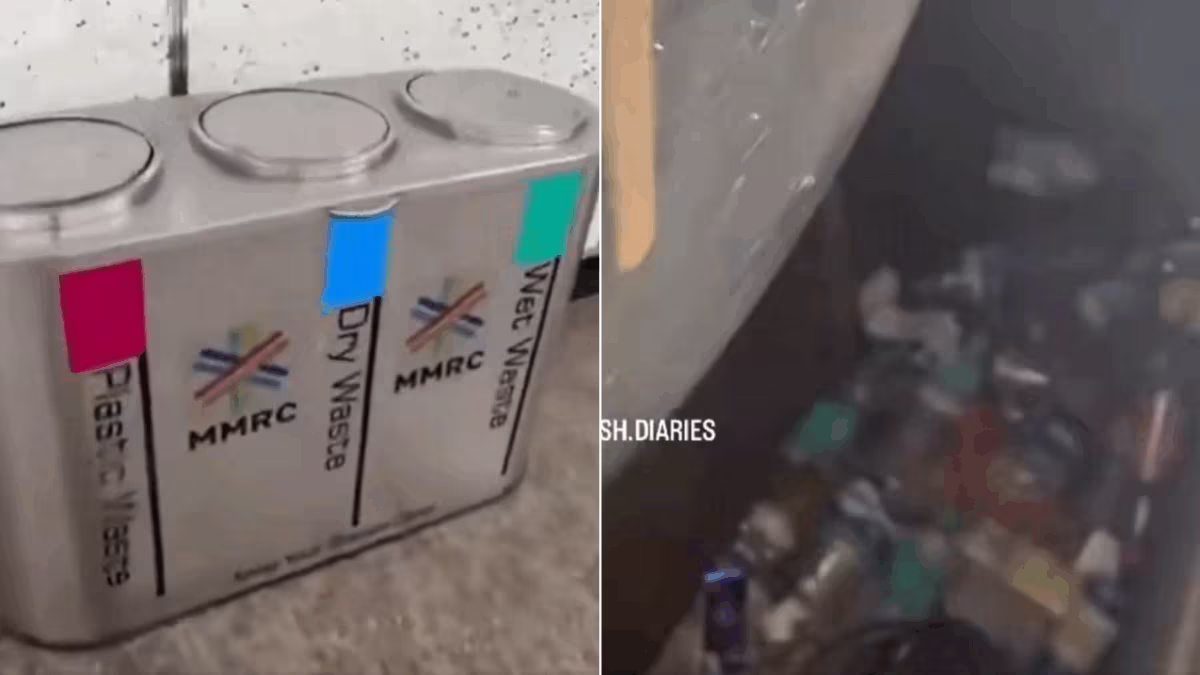
A 16-second video. A sleek, colour-coded dustbin. And absolutely no bags inside it.
That’s all it took for commuter Mohammed Futurewala’s clip from the Mumbai Metro’s Aqua Line to go viral — and for a thousand frustrated Mumbaikars to collectively nod in recognition. The bin, designed with separate colour-coded openings for different types of waste, was spotted with its designated coloured bags missing entirely, rendering the entire segregation system pointless.
Only in Mumbai Metro you will find three bin tops for the waste segregation with a single bin at the bottom..😂😂😂 pic.twitter.com/CCo9CnVlC8— Mohammed Futurewala (@MFuturewala) June 2, 2026
The Mumbai Metro Rail Corporation Limited (MMRCL) responded promptly on X, clarifying that the bin bags had simply not been placed that day and that instructions had been issued to the concerned team. Clean, clinical, corporate.
Thank you for highlighting the issue. Waste segregation arrangements are available at dustbins located at aqualine metro stations . In the instance shown, the designated bin bags were not placed in the dustbins, due to which segregation was not visible. Necessary instructions…— MumbaiMetro3 (@MumbaiMetro3) June 2, 2026
But the reactions told a different story.
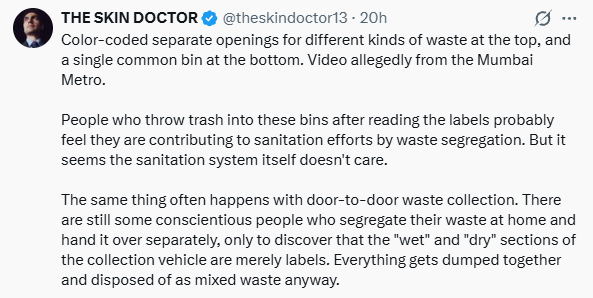
Skin doctor and commentator Dr. Cyriac Abby Philips pointed out that the bin had “colour-coded separate openings at the top and a single common bin at the bottom,” making even a technically functional bin a symbolic farce.
He added that the problem runs deeper — many conscientious households that segregate wet and dry waste at home only discover that the door-to-door collection vehicle mixes everything together anyway.
Veteran journalist Sucheta Dalal was more blunt: “Everything in India is cosmetic — no seriousness or understanding of the reason behind things.”
And X user @vinayaravind delivered perhaps the most Mumbai-coded take of all: “Every day I read something new and insane about Mumbai Metro. This is performance art.”
So What Are The Rules, Anyway?
India’s Solid Waste Management Rules have been through several iterations — 2016, and most recently 2026 — and the direction has always been the same: segregate at source. The new SWM Rules 2026, which came into force on April 1, 2026, make segregation compulsory for all citizens and institutions, with waste to be divided into four categories: wet waste, dry waste, sanitary waste, and special care (hazardous) waste.
The problem? Less than 50% segregation at source is recorded in major Indian cities, with continued dependence on old disposal methods.
A pilot study in Delhi-NCR found that only 14% of households segregated their waste before collection, with residents citing a lack of systems for segregated waste pickup and insufficient awareness about vendors who would collect it separately.
A striking 41% of non-segregating households cited the absence of fines or punishment as their reason for not bothering.
Mumbai’s own track record is a case study in good intentions meeting poor execution. The BMC has imposed fines on citizens for failing to segregate dry and wet waste — while its own workers have been caught mixing the very same segregated waste at dumping grounds.
In Mira-Bhayandar, the MBMC sent notices to around 7,000 housing societies to separate wet and dry garbage into two distinct bins, warning of stringent action including refusal to collect non-segregated garbage and cutting water lines of repeat offenders — yet only 40% of societies complied.
| Bin Colour | Waste Type | What Goes In |
|---|---|---|
| 🟢 Green | Wet / Biodegradable | Food scraps, vegetable peels, fruit waste, tea bags, garden waste, flowers |
| 🔵 Blue | Dry / Recyclable | Plastic bottles, paper, cardboard, metal tins, glass, wrappers |
| ⚫ Black / Grey | Non-recyclable / Inert | Dust, thermocol, rubber, old mops, hair, broken crockery |
| 🟡 Yellow | Sanitary / Domestic Hazardous | Sanitary napkins, diapers, medicine strips, broken bulbs, batteries |
| 🔴 Red | Hazardous (bulk generators) | Chemical waste, paint, e-waste, construction debris |
| Bin Colour | Hospital Waste Type |
|---|---|
| 🟡 Yellow | Human anatomical waste, microbiology and lab cultures, expired medicines |
| 🔴 Red | Contaminated disposables — tubings, IV sets, catheters |
| 🔵 Blue / White | Waste sharps — needles, syringes, scalpels, blades |
| ⚫ Black | Chemical and pharmaceutical waste |
| 🟢 Green | Kitchen and general food waste within the facility |
| Rule | BMC (Mumbai) | MBMC (Mira-Bhayandar) |
|---|---|---|
| Segregation required | Yes — wet, dry, hazardous | Yes — wet and dry minimum |
| Who collects | Door-to-door collection vehicles (separate for wet/dry) | Door-to-door sanitation workers |
| Bulk generators (societies >5,000 sq mt) | Must process wet waste on-premise via composting or bio-methanisation | Must segregate; non-compliant societies risk garbage collection being stopped |
| Penalty for non-compliance | Fines applicable; amount varies by ward | Water supply can be disconnected for repeat offenders |
| Garden / horticultural waste | Must be composted at source, kept unmixed | Must be kept separate |
The Bombay High Court has directed municipal corporations across Maharashtra to make segregation of wet and dry waste mandatory at source — across residential buildings, homes, hotels, and restaurants — calling it “the only way to address this issue.”
So Why Doesn’t It Work?
The Metro dustbin video isn’t just a Metro problem. It’s a systems problem. Citizens who do the right thing — rinsing that plastic bottle, keeping the onion peels separate — are frequently let down at the next link in the chain.
Experts caution that despite well-intentioned new rules, decades of weak enforcement and poor segregation continue to send large volumes of mixed waste to landfills, with towering garbage mountains in cities like Delhi standing as symbols of historical failure. Scroll.in
Until the bags are actually placed in the bin — metaphorically and literally — the colour-coding remains, as one X user put it, performance art.
About the Author

The News Desk is a team of passionate editors and writers who break and analyse the most important events unfolding in India and abroad. From live updates to exclusive reports to in-depth explainers, …Read More
Read More