The Russian missile strike on MV Golden Leo as it departed Ukraine’s Odesa port, killing four Indian seafarers, is the latest reminder that India’s merchant mariners are increasingly paying the price for conflicts far beyond the country’s borders.
While the latest tragedy unfolded in the Black Sea, it marks only the newest chapter in a series of attacks that have steadily expanded from the Strait of Hormuz to the Gulf of Oman and now into the Russia-Ukraine war, exposing one of India’s largest overseas workforces to some of the world’s most dangerous maritime corridors.
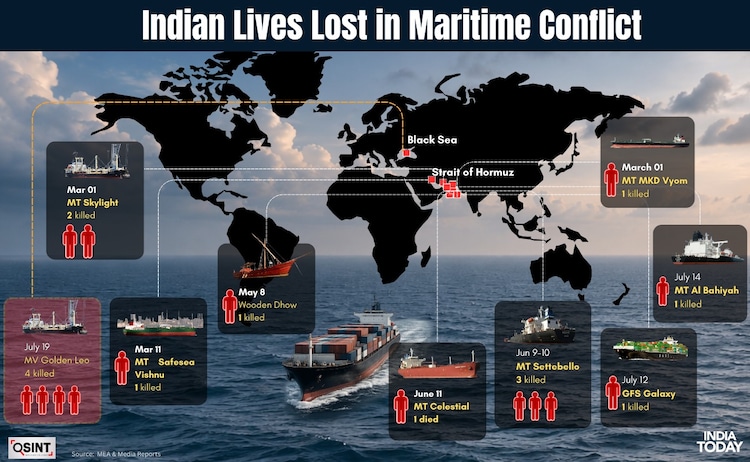
India Today’s Open Source Intelligence (OSINT) analysis of official government data, Ministry of External Affairs statements and media reports shows that 17 Indian seafarers have lost their lives in conflict-linked attacks on merchant shipping since the Iran war began.
CAUGHT IN THE CROSSFIRE
The latest strike in Odesa marks a significant shift. For Indian seafarers, the danger is no longer confined to a single theatre of conflict. As geopolitical rivalries increasingly spill into commercial sea lanes, merchant vessels have become unintended battlefields, placing thousands of Indian mariners on the frontlines of wars they have no role in fighting.
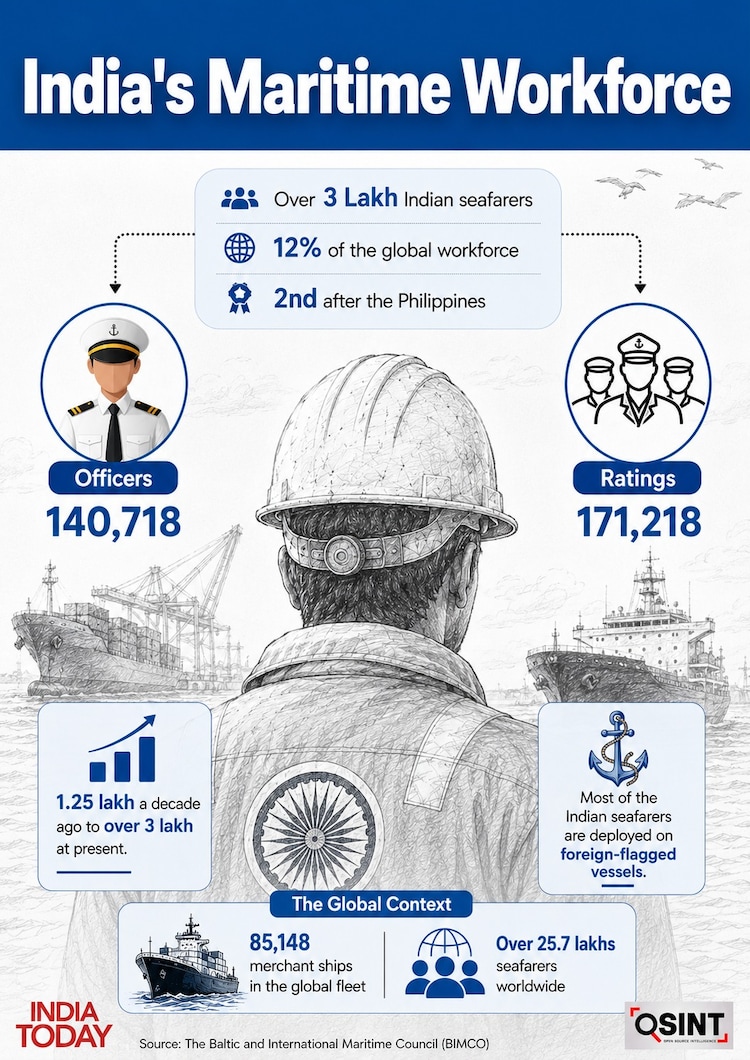
According to the Seafarer Workforce Report 2026, published by the Baltic and International Maritime Council (BIMCO) and the International Chamber of Shipping (ICS), India has more than 3 lakh seafarers, including around 1.41 lakh officers and over 1.7 lakh ratings (skilled workforce). The country accounts for more than 12% of the global maritime workforce and is the world’s second-largest supplier of merchant mariners, behind only the Philippines.
The first major loss came on March 1, 2026, when a tanker named MT Skylight was struck north of Khasab, near the eastern entrance of the Strait of Hormuz, during the opening weeks of the Iran conflict. The missile strike killed two Indian seafarers, with one dying immediately and another later succumbing to injuries after initially being reported missing.
Three months later, on June 10, the Palau-flagged MT Settebello was struck by US forces off the coast of Oman after Washington alleged the vessel had violated its maritime blockade targeting Iranian oil shipments. The attack killed three Indian crew members, making it the deadliest single incident involving Indian seafarers until the latest Russian strike.
The attack also triggered sharp diplomatic exchanges between New Delhi and Washington. In a post on X after speaking with US Secretary of State Marco Rubio, External Affairs Minister S. Jaishankar wrote:
“I reiterated India’s strong protest at the attacks by the US Navy in the Gulf that killed three Indian mariners. Such lethal actions against commercial shipping are not justified.”
According to the US State Department’s readout of the conversation, Rubio stressed:
“All commercial vessels should immediately comply with orders from US forces as they seek to uphold peace and security in the Strait. Violations of the US blockade and the illicit transport of Iranian oil will not be tolerated”
The violence at sea resumed despite a brief lull following the Memorandum of Understanding (MoU) reached between Washington and Tehran on June 17.
On July 10, however, MT MKD Vyom was struck while transiting the Strait of Hormuz, killing one Indian seafarer. Four days later, on July 14, the UAE-flagged MT Al Bahiyah and MT Mombasa came under attack near the Strait of Hormuz. One Indian aboard MT Al Bahiyah was killed, while nine other Indian crew members across the two vessels were injured, including two seriously.
The attacks continued through the renewed phase of the conflict. MT Safesea Vishnu was struck, killing two Indian seafarers, while GFS Galaxy was later attacked in Gulf waters, leaving one Indian crew member dead.
The graphic below by India Today maps attacks on Indian-linked merchant vessels between March 1 and July 21, illustrating how commercial shipping has increasingly become entangled in regional and global conflicts.
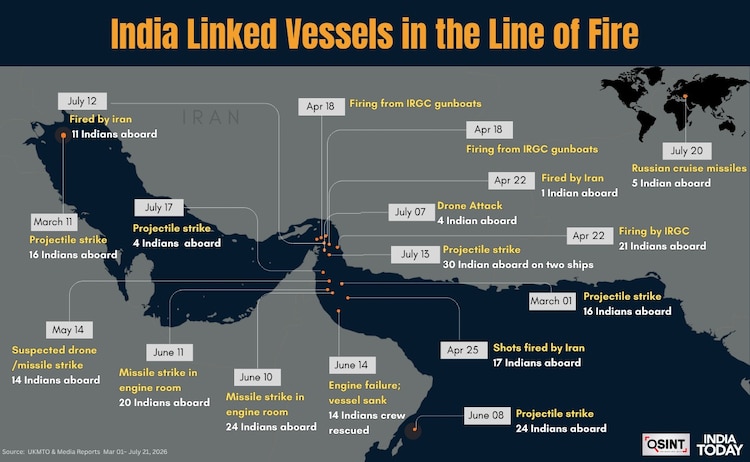
The incidents include Indian flagged vessels, India-bound ships, and foreign-flagged merchant vessels carrying Indian seafarers. During the period, at least 19 such vessels came under missile, projectile, or drone attacks, armed harassment, warning fire, or were caught in conflict-related incidents, including the Russian strike on the port of Odesa on July 19. Together, these incidents placed thousands of Indian seafarers at risk far beyond the country’s shores.
The repeated attacks have prompted a broader response from New Delhi. The Ministry of Ports, Shipping and Waterways launched the “Seafarer First” initiative, directing vessel-by-vessel monitoring, appointing dedicated liaison officers for affected families, and creating a real-time operational dashboard to track Indian seafarers operating in the Persian Gulf, Strait of Hormuz and the Gulf of Oman.
The government also directed that every Indian seafarer in the affected region be individually accounted for, irrespective of the vessel’s flag, while coordinating closely with the Ministry of External Affairs, the Indian Navy and Indian missions overseas.
– Ends