








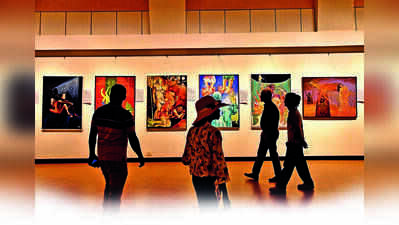
Ahmedabad: Forget stocks, gold, and real estate. Some of the hottest returns of the past year came from the canvas. Prices of works by India’s top 25 artists surged 97% in 12 months, pushing the IIMA-Aura Art Indian Art (Price) Index (IAIAI) from 3,091 to a record 6,078.Put simply, a Rs 1 crore Husain or Raza bought a year ago would be worth about Rs 2 crore today. The index is the brainchild of IIMA’s Prof Prashant Das, and Rishiraj Sethi, director of Mumbai-based Aura Art Development. Launched in Nov 2022, it is built on auction data since 2000. And in a quarter-century of records, there hasn’t been a year like this one.In April, vaccine magnate Cyrus Poonawalla acquired Raja Ravi Varma’s painting ‘Yashoda and Krishna’ for a record-breaking Rs 167.20 crore, the highest price paid for an Indian artwork. At Christie’s last month, the Goodricke Camellia Collection fetched £18.9 million (around Rs 242 crore), a house record for South Asian modern art. It included works by Bengali masters Ganesh Pyne and Abanindranath Tagore. In Sep last year, V S Gaitonde’s work was sold for Rs 67.08 crore ($7.6 million), the highest price commanded by the master painter.Industry experts do not see these as mere figures in isolation. They see the arrival of Indian art in the high-end market, both at home and internationally. The index’s climb broke its previous record of 5,587, touched just two quarters earlier. “It is one of the sharpest surges since the start of the index that has auction and artist data since 2000,” said Prof Das. The index tracks 25 leading Indian artists across generations, from Jamini Roy and S H Raza to Anjolie Ela Menon and Manu Parekh.“The returns are higher than those from several conventional investments. However, the last year was a particularly good one for Indian art. The compound annual growth rate comes to 21.8% in five years, 10.9% in 10 years, and 3.5% in 20 years, indicating short-term trends dramatically outpacing long-run trends,” he said. “Average year-on-year returns over the past decade and past two decades stand at 10% and 11.8% respectively.”What it took to get hereSethi traced four distinct phases of the Indian art market over the past 25 years. “The first phase was from 2000 to 2006/2008. Even before 2000, Indian art auctions were held outside India, but the volumes were too small to draw meaningful long-term conclusions. The early 21st century saw the creation of a secondary market and a secular bull run in art, alongside other asset classes. The IAIAI rose 32 times in six years, driven further by aggressive buying from art funds around 2006. Indian art prices peaked before the financial markets, but the global financial meltdown of 2008 eventually burst the bubble,” said Sethi, who is also a chartered accountant and a chartered financial analyst.The second phase, from 2008 to 2011, played out in the shadow of the financial crisis, when the index saw as much as 67% drop over several years. The third phase, from 2011 to 2022, was one of steady consolidation, with the index creeping upwards even as wealth creation in the economy grew at a much faster pace.“We are in the fourth phase, where there is a major boom,” said Sethi. He sorts art buyers into three categories: consumers, first-time buyers who buy art to decorate their homes and offices; collectors, the largest group, who have developed a love for collecting; and investors, who treat art more as an asset class while still developing a finer sensibility. “All three categories have seen a huge growth in post-Covid India,” he said, pointing to a matching boom in luxury and ultra-luxury real estate for high-net-worth individuals, and a greater appreciation of and awareness of art.The rise in pricing, he noted, has been disproportionate. The highest price for a painting rose from Rs 10 lakh in 1992 to Rs 26.9 crore in 2015. This year, it crossed Rs 167 crore.“For once, we are unable to keep up with the demand for Indian art, and international auction houses are joining the bandwagon, giving South Asian art greater representation in their sales,” said Sethi. “Demand from NRIs has been rising for some time. Now, with individual works crossing the $10 million mark, Indian art merits a place on the radar of larger global family offices, which have deep, long-term exposure to this asset class.”Why the index and what it signifiesTo outsiders, art prices may look arbitrary, but that is not the case, experts say. Das compares a Husain with a real estate project: property rates in an area may eventually stabilise, because when demand is high, developers simply build more. “But is it possible to create another painting by M F Husain?” he asked. “Thus, chances are high that the price of a painting will not go down.”IAIAI provides a systematic understanding of price movements to guide investors and collectors. Its first dataset covered 9,000 artworks by Indian artists auctioned at 11 global auction houses over two decades, with the top 25 artists serving as a market benchmark. The research considered factors ranging from demand trends over 25 years to auction records, subject matter, and medium, drawing on benchmarks such as the Mei Moses Art Indices. “We intend to add more artists to better represent the expanding Indian art ecosystem,” said Das.
IAIAI provides a systematic understanding of price movements to guide investors and collectors. Its first dataset covered 9,000 artworks by Indian artists auctioned at 11 global auction houses over two decades, with the top 25 artists serving as a market benchmark

Views from inside the art world
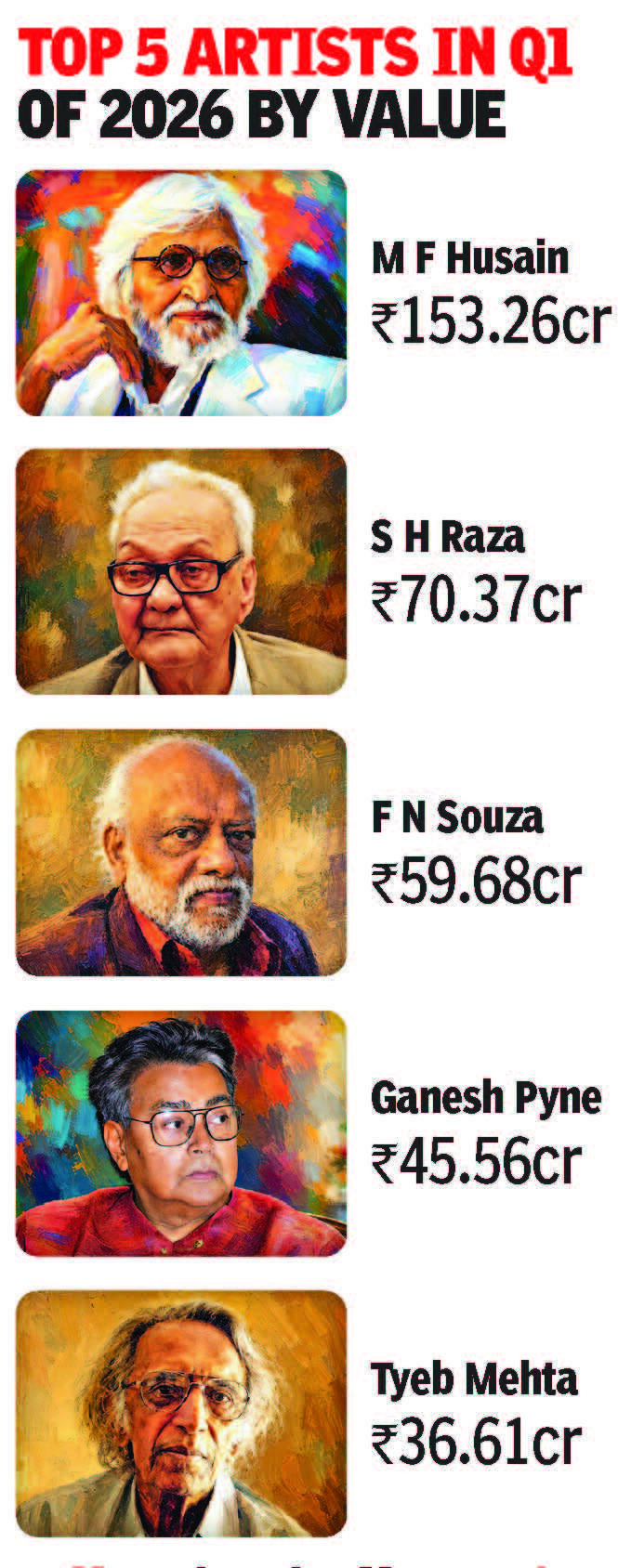
What sets the price– Physicality: 60% (area, medium, base, type: sketch vs others) – Artist identity: 20%– Marketing: 8% (auction house, seasonality, title of work)– Artist attributes: 7% (representative work, primary medium, artist age, Padma award, death, popularity)Other: 5% (subject, style)*Based on Prof Prashant Das’s analysis of hundreds of auctionsFinding the sweet spot– Oil as a medium fetches the highest price, at a 2X factor, compared to 1.3X for tempera and acrylic, and 1X for ink, gouache and watercolour, among others– Realistic style fetches the highest price at 2.7X factor followed by abstract, figurative, and still life– Mythological subjects are preferred the most, fetching 1.8X factor followed by landscape, popular, legendary personality, religious/spiritual, and portrait. Nudes are least preferred– The death of an artist is a major factor in relative pricing, lifting prices by as much as a 2X, followed by Padma awards, the artist’s age and primary mediumDeals in Q1 of 2026-Tyeb Mehta, Ganesh Pyne, and S H Raza were the top three artists in terms of total artwork value -V S Gaitonde slipped to sixth place on a marginal basis, suggesting that other artists commanded relatively stronger price premiums during the quarter – Sotheby’s, Pundole’s, and Christie’s were the top three auction houses in terms of total artwork sold. Pundole’s moved up from fourth to second place this quarter, indicating a stronger quarter for the auction house– Rs 477 crore (approx. $53.5 million): Value of 183 artworks sold at auction in Q1 2026, when the index reached its record high– Rs 47.12 crore (around $ 5.28 million) was the highest and winning bid for Husain’s oil-on-board painting at Sotheby’s. It was followed closely by Rs 36.61 crore for Tyeb Mehta’s oil-on-canvas at Christie’s, and Rs 23.14 crore and Rs 20.89 crore for two tempera works by Ganesh Pyne at Christie’s– Rs 2.61 crore (approx. $ 0.29 million) was the average price per artwork across all auction houses for the quarterInformation source: IAIAI