


Architecture is far more than shelter. It has always been implicated in the consolidation of power, acting as the physical apparatus through which regimes mark thresholds and dictate visibility. Leaders have long weaponised monumentalism and territorial redesign to turn urban fields into vessels for political narrative. From Haussmann’s strategic overhaul of Paris to Mao’s ideological remaking of Tiananmen Square in Beijing, history shows a recurring ambition to reorder space until authority becomes palpably legible.
This structural control executes what the French philosopher Jacques Rancière, a theorist of political aesthetics, called the “distribution of the sensible”. Through such governing of self-evident facts, the state defines the very perception of space. In the contemporary megacity, this exercise of power has evolved from the weight of stone to the pixels of the screen, as regimes deploy both physical intervention and high-fidelity visualisations to permeate public life. This is the architecture of “post-politics”—a condition in which technocratic management and polished visuals replace genuine ideological contestation. Here, the messy friction of debate is bypassed in favour of a doctored consensus.
By mass-circulating architectural renderings—glamorous images that capture a project’s curated best while the foundation is yet to be poured—officebearers pre-empt a visual future. These renderings allow leaders to stake claims not only on the architecture but on authorship over the future itself, asserting a finished narrative before the complex democratic mechanisms required to produce it have run their course.
Regimes use these renderings to seize “political time” and occupy the public imagination. Today, generative AI accelerates this process, flooding the collective consciousness with hyper-realistic hallucinations that blur the line between a plan and a fait accompli. As these images spread through campaign materials and digital platforms, a manufactured familiarity takes root. This transition institutionalises an urbanist iteration of the Thatcherite TINA (”There Is No Alternative”) paradigm. Under this logic, by the time a building finally breaks ground, its politico-economic value has already been produced and harvested. The contest over space migrates from the ground to the mind, a careful orchestration of perception in which a curated future is staged as the only inevitable reality.
In the age of the audio-visual, architectural renderings have moved beyond their role as technical blueprints to become political instruments. Operating as a unifier that bypasses language barriers, these images thrive within a global visual culture where a projected future often carries more weight than present reality. This is captured by the Indian adage “jo dikhta hai vo bikta hai” (what is seen, sells), indicating a marketplace where visual appeal dictates viability.
This visual-first approach takes on Western philosophical traditions, such as the belief that once you put a name to something, you can talk about it, by suggesting that, in the domain of power, one must first show the dream before dialogue can begin. By saturating the public consciousness with these idealistic digital landscapes, political agents ensure that their vision increasingly monopolises the viewer’s imagination.
A documented record of speed
Few projects in contemporary India demonstrate the merger of visual circulation and statecraft more clearly than the redevelopment of the Central Vista. It provides a documented record of how major institutional projects move quickly from bulletin to form.
Announced in September 2019, the programme entered the public domain through photorealistic renderings of a new parliament and secretariat buildings. Throughout 2020, environmental submissions, land-use notifications, and heritage committee reviews moved through regulatory bodies even as legal challenges proceeded through the courts. Critics noted that the conditions under which the project was initiated departed from the conventional pacing of projects of this magnitude. The design consultancy was awarded in about six weeks under eligibility thresholds that, critics argued, were unusually restrictive, conflating urban design and architecture in a single tender without prior heritage audits or a publicly exhibited vision. Such accelerated timelines, they said, deplete public judgment.
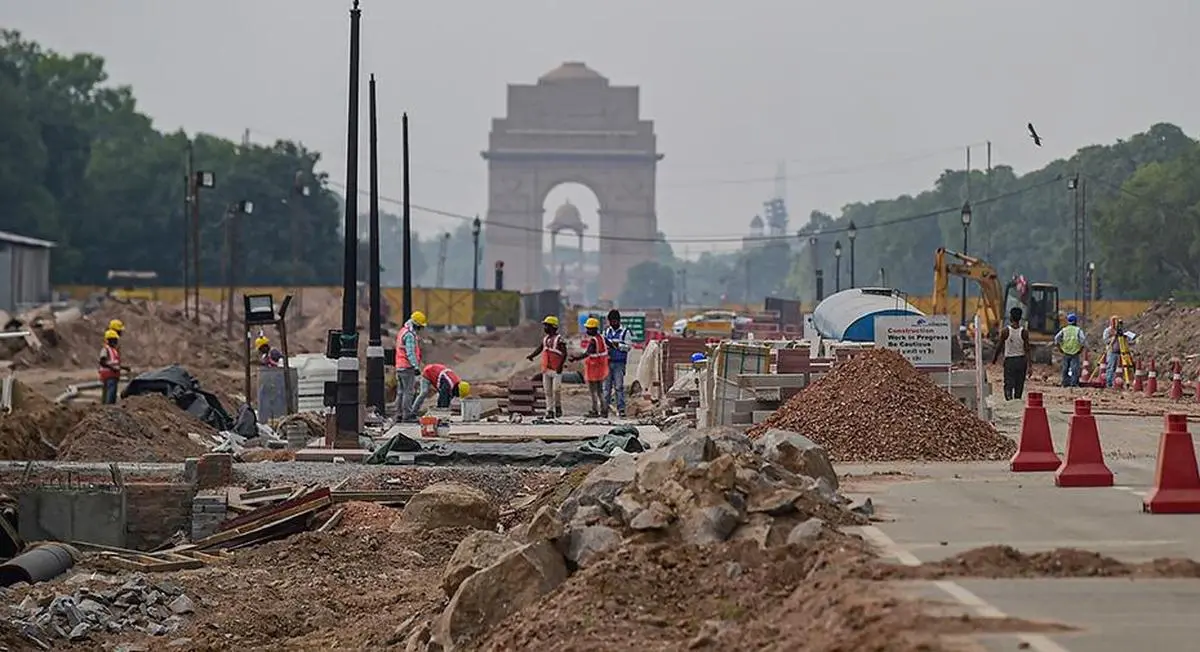
Construction work underway as part of the Central Vista Redevelopment Project at Rajpath in New Delhi on May 6, 2021.
| Photo Credit:
KAMAL KISHORE/PTI
Presenting projects as incontrovertible spectacles rather than open proposals frames the marketed material as conclusive. This masks deep procedural complexities, shifting the burden of reconciling technical resolutions with sensational imagery onto the project teams alone. The mass production of such visuals has hardened into a standardised mechanism deployed to condition public acceptance, furthered by a blurring of the boundary between projected vision and physical reality.
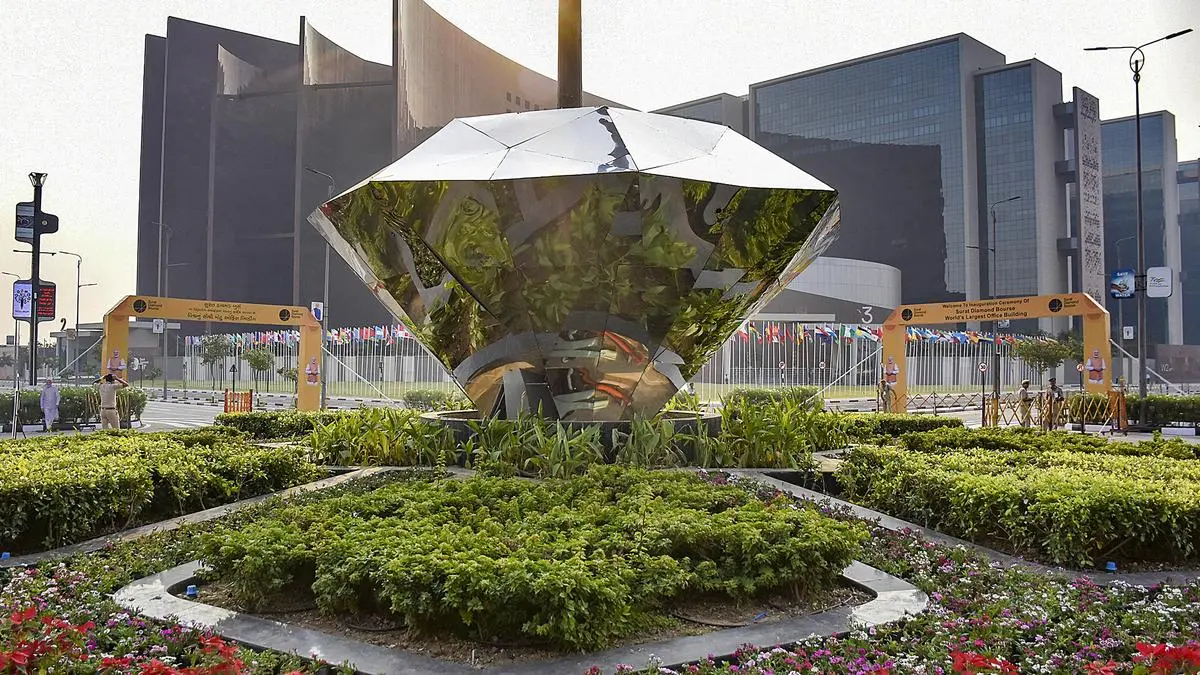
High-profile projects across India increasingly exemplify this strategy of using “hyper-visible” futures to bypass democratic oversight. Visual projections of the Ram Temple and the Statue of Unity functioned as pre-emptive occupations of the national landscape—claiming symbolic victory even where the material reality, such as the latter’s Chinese-cast bronze cladding, sat awkwardly against the nationalist rhetoric. The same aesthetic drove the promotion of GIFT City and the Surat Diamond Bourse, where vast compositions of glass and steel projected narratives of global modernity.
Collectively, these cases reveal a reliance on visual presence to consolidate majoritarian narratives and suppress critical engagement. The visual impact is then amplified by a rhetoric that frames everything from “clearing the site” to the rise of the “world’s tallest statue”, “India’s first operational smart city”, and the “world’s largest office complex” as singular triumphs.
When the spectacle outpaces the scaffolding
While those projects exemplify the use of visual finality, one in Surat stands as a warning of what happens when the spectacle outpaces the scaffolding. The Surat Diamond Bourse is among the most obvious testaments to the deceptive potency of the architectural rendering. Images of the complex once saturated the national consciousness as sweeping aerial compositions, framing it as an inevitable global trading hub.
While that aesthetic projected a high-gloss vision of a financial fountainhead, the project remains today as an “eerily quiet” hub. Of more than 4,700 offices sold, fewer than 250 were in use by August 2025, according to a bourse official cited by Reuters; the industry has largely resisted abandoning the established networks of Mumbai’s Bharat Diamond Bourse for this manufactured outpost. While the rendering may have smoothed over market complexities, the reality has proven far more stubborn.
The failure of the spectacle is rooted in a disconnect between the hyper-modern image and a volatile global landscape. Since its 2023 inauguration, the Bourse has been buffeted by a combination of pressures: weak Chinese demand, the disruptive surge of lab-grown diamonds, and steep US tariffs that have stifled export demand. Marketed as a one-stop hub designed to eclipse a cramped Mumbai, the Bourse’s efforts to force a migration—including offers to those who shuttered their Mumbai operations—have faltered. Firms that briefly moved to the new facility soon retreated to Mumbai, citing an absence of essential ecosystem facilities, from reliable transport to medical infrastructure.
The Bourse has become a study in high-fidelity marketing that sold a premium, frictionless future while neglecting the foundational infrastructure required to sustain it. The project relied on the sheer weight of its visual presence to manufacture a sense of arrival, only for the polished facade to fracture when confronted by the unrendered realities of logistics, human necessity, and market trust. The word “bourse”—derived from the French for “purse”—suggests a vessel for holding value; in Surat, the purse has been built with a false bottom, leaving the industry with a spectacle that is, quite literally, empty.
The discipline of the image
The rendered visualisation must, therefore, be read as an instrument of affective governance that engineers public endorsement. The real force of the rendering now lies less in whether the project succeeds materially than in how the image nests political feeling. The digital certainty of these renderings does more than project a future; it disciplines the present. By choreographing public desire through superlatives—the “tallest”, “largest”, “first”—renderings frame criticism as a hindrance to destiny.
While projects such as the Statue of Unity and the Ram Temple have drawn millions and functioned as logistical successes, their architectural life began as an insular render. That success is precisely what makes the rendering so potent: it creates a sense of finitude. Once a citizen is recruited to emotionally endorse the “finished” vision, the dissenter is cast as an obstacle, positioned against the momentum of national progress.
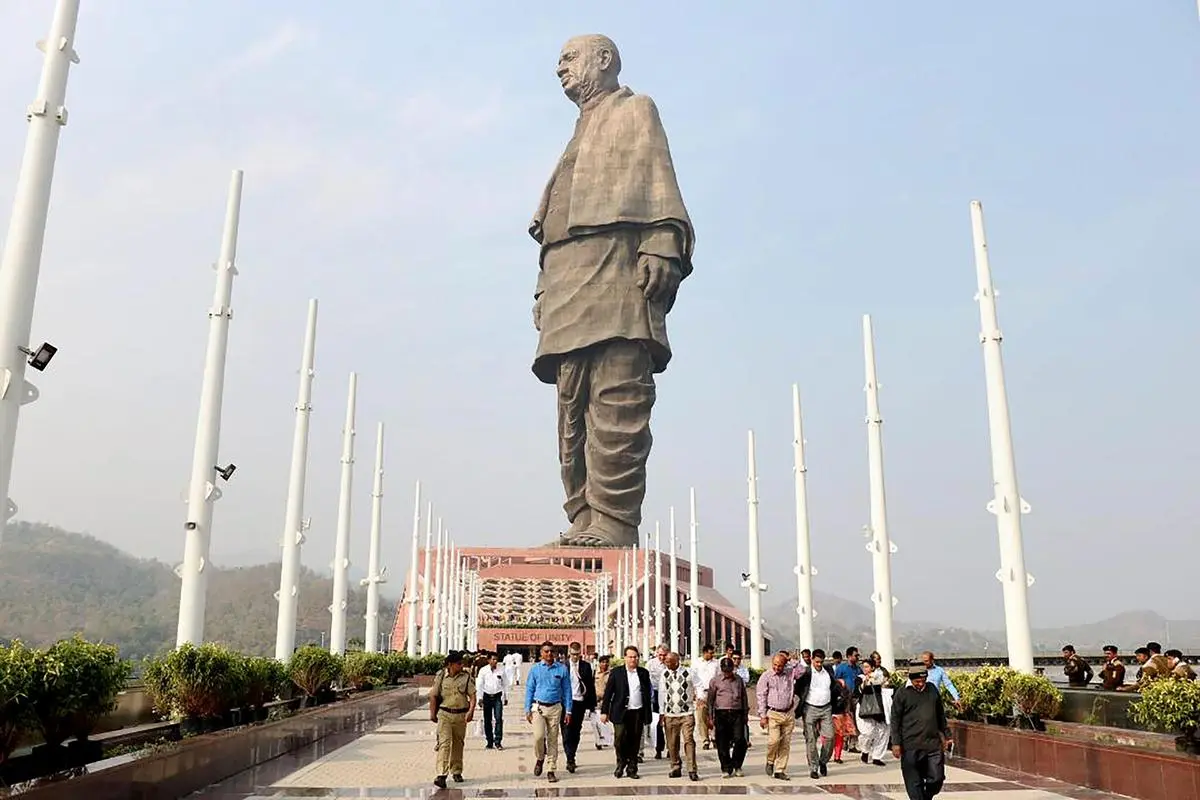
The Statue of Unity at Kevadiya in Narmada district.
| Photo Credit:
PTI
This persuasive force relies on photorealistic renderings acting as digital filters that scrub away the social frictions of the Indian city. Informal vendors, traffic congestion, and security barricades vanish. In erasing the working bodies of delivery riders, sanitation workers, and street hawkers, the rendering performs a visual eviction, condemning the existing city as a flawed draft to justify the erasure of the living reality it seeks to replace. Nowhere is this erasure more visceral than in the recent environmental record of the Central Vista.
The renderings promised a verdant, sustainable future that has failed to take root in the soil. Where the original avenues were defined by the shade of fruit-bearing jamun trees, the new regime of transplantation has proven fatal. Mirroring a pattern seen across the country, 43 per cent of the trees transplanted for the project—1,545 out of 3,609—had perished, the Union government told the Lok Sabha in April 2026. The digital image offered a preview of green growth but delivered an ecological vacancy. These jamun trees, which held decades of collective memory and use, have been replaced by a technocratic logic that cannot survive the sun.
Decolonial speed and democratic depth
The appeal of this visual acceleration is derived from a real exhaustion—a public weariness born of slow drift and deferred civic promises. Proponents of rendered visualisations argue that such spectacles are necessary to break the lethargy of India’s post-colonial latency. From this perspective, the rendering is a reclamation of power—a way to “show something to get the process started” and announce a departure from a bygone-era inertia. The urge for this visual haste does not emerge from a vacuum. For decades, Indian citizens have lived through a file culture in which vital infrastructure languished in bureaucratic purgatory.
The risk, however, is in mistaking decolonial speed for democratic depth. When technical rigour—the work of the surveyor, the ecologist, and the engineer—is rebranded as mere delay, the state could be trading one form of colonial-era distance for another: a technocratic visual order just as removed from situated context. This produces a systemic strain that treats technical integrity as another obstacle to political delivery. Even as the state aims for a decolonial leap, the professional ecosystem—the collective labour that verifies, measures, and builds—is increasingly obscured, forced to navigate the fallout of decisions made at the speed of a reel.
The trend is intensified by AI-assisted visuals, which fuel a speed fetish that prioritises the immediacy of the output over the veracity of the material. Architectural authorship once functioned as a public ledger of responsibility—a lineage of accountability etched into foundation stones and plaques from Joseon Korea to 19th-century London and India’s early public works. Today, this tradition of traceable skill is being anonymised by state-driven imagery that outpaces the collective hand. As projects are premiered through high-fidelity simulations, the social and historical record of authorship dissolves, replaced by a “universal” and detached aesthetic.
Architecture and urbanism require the duration necessary to measure, verify, and revise—the time that ecological systems need to regenerate and materials need to reveal their limits. The rendering folds these durations into a single, flattened moment. Whatever the intent, the result creates violations in many ways, especially in the processes through which environments acquire social meaning. When professional practice is sacrificed for the speed of the spectacle, the resulting architecture risks becoming structurally or socially insolvent, leaving a gilded facade over systemic fissures.
Built slowly, lived in over time
This represents a crucial pivot in statecraft. When Edwin Lutyens was commissioned to design New Delhi in 1912, he used a language of imperial authority. Its democratic legitimacy was forged only decades later, through repeated social sedimentation. With Independence, the landscape underwent a metamorphosis. Republic Day parades and everyday interactions substantiated the transition from colonial capital to democratic republic.
Architecture commissioned under one regime was reclaimed to support the political life of another, deriving legitimacy from the gradual layering of shared public experience. The Indian public reclaimed it after 1947 through parades, protests, and daily life. It became democratic because it was lived in over time.
As a counterpoint to contemporary lures, this historical capacity of citizens to transform a space through use sits against today’s obsession with decolonial speed. While proponents argue that India must build rapidly to outpace colonial-era inertia, the rush for a finished look ignores the fact that democratic meaning must be grown, not merely rendered. More meaning comes from engaging with place over seventy years than from how fast one can render a bhavya (grand and imposing) 3D model.
Jan-Werner Müller, the Princeton political theorist whose work on populism describes how movements claim a monopoly on “the real people”, argues that true legitimacy cannot be manufactured. The case for “taking back power” by outpacing colonial-era inertia is a potent one, but it mistakes a finished image for a finished republic. The Republic, in its truest sense, is built slowly. While the state-driven rendering attempts to bypass this temporal requirement, architecture matures into a public asset only through prolonged exposure to space and time—a process no prognostic image can simulate.
The crisis, then, is not simply aesthetic manipulation but the replacement of democratic duration with visual manoeuvring. The weaponisation of the architectural rendering is, at its core, an evasion of accountability and a clutch at power. A republic cannot be built in a preview mode that is visually perfect yet democratically hollow; while the rendering tries to bulldoze the complexities of lived reality, it cannot replace the unscripted urbanism that sustains lives. To truly stick to the plan is to anchor our foundational processes in the equity of collective labour and to refuse to trade shared agency for momentary virality. If we must render, let us render a future that is not a finished image but an open conversation.
Isha Riza Khan is an urban specialist, trained at the University of Southern California, Los Angeles, and the University of California, Berkeley.
Also Read | Death of an edifice
Also Read | Sheeshmahal to shockmahal