




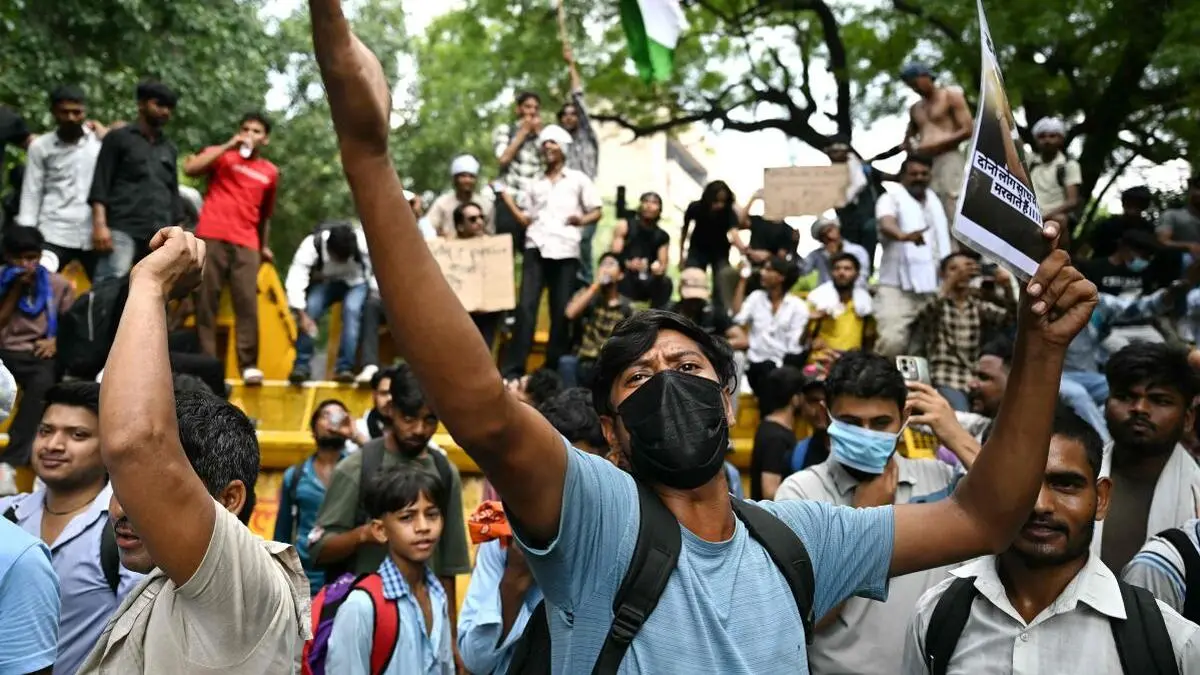
The unprecedented outpouring of youth anger on the streets of the national capital on July 20, when thousands of young protesters almost reached the gates of Parliament, braving lathicharge and tear gas from the police, has had a marked impact on proceedings inside the building—more so since it coincided with the opening day of the Monsoon Session of Parliament.
In the run-up to the session, there was intense speculation over the government’s agenda, with the focus on the BJP’s efforts to revive the Constitution (131st Amendment) Bill as the ruling party worked the faultlines in the opposition to secure the elusive two-thirds majority the legislation requires.
The BJP was emboldened by the shift in the opposition’s dynamics since the special session in April, when a united opposition had ensured the Bill’s defeat. Twenty of the Trinamool Congress’ 28 Lok Sabha MPs have, since the last sitting of Parliament, moved over to the ruling side. Six of Shiv Sena (UBT)’s nine Lok Sabha MPs have merged with the Shiv Sena led by Eknath Shinde. There has also been talk of a possible merger between the two factions of the Nationalist Congress Party.
The government hoped that the Dravida Munnetra Kazhagam (DMK), given its changed equation with the Congress, could be brought on board. The DMK had been a prominent member of the opposition INDIA bloc but has since distanced itself from both the alliance and the Congress—a realignment that followed the Congress’ decision, after the Tamil Nadu Assembly election, to join hands with C. Joseph Vijay’s Tamilaga Vettri Kazhagam. The ruling side was also hopeful that the Samajwadi Party could be persuaded to reconsider its stand on the delimitation bill, especially since Uttar Pradesh stands to gain significantly from any upward revision of Lok Sabha seats.
Youth anger disrupts the agenda
However, the scale of the July 20 march—held in response to the “Sansad Chalo” (Let’s march towards Parliament) call given by the newly formed Cockroach Janta Party to protest against paper leaks and demand the resignation of Union Education Minister Dharmendra Pradhan—has forced both the government and the opposition to take notice of the youth agitation. It has upended the government’s plans for the session and pushed the opposition to rework its priorities.
Faced with this display of Gen Z anger in the country’s power centre, the government has, for now, signalled that it will not accept the demand for Pradhan’s removal, even as it has sought to emphasise the steps it has taken on paper leaks.
As pressure mounted on the government to clarify its stand, Modi posted a message on X reaching out to the youth: “Nothing is more important than the welfare and future of our youth!” He said the government had decided to set up fast-track courts for swift and stringent punishment in paper-leak cases.
“Have directed the concerned authorities and officials to take all necessary steps in this regard. This continues our series of steps for safeguarding the interests of students,” Modi wrote, adding: “Those who try to harm the future of our youth will not be spared.”
Later that day, in a sign of the government’s growing concern, Modi posted a video message on Instagram at midnight, addressing the protesters as “friends” and announcing that the government would bring a bill in the ongoing session to strengthen laws against paper leaks and provide for more stringent punishment.
Government softens its stance
There are concerns within the ruling dispensation over the protests expanding in scale in the capital and spreading to other cities. From an initially unyielding stand, the government now says it wants to talk to the protest leaders and find a solution. In a marked shift, Union Ministers reached out to social activist Sonam Wangchuk, persuading him to end his fast. The government has also agreed to the opposition’s demand for a discussion on the NEET paper leak in Parliament, though the opposition is insisting on Pradhan’s resignation before any debate.

Opposition MPs hold a protest at Parliament premises, demanding the resignation of Union Education Minister Dharmendra Pradhan, during the ongoing monsoon session, in New Delhi on July 24, 2026.
| Photo Credit:
Naveen Sharma/ANI
“As the Leader of the House in the Rajya Sabha, I have always maintained that if the opposition decides the duration of the discussion, the government is ready for it. The opposition should not keep shifting its goalposts. We are not here to trade allegations and counter-allegations. Instead, we should focus on how this problem can be resolved. Parliament is the most appropriate forum for such a discussion,” said Union Health Minister J.P. Nadda, who has emerged as a key interlocutor for the government with the protesters, at a press conference at the BJP headquarters on the evening of July 22.
The opposition, meanwhile, has moved quickly to take up the protesters’ issues. Parties in the anti-BJP bloc differ on how closely to associate themselves with the CJP-led protests, and not all have spoken in one voice, with some running separate protests of their own. What is significant, though, is that every opposition party has placed the youth’s concerns at the top of its agenda.
The Congress, having initially kept its distance from the protests at Jantar Mantar while running its own campaign on youth issues, is now taking up the protesters’ cause aggressively, particularly the police action against them on July 20.
Opposition rallies behind the protesters
Signalling solidarity with the youth, Leader of the Opposition Rahul Gandhi sat on a dharna outside the Prime Minister’s official residence on July 21, along with fellow party MPs, before being detained by the police and removed from the spot.
A day later, at a press conference, Gandhi said the Prime Minister owed the young protesters an apology. He repeated the Congress’s demand for Pradhan’s resignation and said all those responsible for the police action against the protesters, including the police personnel involved, must be held accountable.
If the government had hoped for a splintered opposition in the Monsoon Session, there are indeed realignments under way in the anti-BJP bloc. But it was not lost on the BJP that Sharad Pawar and Akhilesh Yadav joined Rahul Gandhi in the protest outside the Prime Minister’s residence. Party leaders are reading these developments in light of their calculations on the delimitation bill and its implications for politics in Uttar Pradesh and Maharashtra.
According to a senior BJP leader, the DMK had originally appeared willing to consider the government’s proposal that the State-wise ratio of Lok Sabha seats remain unchanged after delimitation, and outreach has been made to the party ahead of the session—though its support remains unconfirmed.
“The DMK has always supported women’s reservation. With regard to the delimitation bill, the government has not come out with any clarity. Anything that is being done which will affect the southern States, the DMK will never accept,” DMK MP Tiruchi Siva told reporters after the all-party meeting convened by the government on July 19.
While the DMK is not participating in joint opposition protests in Parliament, it has come out in support of the youth protest. Kanimozhi Karunanidhi, the DMK’s parliamentary party leader in the Lok Sabha, took part in the protests at Jantar Mantar on July 22. “Many MPs from the DMK, from the Lok Sabha and the Rajya Sabha, have come with me today to extend their support… the DMK has been fighting this fight for many years. From the day NEET was introduced, our leader Dr. Kalaignar, and after him, our leader M.K. Stalin, have been fighting against NEET,” she told reporters.
The youth protests are reverberating through Parliament, forcing both the government and the opposition to rework their agendas.
Also Read | Delhi Police crackdown turns CJP protest into a national challenge for Modi
Also Read | The day the CJP broke the politics of fear


