







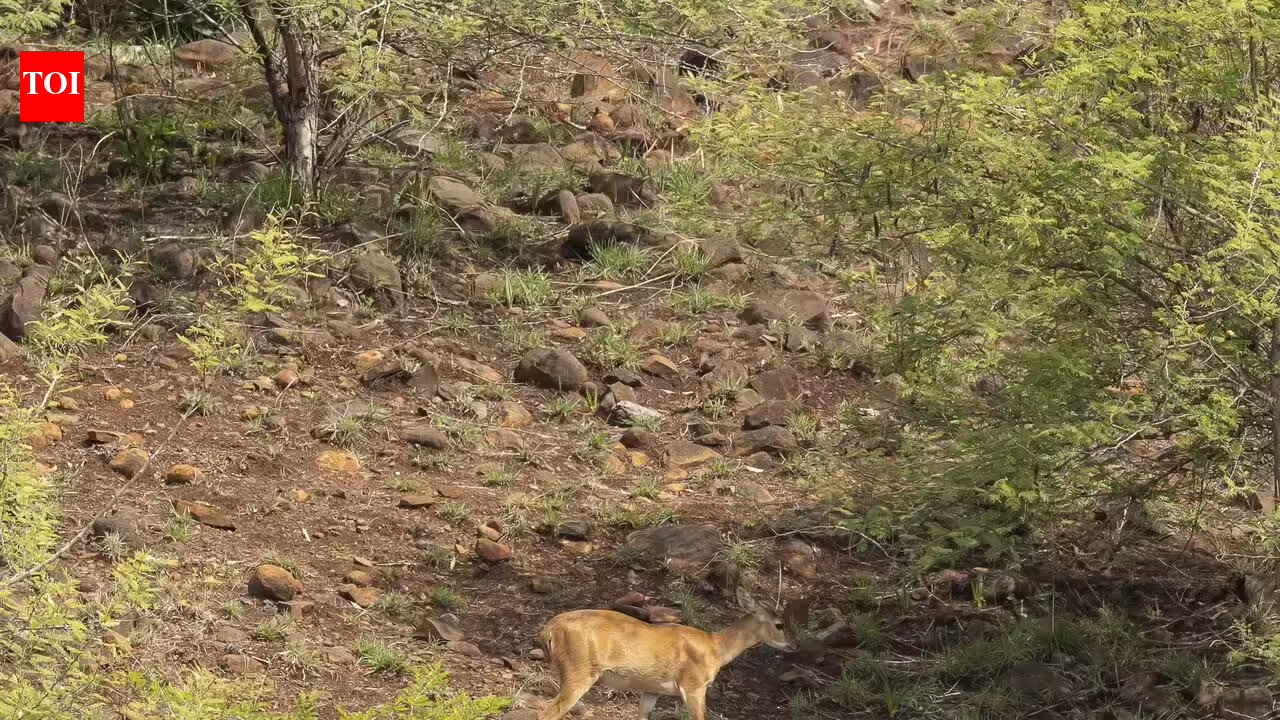
Pune: In what is believed to be the first confirmed sighting in over two decades, a four-horned antelope, also known as the chousingha (Tetracerus quadricornis), has been recorded on Pune’s hills by wildlife enthusiasts.Classified as Vulnerable on the IUCN Red List, it is the only wild mammal that naturally grows exactly four horns.The sighting was made as part of the Urban Mammalian Project, a self-funded initiative by four friends who aim to document the diversity of mammalian species on Pune’s hills, nearly 25 years after the publication of Retreating Wild Mammals of Pune Urban Area. In that study, Sanjeev Nalawade, former head of the geography department at Fergusson College, documented more than 60 mammalian species across the city’s hills.The project began when wildlife biologist Arnav Gandhe started wondering how many of the mammal species recorded by Nalawade between 1980 and 2000 still survive in Pune. “Rapid urbanisation, with little regard for nature, has destroyed natural habitats. We started a pilot project last year around Vetal Tekdi and managed to record several mammal species. Encouraged by the findings, we expanded the survey across Pune. We currently use three automated motion-sensing camera traps on the city’s hills to document wildlife,” said Gandhe.Interestingly, the four-horned antelope was not captured on a camera trap but spotted during a field visit to the Bavdhan-Bhugaon-Bhukum hills. “We saw the female four-horned antelope only for a few seconds. My teammate, Rohit Khare, managed to photograph it immediately last month. We deliberately chose not to publicise the sighting then, and we are also not revealing the exact location because such information often attracts crowds hoping to spot this rare and vulnerable species, causing it unnecessary stress,” Gandhe said.Reflecting on the project’s findings, Gandhe said the animals continue to use Pune’s hills but actively avoid human interaction. “They come out only during a brief window at night because of anthropogenic pressure. The hills are rarely free of human activity, with people present from before dawn until late at night,” he said.He said while Mumbai has successfully protected the Sanjay Gandhi National Park despite being a megacity, Pune has no comparable protected natural habitat apart from its hills, which remain under constant threat from encroachment and construction.So far, the team has recorded jungle cats, Asian palm civets, barking deer, black-naped hares and Hanuman (grey) langurs across various hills.“Most of Pune’s hills were once interconnected, but roads fragmented these natural linkages. The Bavdhan-Bhugaon-Bhukum hills remain connected, providing an important wildlife corridor. A govt official once remarked that iIf there are no animals, how can these hills be called forests? That reflects a lack of awareness about urban wildlife. These hills may not have dense tree cover, which is typically associated with forests, but they are valuable urban natural habitats that support diverse flora and fauna. Any construction or human disturbance, especially at night, will severely disrupt whatever wildlife still survives in the city,” Gandhe said.