










On May 6, an account on X impersonating Ingrid Carlberg, a member of the Swedish Academy, the institution that awards the Nobel Prize in Literature, announced that Orhan Pamuk was dead.
“The Swedish Academy now receives from Istanbul the sad news of the sudden death of the writer Orhan Pamuk, Nobel Prize in Literature for 2006,” the account @CarlbergSvAkad, which had four posts and 68 followers, wrote on X. The account had been created in April, 2026.
Within minutes, the announcement began spreading across the platform and beyond. Readers mourned the 73-year-old Turkish novelist whose books, including My Name Is Red, Snow and The Museum of Innocence, have made him one of the most internationally read writers of his generation.
Users reposted the claim, and at least one news outlet published the news. Pamuk, however, was alive and well.
Hours later, the account admitted the deception. “This account is a hoax created by Italian journalist Tommaso Debenedetti and Orhan Pamuk is alive and well.”
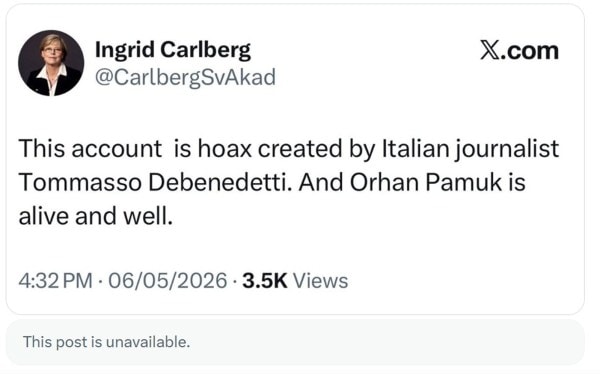 The post was taken down after a few hours, but not before keen-eyed littérateurs took a screenshot. (Credit: X /@samjawed65).
By then, the lie had already done what it was designed to do.
The schoolteacher behind the hoaxes
Debenedetti, a former journalist, is a schoolteacher in Rome who has spent much of the past two decades impersonating institutions and public figures online in order to spread false death announcements. After the hoax gains traction, he often reveals himself before deleting the account.
Story continues below this ad
Those familiar with Tommaso Debenedetti’s long career as a professional hoaxer barely blink at the hoax announcements. They see it as just another entry in Debenedetti ongoing experiment in media failure.
For over 15 years, Debenedetti, an Italian schoolteacher and former journalist, has repeatedly convinced journalists, publishers, politicians, and readers that famous people are dead when they are not.
He does it with credible fake accounts and an intricate understanding of how modern journalism works.
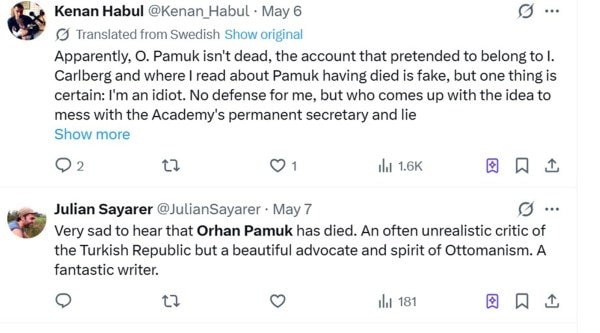 Several people were taken in by the convincing handle name that used both Academy member Carlberg’s name and SvAkad, shorthand for Svenska Akademien (Swedish Academy), only to realise later that it was a hoax. (Screenshot: X/@Kenan_Habul/ and X@JulianSayarer)
At least 3 writers ‘killed’ in 57 days
Pamuk was not even the first novelist “killed” this spring. Eight weeks ago, another account falsely announced the death of Elena Ferrante, the famously anonymous author of the Neapolitan Quartet, which begins with My Brilliant Friend. This time, the account appeared to belong to Ann Goldstein, Ferrante’s longtime English translator.
Story continues below this ad
Ferrante has published under a pseudonym since her 1992 debut, and her real identity remains one of the literary world’s most closely guarded mysteries. If news of her death were ever to emerge publicly, readers might reasonably expect it to come from someone like Goldstein. The post read, “I received terrible news from Rome. Elena Ferrante passed away. She hadn’t written for some time and was ill. Goodbye, my extraordinary, unforgettable, brilliant friend!”
The tweet, which was warm and personal, gathered hundreds of thousands of views, and among those who shared it was the novelist Amitav Ghosh. The account itself had almost no credibility on closer inspection. It had been created only days earlier, had just four posts, and only a few dozen followers. But death announcements tend to short-circuit skepticism–after all, who would post such a joke!–people share first and verify later.
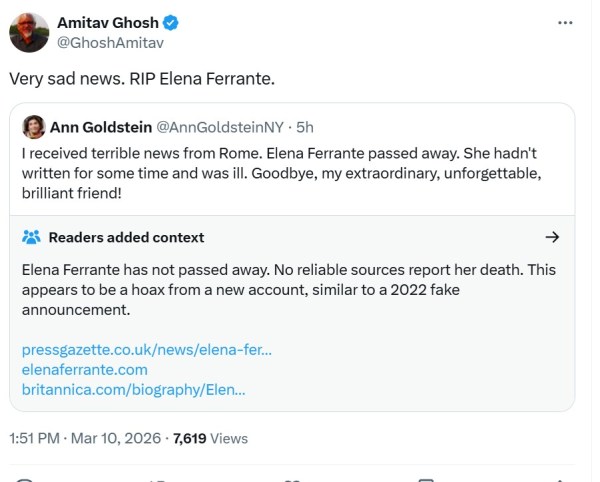 Even Amitav Ghosh, an author of international repute, was taken in by the hoax, perhaps because the Debenedetti was impersonating Ann Goldstein, the elusive Ferrante’s translator. (X@AmitavGhosh)
Three hours after the post appeared, the same account admitted the deception. “This news is false, created by Italian journalist Tommaso Debenedetti.”
Then, on April 22, from the same account that would later announce Pamuk’s death, came a similar announcement, this time targeting Japanese-British novelist and screenwriter Kazuo Ishiguro. Weeks later, came Pamuk.
Story continues below this ad
Somewhere in between even Nobel laureate J M Coetzee was declared dead.
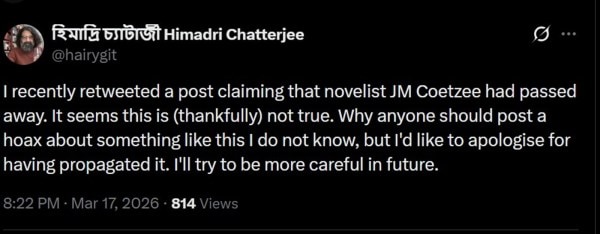 Even Nobel laureate J M Coetzee found himself in Debenedetti’s crosshairs. (X@hairygit)
The list of fictional deaths announced by him is extensive:
📌In 2012, a fake account impersonating Syrian President Bashar al-Assad announced Assad’s death, briefly contributing to a spike in oil prices before the claim was debunked.
📌In June 2020, three years before Milan Kundera’s actual death, a fake account impersonating Petr Drulák, then the Czech ambassador to France, announced that the novelist had died. Newspapers published the claim before Kundera’s family and Czech officials issued denials.
📌In March 2022, a fake account impersonating the British publisher Faber & Faber announced the death of Kazuo Ishiguro. Several news organisations reported the claim before correcting it.
Story continues below this ad
📌He has also falsely announced the deaths of Desmond Tutu, Elfriede Jelinek and Amartya Sen. Jelinek, when she was informed by reporters that she had been declared dead on the internet, reportedly said, “Oh, again? It’s the second time I’ve been dead. I’m still alive.”
📌Pamuk himself has now been falsely declared dead at least twice. The first time was in 2019, when a fake account impersonating İletişim Yayınları, a respected Istanbul publisher associated with Pamuk’s work, announced that the novelist had died at the age of 66. The claim spread widely before the account was suspended.
But, why would anyone do that?
Anyone taken in by Debenedetti finds themselves asking, “Why would anybody do that?” Death, across cultures, is a subject one usually does not joke about, which is perhaps what makes people gullible to his hoax, with many high profile people resharing and lending credibility to Debenedetti’s hoax.
In interviews dating back to 2012, Debenedetti has described his hoaxes as demonstrations of how easily journalists can be manipulated by social media.
Story continues below this ad
“Twitter works well for deaths,” he told The Guardian in 2012. “Social media is the most unverifiable information source in the world but the news media believes it because of its need for speed.” The observation has aged uncomfortably well.
Long before the social media hoaxes, Debenedetti was already testing how easily the press could be manipulated.
In the 2000s, he fabricated interviews with celebrated writers including Philip Roth, Gore Vidal, John Grisham, Toni Morrison and Derek Walcott, placing them in Italian newspapers as genuine conversations.
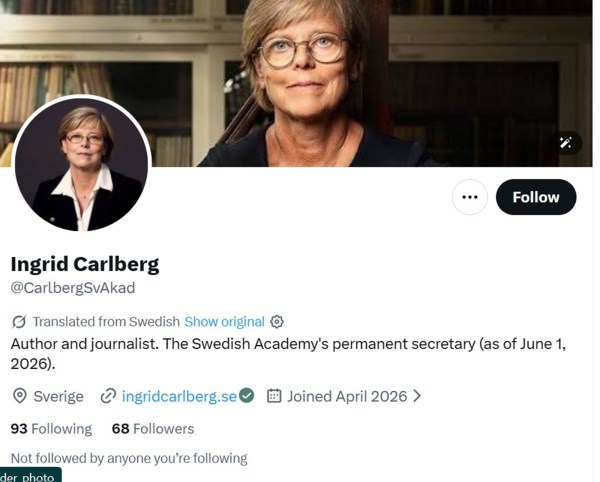 A fake account created by Tommaso Debenedetti. (X@CarlbergSvAkad)
The scheme unraveled in 2010 when a journalist asked Roth about remarks he had supposedly made criticising Barack Obama. Roth denied ever speaking to Debenedetti and publicly disowned the interview.
Story continues below this ad
The exposure embarrassed sections of the Italian press, but did not give Debenedetti pause.
After the Roth scandal, he shifted online. At one point, he sent an anti-war email to the International Herald Tribune signed with the name of Umberto Eco, then phoned the paper after publication to reveal the deception.
He later impersonated the Mexican writer Paco Ignacio Taibo in a fabricated letter praising Pope Benedict XVI, which was published on the front page of the Italian Catholic newspaper Avvenire.
Then he decided to exploit Twitter. Soon he was impersonating presidents, ministers and diplomats. A fake Mario Monti account created by him was once followed by Nicolas Sarkozy, the former French president.
Story continues below this ad
“I have no regrets for my hoaxes,” he told The Ringer in an email interview. “My plan is to continue to create hoaxes and I will continue because journalists are very, very credulous.”