


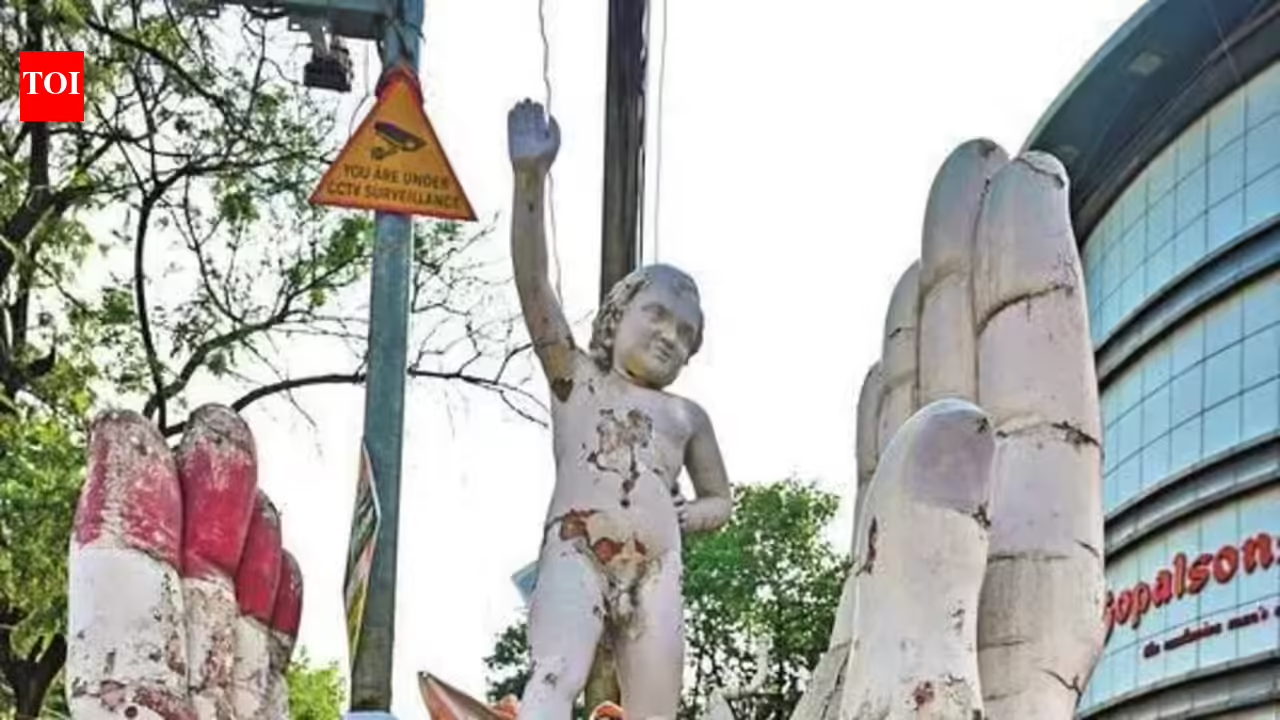
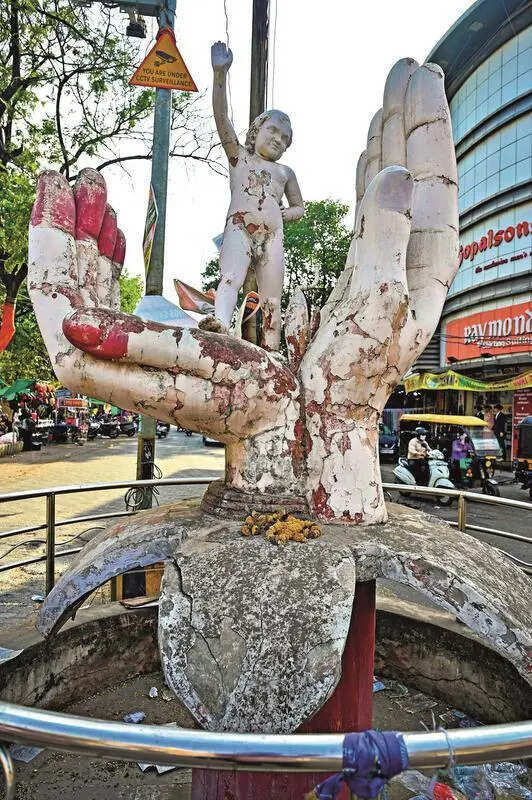
Nagpur: Long before concrete roads and Metro pillars altered the look of Itwari, and long before the advent of Google Maps, the landmark that was once a major guide to navigate the narrow lanes of the cramped marketplace is as obscured as the stories circulating around its origin. It’s the ‘Nanga Putla’, a statue that stands weathered with fading paints, dry fountains and wide cracks. Today, it is barely noticed even as traffic circles endlessly around it.The white statue of the unclothed child cast in concrete has a layered history, at the heart of which is the death of a five-year-old boy that shook the locality more than five decades ago. The story dates back to November 1971, when Itwari, much like today, bustled with crowded market lanes, traders and relentless movement through its narrow roads. On November 7 that year, a boy named Anurag was born into the Jain family, which still lives on Dharaskar Lane in the area. Anurag’s elder brother Munna, just five years old, ran around the house with joy. “He exclaimed “Bhai hua, bhai hua,” recalls Anurag Jain, now 54, while sharing the story narrated to him over the years by his parents and relatives. “Two days later, Munna accompanied our elder sister to the Daga Hospital where I was born. Nobody imagined he would never return home.” As they walked through the crowded Itwari stretch, Munna reportedly slipped near flowing roadside water puddle just as a city bus crushed him. Outrage following the accident led to permanent ban on plying of city buses through the market. The Jain family was reportedly offered compensation of Rs4,000, considered a significant amount in the early 1970s “But father refused to accept it, saying no amount of money could bring back his son,” added Anurag who now runs a garment business in Itwari. Nearly nine years later, in 1980, a memorial structure, today known as the Nagna Putla, was installed at the junction. According to Amar Nagpal, a resident and shopkeeper in old Itwari, the sculpture was created by noted artist Moolchand Painter of Chitar Oli during the tenure of then mayor Vallabhdas Daga. The late Umesh “Babu” Chaubey, then a corporator, too is believed to have played a role in commissioning the structure. The statue of the unclothed child stands on two giant hands — one representing the mother and the other the father — while below rests a Brahma Kamal symbolising purity and peace. Hitesh Jain, Munna’s nephew who lives in Itwari, says, “Though the official name was Shri Vallabhacharya Chowk, the public prefer calling it Nanga Putla.” However, today the memorial reflects the neglect surrounding many of the city’s older structures. The fountains that once flowed around the statue have dried up. Dust coats the structure while traffic fumes and constant movement have slowly worn it down with visible huge cracks on it.“Every few years there is cosmetic work, but nothing major. The fountains should start again like before. Old memories are attached to this place definitely for us but also for the city,” says Anurag.A parallel story about how the statue reached the chowk in the first place is also narrated in Old Nagpur.As per the local residents and history enthusiasts, the sculpture may not originally have been designed for the Itwari junction at all. During redevelopment work at Mokshadham crematorium in the late 1970s, corporator Umesh Chaubey had reportedly envisioned symbolic sculptures representing the cycle of life and death. Moolchand Painter was commissioned to create two separate installations — one depicting a fetus inside a womb and another showing a newborn child held protectively within giant hands. However, before the newborn sculpture could be shifted to Mokshadham, former mayor Vallabhdas Daga reportedly saw it at the sculptor’s workshop and opposed placing it at a crematorium. According to local accounts, Daga believed the sculpture symbolised life and innocence and therefore belonged amid the movement of the living city rather than a place associated with death. Eventually, it was installed at the busy Itwari junction. Ironically, despite civic authorities officially naming the square Brahma Sayok and later Vallabhacharya Chowk, the public rejected every formal title. Surrounded by relentless traffic, peeling paint and dried fountains, the Nanga Putla now stands as a reminder of the city’s fading regard for its own landmarks. A senior NMC official from the Gandhibagh zone said the civic body would take up restoration work if residents formally raised the issue. “Every year, funds are allocated for maintenance and renovation of statues. Once funds are released after the Model Code of Conduct ends, the work will be taken up on priority,” the official said.