






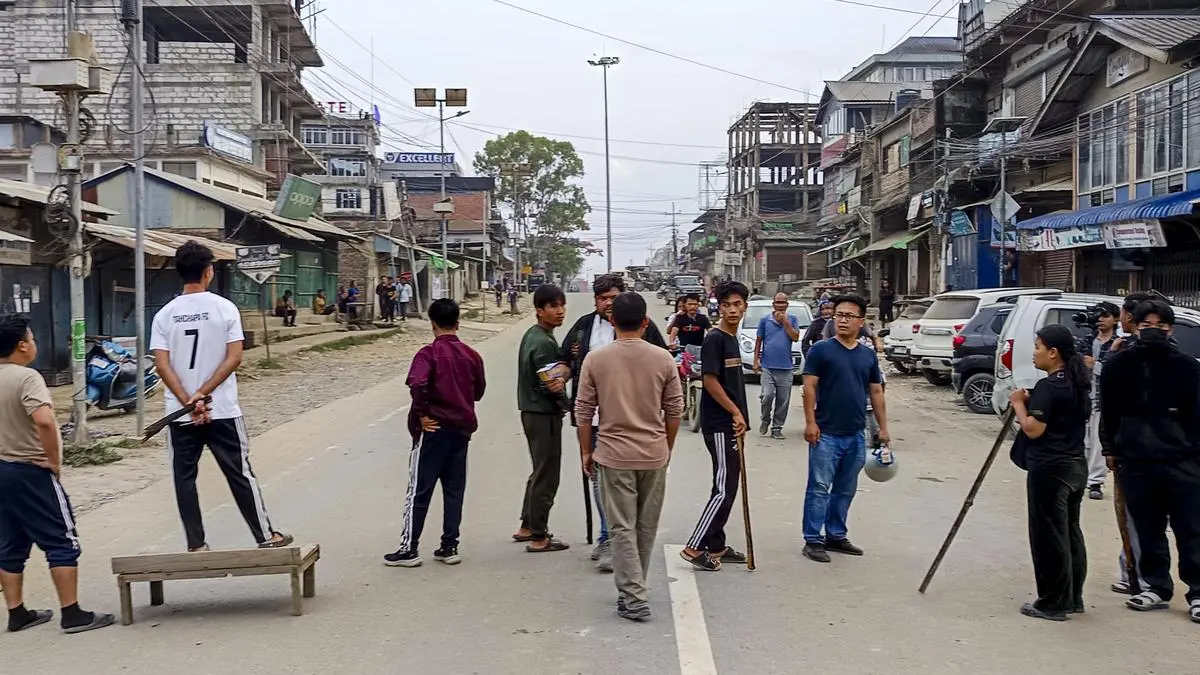
The Supreme Court recently ordered a forensic examination of a 2-hour-and-36-minute audio recording that allegedly implicates the former Chief Minister N. Biren Singh in the violence that rocked Manipur in 2023. The recording has the potential to hold the State’s highest leadership accountable for that initial outbreak of violence. But Manipur is facing another crisis now. The rocket attack in Tronglaobi on April 7, 2026, which killed a five-year-old boy and a five-month-old girl, has weakened the fragile optimism that surrounded the new administration’s quest for peace, and signals Manipur’s transition from a State rocked by sporadic riots to one divided permanently by buffer zones.
Manipur has virtually bifurcated itself in these three years. Initial reports termed the Manipur riots as originating from “spontaneous” anger at the Manipur High Court’s order to initiate Scheduled Tribe status for the Meitei. It was seen as a sudden ethnic battle between the Meitei and Kuki, but in 2026, the situation has evolved into a more entrenched and complex one, with significant structural changes.
Although the narrative still largely peddled is of a conflict between ethnic groups, in reality it has evolved into a war of maps and legal definitions. What is being witnessed in real time is a systematic attempt to redraw the historical, geographical, and legal identity of the Kuki-Zo people, using satellite imagery and selective forest acts that can transform indigenous landowners into encroachers.
To contain the violence in 2023, Central security forces were rushed into Manipur. They created a buffer zone—a no-man’s strip of land between the hill and valley areas—which they would patrol and use to prevent the two communities from coming into direct conflict. Without any accompanying meaningful dialogue, and given the Centre’s failure in intent and action to ease the situation, the buffer zones have today become fixed borders. The communities are now permanently divided behind these invisible but impenetrable barriers, with security forces no longer neutral patrollers maintaining the peace but mere observers, powerless either by choice or circumstance.
Meanwhile, the ongoing forensic investigation into the State’s command responsibility—a legal doctrine establishing leadership liability for the actions of subordinates—is a manifestation of a more profound crisis of justice. Besides the widely publicised tapes, there is ample evidence in Manipur of a significant accountability vacuum paralysing the justice system.
The situation is further complicated by the “unknown” factor. More than 12,000 first information reports (FIRs) have been filed against “unknown miscreants”, creating a legal gap and ensuring that there are no convictions. About 60,000 individuals remain in relief camps. The situation in Manipur points to both policing challenges and the challenges ensuing from an ongoing information war. The national media is accused of perpetuating the structural violence through underreporting or misreporting.
Legal encroachments
Over and above the armed conflict, there is a more dangerous war of maps in progress—a redrawing of ancestral territorial lines. The State’s main approach here has been the discriminatory implementation of the Indian Forest Act of 1927, which has long been criticised for its basis in colonial law, its continued colonial approach, and its failure to fully recognise forest-based community rights. The Forest Rights Act, 2006, and other Acts have only partially addressed the lacunae in the 1927 Act.
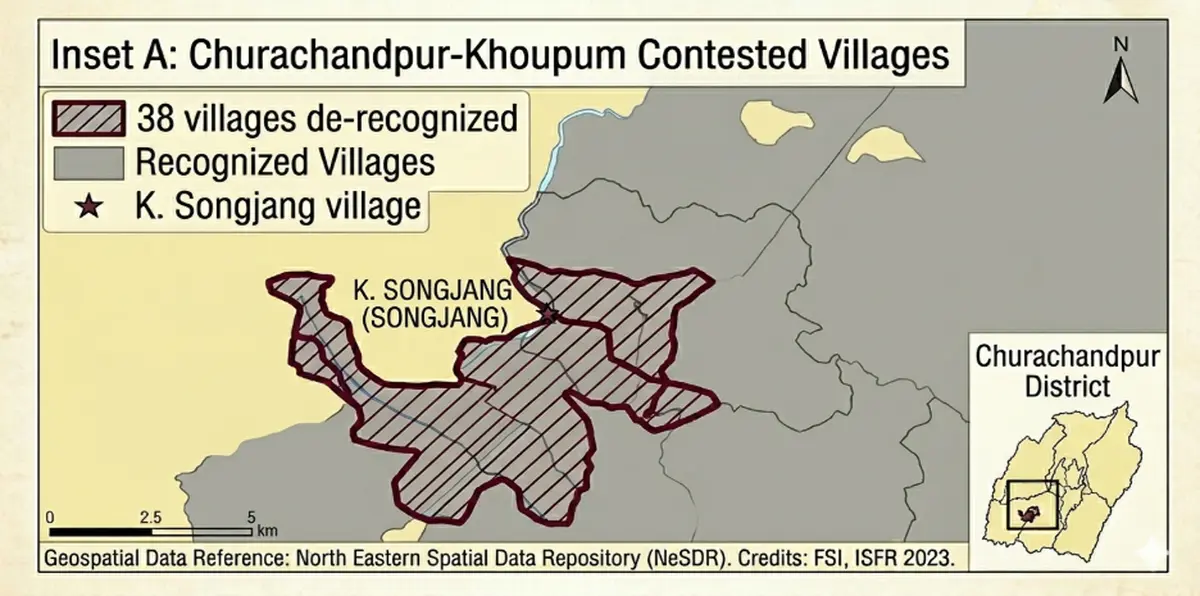
In Manipur, under the pretext of environmental protection, the State has issued notifications designating areas as “Protected Forests” (dating back to 1966) to de-recognise long-established villages in these areas. As BJP MLA Paolienlal Haokip has stated, “The suddenness with which the revenue survey was conducted in the Churachandpur-Khoupum region in a statutory vacuum has invalidated all former land orders.” Similarly, the reliance on a 2020 Google Maps depiction to evict the entire village of K. Songjang ignored the concept of tribal land as communal property simply because it did not produce a “satellite footprint” of the kind cities or towns create. This has resulted in criminalising indigenous sovereignty as “encroachment” and the appropriation of ancestral lands as “state property”.
The map below illustrates the selective derecognition of 38 tribal villages in the Churachandpur-Khoupum region and underlines the cartographic aggression that preceded the putative ethnic conflict.
Deconstructing the “infiltrator” myth
The State’s narrative revolves around the idea of a “population explosion” brought about by infiltration from Myanmar. The data, however, tells a different story. Census figures from 1901 to 2011 show that the proportion of the Kuki-Zo in Manipur has remained broadly consistent, rising from 14 per cent to 16 per cent over 110 years. Moreover, 2024 statistics on refugees from Kamjong district (on the Manipur-Myanmar border) underline the sectional bias: although the State casts the Kuki-Zo as “infiltrators”, 70 per cent of the refugees identified from these border statistics were non-Kuki. The “illegal migrant” tag is not rooted in demographics; it functions as a political instrument designed to delegitimise the community’s claim as original stakeholders in the land.
The marginalisation of the Kuki is often justified by attempts to erase their history and brand them “nomadic refugees.” Yet the term “Kuki” first appeared in British colonial records in 1777, when the chief of Chittagong appealed to Governor-General Warren Hastings for help against Kuki raids from the hills. The community was formally documented in 1904 by G.A. Grierson, compiler of the Linguistic Survey of India. Historical records attest to the Anglo-Kuki War, fought between 1917 and 1919, in which the Kuki resisted British imperial rule—an engagement that cost the British Rs.28 lakh to suppress and necessitated the deployment of military aircraft. The Kuki’s distinct political existence before the formation of States in independent India is evidenced by the British acknowledgement of “Kuki Country” in 1904.
The Meitei, however, describe the war as a Kuki rebellion and have moved the Manipur government to halt all commemoration.
The Kuki were granted Scheduled Tribe status in 1950, with Kuki clans in various States recognised as Scheduled Tribes and listed under “Any Kuki Tribes”. This is now cited by critics as a blunder that has enabled illegal infiltration, and they demand that “Any Kuki Tribes” be removed from the Scheduled Tribe list. Several academic and historical records, however, show that the Kuki predate modern Indian political boundaries.
It is this ancient history that is sought to be ignored in the battle of the “base years”. The Manipur government has recently pushed to notify 1961 as the base year to implement the National Register of Citizens (NRC). This move is viewed as a demographic offensive designed to delegitimise current residents as “illegal immigrants”, and has forced Kuki groups to retreat into a demand for separate administration under Article 239A of the Constitution—effectively seeking Union Territory status for the hill areas to escape what they describe as State-sponsored ethnic cleansing. Against the limited scope of Article 371C, the Sixth Schedule provides for Autonomous District Councils with powers of legislation and jurisdiction over their lands and forests.
Industrialisation of anarchy
By February 2026, the weaponry being used in Manipur had evolved to include firearms that are manufactured rather than stolen. On April 7, 2026, the five-year-old and the five-month-old were killed in Tronglaobi village by a bomb attack. According to reports, an unexploded device using a galvanised iron pipe and a factory-made rocket tip was recovered nearby. Since the beginning of the violence in 2023, commentators have raised questions about the role of militant groups on both sides and their access to weapons.
The economy follows the same militarised logic. While 85 per cent of the poppy cultivation area (13,121 acres) lies in the Kuki-Chin districts, the Meitei social scientist Dhanabir Laishram has highlighted the role of various groups in the industry—planters, transporters, and sellers—and attributed a significant portion of the funding of poppy cultivation to the Meitei community. This points to a layered narcotics industry in which the poorest tribal labourers provide the land while the cartels and sponsors operate under the political shelter of the valley. While the Kuki are primarily labelled narco-terrorists, it is valley-based insurgent groups such as the People’s Liberation Army (PLA), the United National Liberation Front, and PREPAK that have actually been designated as unlawful associations under the Unlawful Activities (Prevention) Act.
The human cost of the conflict is not restricted to Manipur alone. In their 2024 research, Sinam and Singh examined the “invisible costs” borne by Manipuri students in large Indian cities. The prolonged internet shutdown in Manipur compounded these costs, cutting students in Delhi and Bengaluru off from family remittances, forcing them into debt, and saddling them with university late fees. More damagingly, they were compelled to conceal their identity for fear of racial slurs or targeted violence, even outside the State.
Road ahead: disarmament or division?
The violence in Manipur is evidence of a loss of faith in the Constitution. Article 371C, whose purpose is to safeguard the hill areas by mandating a committee of the hill MLAs, has not been able to fulfil its mandate. Through selective mapping, the State has weaponised its administrative mechanism against its own citizens. In the present situation, the demand for separate administration or Union Territory status is no longer seen as a radical or separatist position but as a rational objective for an indigenous population seeking to survive attempts to brand it “alien”. The failure of the administration has made the Sixth Schedule no longer just a matter of policy but a question of urgency for the Kuki-Zo community.
The restoration of the democratically elected State government, headed by Chief Minister Yumnam Khemchand Singh on February 4, 2026, is regarded by many as a step towards peace. Nonetheless, as analysts such as Major Vikas Yadav have argued, symbolic political gestures will not suffice. Genuine peace will remain out of reach without the disarmament of armed groups and the physical retrieval of the hundreds of stolen weapons.
This is a crucial juncture for Manipur. To achieve lasting peace, the maps must reflect the realities of the people rather than the ambitions of a communalised state. The free run of weapons must end. The government can either dismantle the vigilante system that has displaced the rule of law, or concede that Manipur is irrevocably lost to violence—divided into territories bound together only by the shared pain of their people.
Vishal Tiwari is a senior research fellow at Dr Harisingh Gour Central University, Madhya Pradesh.
Also Read | In Meghalaya, rat-hole mining survives every ban and blast
Also Read | A closer look at Bengal’s tribal mandate