


The Centre’s decision to redraw Ladakh’s administrative map is likely to skew internal representation and harden resentment in the Shia-Muslim majority Kargil region. The Union government says the carving out of five additional districts fulfils a long-pending demand; legal and political voices in the region call the move discriminatory.
On April 27, the Lieutenant Governor of Ladakh, Vinai Kumar Saxena, approved a notification for the creation of five new districts—Zanskar, Drass, Sham, Nubra, and Changthang. The Ministry of Home Affairs had cleared the proposal in August 2024. Until now, Ladakh consisted of two districts, Leh and Kargil; now it has seven.
“I have approved the notification for the creation of five new districts in Ladakh, fulfilling the aspirations and long-pending demand of the people of Ladakh,” Saxena said in a post on X. On April 29, he formally inaugurated the new districts and directed newly appointed deputy commissioners and senior superintendents of police to address grievances and maintain law and order.
Ladakh, bordered by China and Pakistan, is one of India’s biggest Union Territories by area but home to fewer than three lakh people, with a Muslim plurality and a substantial Buddhist population. Demands for new districts have come from sections in Zanskar, Drass and Nubra, citing distance from administrative headquarters and gaps in service delivery. Critics argue, however, that the way the lines have been drawn is what makes the redrawing contentious.
Ghulam Mustafa Haji, a lawyer and legal adviser to the Leh Apex Body (LAB), told Frontline that the redrawn boundaries had reduced Kargil to 80 revenue villages. Areas such as Shargole, Chiktan and Suru, he said, could have qualified for district status on their own; instead, parts of Shargole and Chiktan, along with Drass, have been merged into a Kargil district that now has a population of more than 1,50,000.
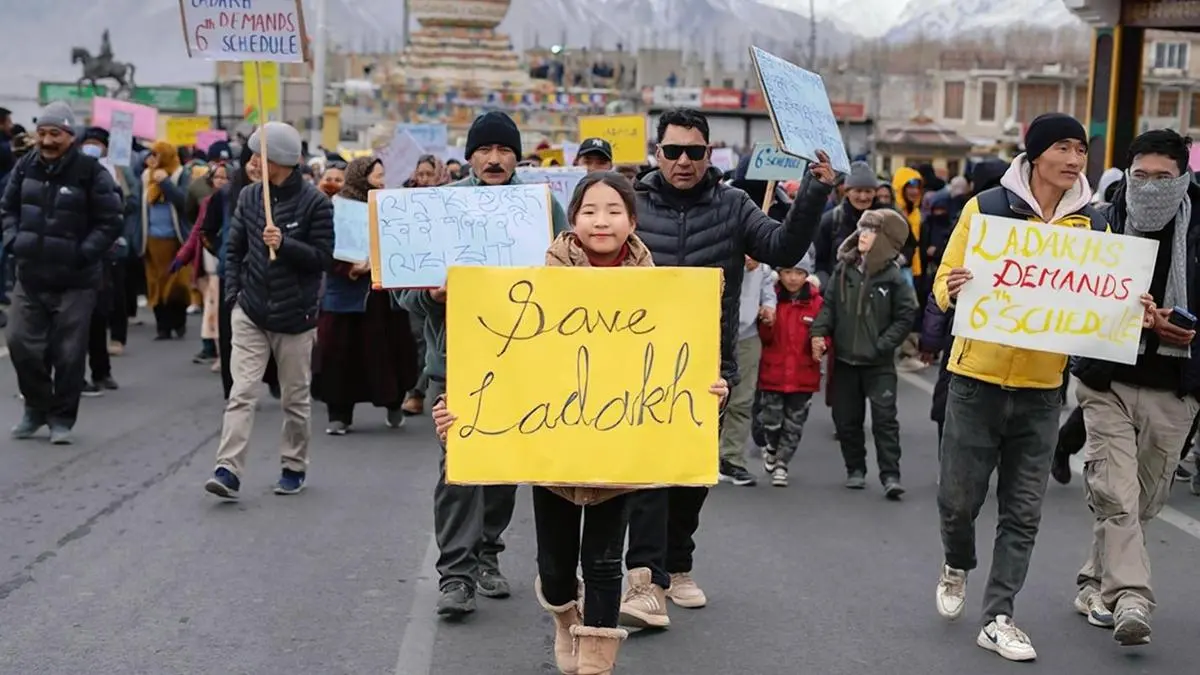
“Given how the ruling BJP has been disenfranchising the Muslim community everywhere across India, the latest move looks like a leaf out of the RSS playbook,” Haji said. He has been involved in negotiations with the MHA on the LAB-Kargil Democratic Alliance (KDA) joint demands for Statehood and Sixth Schedule status.
Haji also pointed out that the notification is silent on the role of the Hill Councils, the elected bodies in the region. If Statehood and Sixth Schedule status are not granted, he said, the new arrangement will be perceived as an extension of the centralised, bureaucratic model in place since August 2019.
Mohammad Jaffer Akhoon, chairman and chief executive councillor of the Ladakh Autonomous Hill Development Council, Kargil (LAHDC-K), said the exclusion of Muslim-majority sub-divisions Sankoo, and Shakar Chiktan-Shargole was “discriminatory, deeply unfortunate and cannot be overlooked”. Several other voices from the Kargil region told Frontline that two more districts ought to have been considered for the area. Of the seven districts in Ladakh, two are Muslim-majority and five Buddhist-dominated.
Sajjad Kargili, a member of the KDA, said the redrawing appeared less an administrative reform than an attempt to fragment the joint Buddhist-Muslim movement for Statehood and Sixth Schedule status.
Fissures and faultlines
Within Kargil and Leh, residents fear that the new map will deepen political and social divisions. Some experts call it demographic and electoral gerrymandering, though Ladakh has no Legislative Assembly and a single Lok Sabha seat. Stakeholders say the deeper concern is the splintering of the unified movement.
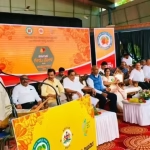
Noor Ahmad Baba, a political scientist who follows the region closely, said New Delhi’s decision is likely to create an internal imbalance in representation and aggravate resentment in Kargil. Speaking to Frontline in the context of Union Home Minister Amit Shah’s two-day visit to Leh on April 30 and May 1 for the Sacred Exposition of the Holy Relics of the Tathagata, Baba said: “New Delhi understands the resentment is building up in Ladakh. Therefore, what followed was the policy to pacify the situation and offer certain concessions both psychologically and politically.”
Shah avoided politics during his Leh visit. He confined his remarks to Buddhist spirituality, urging the leadership in Ladakh to “keep faith in Lord Buddha”. Sonam Wangchuk, environmentalist and a key LAB member, met Shah in Leh. According to sources, the next round of talks between LAB-KDA representatives and the MHA sub-committee is scheduled for May 22.
Baba said the coming negotiations would test how much flexibility New Delhi was willing to offer and whether it could meet the demands of both Kargil and Leh. “For now, it seems like a wait-and-watch policy,” he said.
The administration says the restructuring is reformative, designed to allow deputy commissioners and senior superintendents of police to address local grievances and maintain law and order. Saxena has called the decision a long-pending fulfilment of public aspirations and said it will improve service delivery in remote areas.
As per the 2011 Census, Ladakh has a population of 2,74,289, with Muslims accounting for 46.40 per cent—concentrated in Kargil—and Buddhists 39.65 per cent. Asaduddin Owaisi, president of the All India Majlis-e-Ittehadul Muslimeen, wrote on X on April 28 that the government had created “5 districts for 39.65% population and only 2 districts for 46.40% population”, calling the move gerrymandering and an attempt to divide “the unified statehood movement of Buddhists and Muslims”.
Geopolitical ramifications
Beyond Kargil and Leh, the decision has drawn a sharp response from Pakistan. Ladakh has been a federally administered territory since August 2019, when the Union government abrogated Articles 370 and 35A and bifurcated Jammu and Kashmir. Beijing at the time rejected the move, calling Ladakh a disputed territory.
Pakistan’s Foreign Office spokesperson, Tahir Andrabi, rejected the latest decision at his weekly briefing. “We do not accept this status for Ladakh as a Union Territory. It has never been a Union Territory, and it will never be,” he said. He added that the creation of additional districts in “the illegally occupied Ladakh region” was a unilateral action that contravened the resolutions of the UN Security Council.
Baba told Frontline that both China and Pakistan continue to treat Kashmir and Ladakh as disputed territories. Beijing, he said, had shown a high degree of sensitivity over the bifurcation in August 2019, mobilising troops along the Line of Actual Control. “Islamabad has always been resentful and against altering the status quo,” he added.
The Centre maintains that the additional districts will improve accessibility, ensure faster service delivery and smooth administrative outreach across the Union Territory’s vast and challenging terrain.
Gowhar Geelani is a senior journalist and author of Kashmir: Rage and Reason.
Also Read | Panchayati Raj fades from the Valley
Also Read | How a medical college turned into a proxy battleground in Jammu