








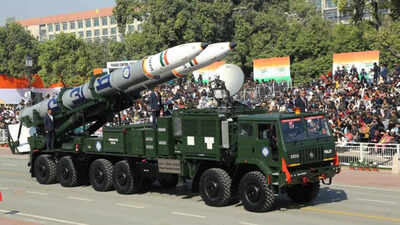
Iran’ use of ballistic missiles to cause wanton destruction across West Asia has demonstrated the expanded nature if the use of these weapons and also how it is difficult for most air defence systems to tackle these projectiles hurtling down at hypersonic speeds. The inability of Ukraine to intercept the Russian Oreshnik missile further solidifies the use of tactical ballistic missiles as an effective warfighting implement. These developments have sparked debate in India about creating a dedicated Rocket Force, something the Chief of Army Staff, General Upendra Dwivedi himself announced earlier this year during his annual press conference.A rocket force can perform multiple functions such as provide conventional deterrence through precision firepower, enable deep strikes with long-range vectors and to reinforce frontline troops with additional firepower. Pakistan’s Rocket Force aims to plug gaps in conventional deterrence exposed during Operation Sindoor, China too has a rocket force as does Russia.India’s Rocket Force will derive its strength from a carefully chosen mix of missile systems that complement each other and provide layered tactical capabilities, outside the realm of nuclear payloads carrying capabilities. The Pralay missile offers a short-range, quasi-ballistic option designed for precision strikes against tactical targets. Its ability to evade interception and deliver conventional warheads makes it a credible deterrent against immediate threats along the borders. BrahMos, with its supersonic speed and versatility, adds a deep-strike dimension. Capable of hitting land and maritime targets at extended ranges, it ensures India can project power far beyond the frontline and complicate adversary planning.Pinaka multi-barrel rocket launchers provide saturation firepower for battlefield dominance. Their rapid-fire capability and extended ranges make them ideal for hitting targets closer to the battlefield. Variants of the Pinaka have a range of up to 120km, this system is the least expensive of the other options. The Long-Range Land Attack Cruise Missile (LR-LACM), will further expand India’s reach. With subsonic endurance and precision guidance, it will allow strikes deep into adversary territory, complementing BrahMos by offering flexibility in payloads and trajectories.Together, these systems create a layered arsenal that balances deterrence, deep-strike capability, while reinforcing other firepower assets.


