






4 min readNew DelhiJul 15, 2026 03:43 AM IST
Almost 200 years ago, an aristocratic English lady of remarkable talents travelled across North India, recording her experiences in words and in art.
Emily Eden, a correspondent of Queen Victoria and the sister of a Governor-General of India, sketched Indian princes, soldiers, and servants.

Her artworks featured a number of Indian cities – among them Calcutta, Lahore, Punjab, Simla, and Kabul. But she ignored Delhi – for she found “nothing to see” in the city that had then recently passed under the rule of the last Mughal king Bahadur Shah Zafar.
The art of Emily Eden is now back in the city that she barely found worth sketching. An exhibition titled Princes & People of India: Portraits by Emily Eden, featuring almost 30 hand-coloured lithographs and the Eden Family Archives, both now part of the DAG collection, is ongoing at DAG on Janpath until August 1.
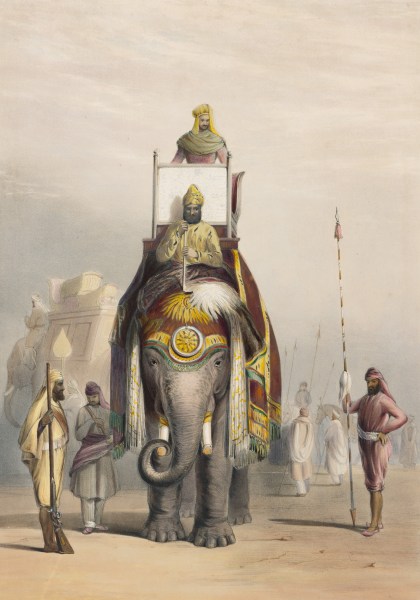 The Raja of Putteealla, on his state elephant.
Eden travelled from Calcutta, the capital of British India until 1911, to Lahore in the company of her brother George Eden, the 1st Earl of Auckland and Governor-General of India from 1836 to 1842, and their sister Fanny.
The siblings began their journey in 1837, their 1,700-mile trip ending in the court of Maharaja Ranjit Singh in Lahore. It was the intention of the Governor-General to cement an alliance with the founder of the Sikh Empire against the Barakzais of Kabul, and as a hedge against the expansionism of Russia’s Tsar Nicholas I.
“Emily Eden’s first portrait in India was that of a young student from Hindu College in Calcutta (which has evolved into today’s Presidency University),” art historian Mary Ann Prior, who has curated the exhibition, said.
Story continues below this ad
The image of the young man in his jewels and ornate turban and robe speaks to the prosperity of Calcutta in the early 19th century.
The Punjab provided Emily with the richest repository of inspirational subjects. “Her portrait of Ranjit Singh (painted towards the end of the Maharaja’s life) captures simplicity, frailty, yet authority,” Prior said.
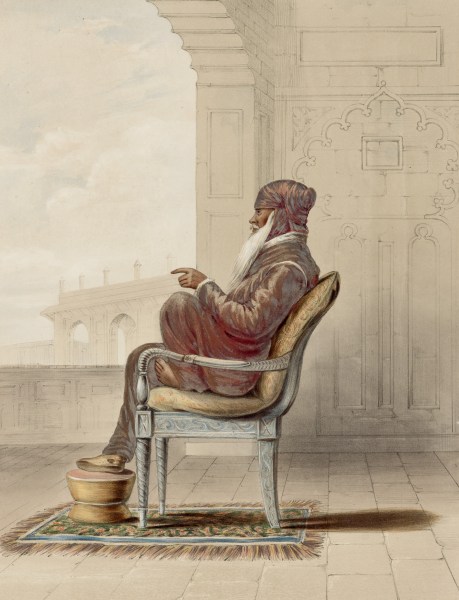 Runjeet Singh
In between Calcutta and Lahore, Emily drew a lot else – portraits of the Raja of Nahun (present-day Himachal Pradesh), a prince in Simla, and the Raja of Patiala (“Putteealla”) on his elephant, as well as fakirs, jemadaars, servants of nawabs, and “Thibet Tartars” (traders from Tibet).
But Delhi did not find a place in her sketchbook.
A fort that forms the indistinct backdrop to her portrait of the Maratha nobleman Raja Hindu Rao, brother-in-law of Maharaja Daulat Rao Scindia of Gwalior, could have been Delhi, for Hindu Rao had made the capital of Mughal India his home after retirement – but such structures were scattered across the subcontinent at the time. Emily did not say where she had sketched the man whom she described as “an unintelligent, native aide-de-camp”.
Story continues below this ad
Indeed, Emily saw the city in which she spent close to a week, as a ghost town. In a letter to her nephew William Eden, she wrote that around the city, “there is nothing to be seen but gigantic ruins of mosques and palaces”.
The British artists who painted India before Emily – Thomas Daniell and his nephew William Daniell, William Hodges, and several others – were all men, and they largely painted landscapes of the “picturesque” country they ruled. In their paintings, humans appeared only incidentally – Emily, by contrast, made people her primary subjects.
“She is likely one of the first British women artists whose works you’re seeing. She was niche, having access to Indian royalty, which was unique. Few women had that experience,” Prior said.

Stay updated with the latest – Click here to follow us on Instagram


