


In the 10th episode of SpeakEasy with Amit Baruah, senior journalist Radhika Ramaseshan joins the conversation to discuss the results of the Assembly elections across West Bengal, Tamil Nadu, Assam, Kerala, and Puducherry. She examines the defeat of key opposition leaders, the rise of new political forces like Vijay in Tamil Nadu, and the broader implications for India’s political landscape.
Ramaseshan analyses how the results signal a major shift in opposition politics, raising questions about the future of the INDIA bloc and the Congress party’s declining national footprint. She also explores the BJP’s electoral dominance, its strategies across States, and the structural challenges faced by regional parties.
Edited excerpts:
Radhika, what is your overall take? What does the defeat of Mamata Banerjee and M.K. Stalin mean for the opposition?
It means a great deal for the opposition. The DMK and the TMC were the two robust pillars of the INDIA bloc. When the bloc was first constituted, the JDU was also a constituent—but Nitish Kumar backed off and returned to the NDA, and so one crucial partner exited. After that, the bloc became an amorphous formation. There were certain things they had agreed upon—chief among them was fielding joint candidates in elections—but no one really followed that coalition dharma. Still, there was always a feeling that as long as the DMK and the TMC were there, a federal front with the Congress as either leader or participant would survive, if not make a spectacular showing. Now, with these two weakened, very little remains of the INDIA bloc.
The Congress has a long way to go before it can think of emerging as an alternative to the BJP. Yes, it has won Kerala as leader of the UDF—but is that enough for a revival? It still has to hold Karnataka and make a mark in Uttar Pradesh. Stalin never really aspired to go beyond Tamil Nadu—the DMK puts up a few candidates in Karnataka but does not invest much there. Within Tamil Nadu, however, he was strong. And more importantly, Amit, these were the two parties that took a firm stand against the Centre’s bid to enforce its agenda on the States—the imposition of Hindi, changes to the education system, diminishing the powers of a State, and tampering with the architecture of federal polity. And then there was the Hindutva agenda. Stalin did not look over his shoulder before taking a stand against the Centre’s bid to enforce Sanatana Dharma in Tamil Nadu.
He could afford to do so because, in Tamil Nadu, religion and politics are fairly well segregated in people’s minds—at least for now. There was, therefore, some countervailing force against the Centre through these two parties. Mamata was often defensive on Hindutva; she could not take as open a stand as Stalin. But even then, she confronted the Centre on other issues—notably its attempt to enforce its writ on the electoral rolls under the guise of cleaning them up. The intention went beyond electoral hygiene; it was gerrymandering of the kind done in Assam, designed to shift demographics in favour of the BJP. That process was quite visible, and it unfolded over months.
Let us look at some of these States individually, starting with Tamil Nadu. Many people thought Vijay would do well—perhaps emerge as a third force—but he has emerged as the first force, with his party just 10 seats short of an absolute majority. Many people believe that the DMK and Stalin delivered a good administration: economic growth was solid, and development was evident.
And yet the people of Tamil Nadu rejected Stalin. The BJP may claim it has done well, but the numbers do not suggest the NDA gained significant traction. What is your sense? Will Vijay be able to run a stable government for five years? And how will the two principal Dravidian parties deal with him as he takes office?
First of all, people are writing an epitaph for the binary Dravidian politics that has defined Tamil Nadu. That is not going to happen. The DMK will survive—and survive well—and so will the AIADMK, once it gets its act together.
The AIADMK lacks a clear leader after Jayalalithaa’s death, but they still got around 21 per cent of the vote.
Exactly. You cannot say these two parties are finished. But for the first time, a significant third force appears to have emerged in Tamil Nadu. Whether Vijay can translate the political capital he has gained into durable governance is another question. I think his support is driven more by emotion than politics. I am from the State—I know how emotionally people respond to elections, the way they do to a new film release. These are events. But what is Vijay’s party actually about?
He has no second-rung or third-rung leadership, no cadre structure. It seemed like a spontaneous popular response to both Dravidian parties—as if people wanted to punish both the DMK and the AIADMK, without seeing the latter as a viable enough alternative. I actually think that if Vijay had not been in the race, the AIADMK might not have won on its own either; the DMK might have just scraped through. You are right about governance—Stalin cannot really be faulted there. Tamil Nadu’s economic indices are quite strong by Indian standards, and its social welfare architecture, built over decades, has been preserved and expanded by Stalin—a good combination of economic reform without unbridled capitalism and continued social investment.
That said, the Dalits of Tamil Nadu remain a marginalised community; no Dravidian party has adequately addressed their situation. As for Vijay, he invokes all the Dravidian icons, from Periyar to Annadurai, which suggests he is not straying too far from the Dravidian tradition. But the small shortfall in seats will define his politics before he has even begun to govern.
Also Read | Dark horse wins race
He will have to make some kind of a choice.
He will—and the choice is not easy. An alliance with the AIADMK would mean an alliance with the NDA, unless the AIADMK is willing to snap its ties with the BJP. Those ties have never been entirely comfortable. I suspect the BJP uses pressure tactics to prevent the AIADMK from fully breaking away. An understanding with the DMK is not really possible.
The Congress probably does not have enough seats to make up the shortfall, and the Left has won just one seat. So, the choice Vijay makes will reveal what direction his politics will take. Tamil Nadu is not on the cusp of a tectonic change, as some commentators are saying—it is likely to be more of the same. But there is also a possibility that Vijay, being a newcomer, may not want to antagonise the Centre entirely. These state governments are very dependent on Central funds.
One recalls that educational funding under the Sarva Shiksha Abhiyan was cut after Tamil Nadu took a firm stand against Hindi imposition. Vijay may not want to repeat that experience. If that is the calculation, he may well join hands with the AIADMK, which would give the BJP a foothold in Tamil Nadu. That would not be a good thing for the State—Tamil Nadu is, at present, the one remaining state that has largely resisted the Hindutva onslaught.
We will have to watch the choices Vijay makes very carefully. Moving on to West Bengal, Radhika—in a sense, West Bengal has been a laboratory for the Election Commission and the BJP. We know that 27 lakh voters were excluded and had filed objections; they wanted to vote, but the Supreme Court’s slow pace of adjudication meant that they were not able to exercise their franchise.
The figures on the Election Commission’s website on the morning of May 5th show the BJP at 45.84 per cent of the popular vote and the TMC at 40.80 per cent—a difference of roughly 5 percentage points, or about 32 lakh votes. Obviously, there is no direct correlation between the 27 lakh excluded and the 32 lakh margin, but the margins are narrow.
The Economic Times reported that morning that in nearly 50 seats, the number of those excluded under the Special Intensive Revision (SIR) exercise exceeds the margin of victory.
Right.
And this question was also raised in the Supreme Court—what happens if such a scenario unfolds? We will have to see what the court does. But what I want to ask you, Radhika, is this: It is now evident that the Election Commission is no longer a neutral umpire. Over the years, a strengthened Election Commission empowered itself to act on behalf of the people. But now we see a massive disenfranchisement.
The Economic Times report adds that the seats where margins fall below the exclusion figures are split 25-25 between the BJP and the TMC. With the Election Commission, the ED, the CBI, and five DGs of Central Police Forces in West Bengal, does any opposition party stand a chance against this kind of apparatus?
Credit to Mamata—she fought this battle to the end. It was obviously a very uneven contest, for the reasons you have outlined. The entire might of the Union of India was lined up against her. What did she have? Herself, a few party colleagues, and some workers. Even the West Bengal police and administration must have been circumspect—they would not have wanted to completely burn their bridges with the BJP.
So, I doubt they cooperated to the extent Mamata would have wanted. It was, in effect, Mamata versus the Indian Union. At no point could she even level the playing field, even slightly. I, for one, never gave Mamata much of a chance—and not even taking anti-incumbency into account, which is the latest theory being advanced against her. My mind went to the Gujarat government, which has been in power continuously since 1995, with only a brief interruption when the Congress supported a coalition.
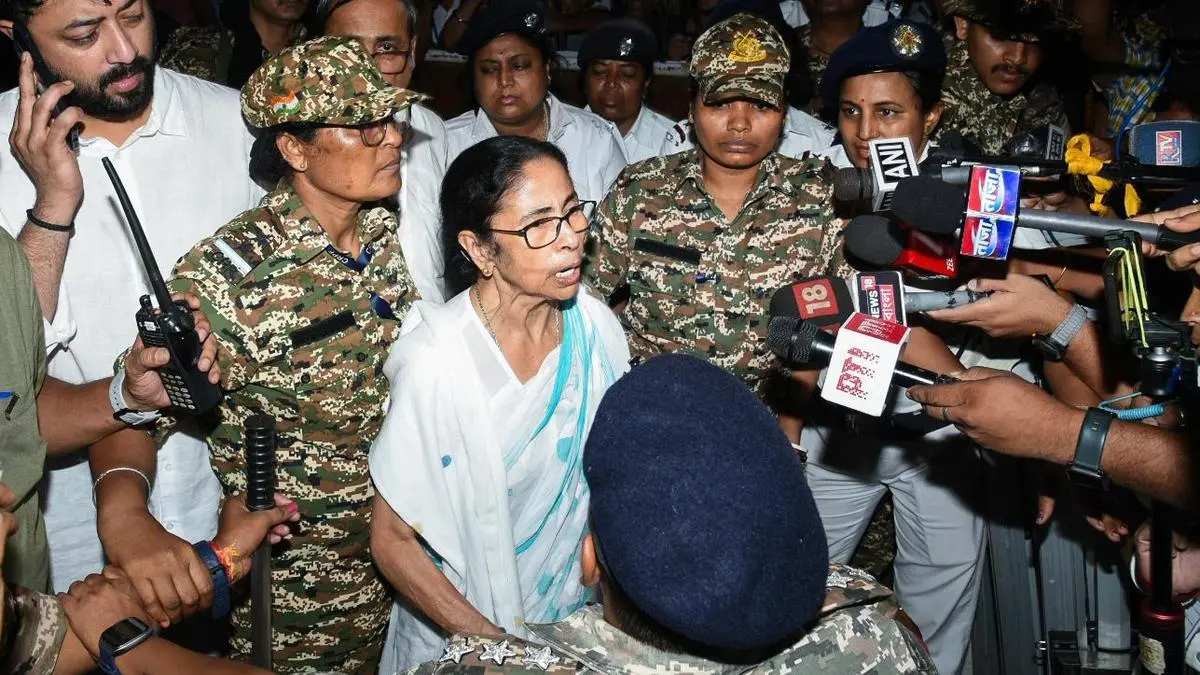
West Bengal Chief Minister and TMC Supremo Mamata Banerjee speaks to the media after she concedes the elections to the BJP, in Kolkata on May 4, 2026.
| Photo Credit:
ANI
So anti-incumbency is apparently a factor only for the opposition.
Absolutely. What happens to anti-incumbency in BJP-ruled States? I would not call Madhya Pradesh an absolute paradise, and the BJP is in its third or fourth term there. As for Gujarat, the BJP appears to never be leaving power. And yet, having travelled to the interiors of Gujarat, I have seen rural areas worse than villages in UP—no toilets, no clean drinking water, bridges between villages and the outside world broken and unrepaired. There are a number of things wrong in rural Gujarat; people are simply dazzled by what they see in Ahmedabad or Vadodara.
So anti-incumbency was not what I was focused on. What you described—the targeted deletions from the electoral rolls, with voters having no legal recourse because the judiciary was, to put it mildly, apathetic—is the main story. Where could those voters go? And these were not random deletions. From what one hears, after losing the 2021 elections, the BJP spent the intervening years mapping every Assembly constituency in West Bengal—studying the demographics, identifying where Mamata drew her support—and reworked their strategy accordingly. In Assam, the gerrymandering was fairly open. In Bengal, it was done much more discreetly.
Radhika, in all your years of covering politics, have you come across an instance of 27 lakh people being excluded from voting? The Election Commission’s entire mandate has been to enrol more voters and improve turnout. What does this tell us about the institution—that it is completely compromised and has pledged its allegiance to Narendra Modi and Amit Shah?
Absolutely—there is no question. It has capitulated entirely to the Central government. You are from Assam—correct me if I am wrong—but even during the height of the AASU [All Assam Students’ Union] agitation, when electoral rolls were revised, and some names were struck off on suspicion of being illegal infiltrators, it was never on this scale. Interestingly, this brings me to two by-elections in Uttar Pradesh held after the BJP’s below-par performance in the 2024 Lok Sabha election—Milkipur, near Ayodhya, within the Ayodhya Lok Sabha seat, and Kundarki, within the Moradabad constituency.
Looking at the historical data, neither the Jan Sangh nor the BJP has ever won these seats since independence, because of their demography—they are Muslim- and Yadav-dominated seats that went to Socialists, occasionally to the Left, or to the Congress.
Both were won by the BJP with large margins, defying belief. When I checked with sources, I was told names were struck off rolls, and Muslims and Yadavs who turned up to vote were told their names were missing. There was also intimidation—voters were discouraged from leaving their homes, and those who reached polling booths faced threats. This was a controlled experiment of what they had done in Milkipur and Kundarki. You saw something similar in Bihar—Rahul Gandhi’s “vote chori” slogan really resonated during the Bihar elections — but not on the same scale as Bengal. In Bengal, they went all out.
They were determined to take the State, and when Amit Shah sets his sights on a state, he makes sure he gets it. That is what happened in Bengal, with the Election Commission not merely complicit but openly assisting the BJP. They could not redraw constituency boundaries as they did in Assam, but they did tamper with the demography through targeted disenfranchisement. Today, you hear BJP functionaries claiming that Muslim votes no longer matter because they have won several minority-dominated seats. The other theory circulating is that the Left, the Congress, and the Indian Secular Front split the Muslim vote away from Mamata. But this is all morning-after wisdom. Muslims in Bengal understood clearly: if not Mamata, they were looking into an abyss. That is where things stand in Bengal.
What do you think the future holds for Mamata Banerjee? We have seen how the BJP operates —splitting parties, targeting leaders. We have seen what happened to Chief Ministers who were once allies of the BJP: in Maharashtra, Bihar, and Odisha, the BJP ultimately absorbed its partners. Mamata is not an ally, but will she be able to hold her flock together?
She is a fighter, but I have my doubts. Mamata is a strong leader who runs a robust organisation—but many of her party colleagues are not above reproach. There are charges even against her nephew, Abhishek Banerjee. The BJP must have dossiers on several TMC leaders, and sooner or later, they will deploy them—raids, FIRs, charges — to frighten their targets into making peace with the BJP.
So Mamata’s party is extremely vulnerable at this moment. The BJP may not strike immediately, in the first flush of victory, though there is marked impatience among the top leadership. They will wait a while and then begin the kind of operation we recently saw with the Aam Aadmi Party—splitting the parliamentary party in the Rajya Sabha, as they did by picking off Raghav Chadha and a few others. They must have already drawn up a list of TMC leaders they want on their side. Mamata also has little to offer her own people right now. If they want to leave, they will defect to the BJP.
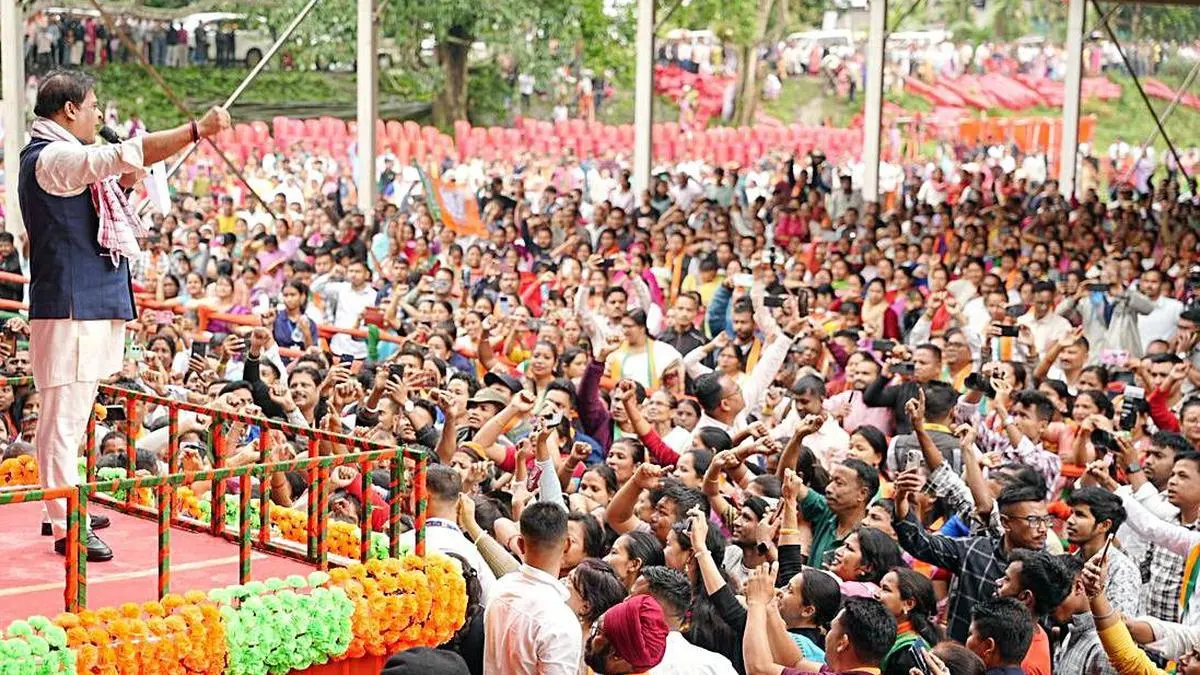
Assam Chief Minister Himanta Biswa Sarma, during a public meeting for the upcoming Assam assembly elections, on April 7, 2026.
| Photo Credit:
X/@himantabiswa via ANI
Coming to Assam—as you noted, the delimitation exercise amounted to gerrymandering. Some analysts suggest that the number of seats where Muslims had a decisive influence has been reduced from roughly 40 to 20. And quite strikingly, the Congress has effectively been reduced to a Muslim party—18 of its 19 elected MLAs in Assam are Muslim, with just one Hindu elected on the party’s ticket.
I imagine Gaurav Gogoi lost his seat.
Exactly.
I would never have imagined that in upper Assam—in Jorhat.
Yes. Assam is a complicated ethnic mosaic, as you know well. The BJP has operated there with a combination of suppression and co-option. The AIUDF [All India United Democratic Front] has also been diminished, as the results show. What is your sense of these ethnic equations? The BJP has capitalised on the anger of the caste Hindu Assamese. They have all their Hindu MLAs, and interestingly, they arranged for the AGP [Asom Gana Parishad] to field 10 Muslim candidates—presumably to dilute the Muslim vote in seats where it was otherwise inconvenient. Given the ethnic stresses and fissures in Assam’s society, what does this kind of polarisation portend? Could it lead to greater conflict and disaffection—as we have seen in Manipur?
There is already significant disaffection, Amit. The BJP will only deepen it through the methods it is employing. But having said that, it is genuinely troubling that the Congress has effectively become a Muslim party in Assam. The Congress must introspect—though it rarely does; it tends to lurch from one election to the next. Something is seriously wrong. They lost several leaders to the BJP before the elections, and those leaders won their seats under the BJP flag.
In a sense, the BJP has become the B-team of the Congress in Assam, absorbing the bulk of its leadership.
Absolutely. It is now a tightly polarised society. When the AGP first came to power—I was in Assam at the time—there was polarisation between Bengali-speaking and Assamese-speaking communities, between Hindus and Muslims. But even a party that rode a divisive agenda to power eventually moderated that agenda. The AGP reached out to the United Minorities Front, a Muslim party, and sought to smooth the rough edges of Assam’s politics. A degree of harmony was attempted. Then came a long spell of Congress rule—imperfect, but the society did not disintegrate. Now, with the BJP in power, things are going to get very bad. Assam has a substantial Muslim population; they will not accept this indefinitely. Sooner or later, there will be a pushback. I see Assam heading towards a serious conflict.
Briefly, let us go back south to Kerala—the one bright spot for the Congress. The numbers speak for themselves. But nationally, the Congress governs very few States: Karnataka, Kerala, Himachal Pradesh—
And Jharkhand, where it is a junior partner to the JMM [Jharkhand Mukti Morcha].
So the map is shrinking. Should Congress celebrate Kerala, or reflect on its defeat in Assam, its poor showing in Tamil Nadu, and its near-invisibility in West Bengal?
If I were the Congress, I would reflect on the latter. They did not even seriously contest Bengal. Rahul Gandhi appeared only towards the very end of the campaign—and then he used that appearance to attack Mamata.
And today he is saying, don’t gloat over Mamata’s defeat.
I think Rahul Gandhi effectively finished off the INDIA bloc with that speech. And in Tamil Nadu, there was friction within the Congress itself. Rahul never shared a stage with Stalin—two of his close aides, Praveen Chakravarti and Manikam Tagore, were pushing for an alliance with Vijay. Looking back, perhaps Stalin could have considered it and explored a broader coalition. But Stalin chose to go it alone—everyone grows arrogant after a point. And Assam is frankly shocking. Gaurav Gogoi’s father, Tarun Gogoi, was one of the State’s most successful Chief Ministers. Why has his son simply handed the State on a platter to Himanta Biswa Sarma, a man facing corruption charges in the public domain, known for being high-handed, though also credited with being accessible to workers and voters?
There is no reason you cannot take on such a complex figure. The problem with Gaurav Gogoi, from what my sources in Assam say, is that he is inaccessible—more focused on policy planning than on the management of politics. You manage your politics first; you think about policy when you come to power. There is something fundamentally wrong with the way Congress approaches politics as if it were an NGO, and this flows from Rahul Gandhi at the very top. The impression I got is that everything was left to Gaurav Gogoi with barely any direction from the Central leadership. This ultimately comes back to the question of the Congress’s leadership. The party was disintegrating even during Vajpayee’s time, when Sonia Gandhi was president.
But she—a plucky person—gathered her resources and almost single-handedly reorganised the Congress, bringing it back to power in 2004 when no one expected it. She had a political mind. What the Congress desperately needs today is a leadership with a hardcore political instinct—because taking on the BJP is not easy. They were in power for 10 years. Ahmed Patel, Sonia Gandhi’s closest advisor, was from Gujarat. And yet they never truly understood Amit Shah and Modi. They had absolutely no idea what these two strategists were like. Today, the Congress is at a loss on how to respond to what is, rightly, called the new BJP. At least with Vajpayee—who grew up in Lutyens’ Delhi and absorbed something of the Nehruvian ethos—there was a semblance of decorum and propriety in how things were conducted, even if the BJP’s ideological underpinning was the same.
Also Read | Bengal’s silent tsunami
On that note, relating to the BJP, it appears that Hindutva has become the dominant governing ideology of the country. The BJP has been winning election after election, and as you mentioned, even after its reduced numbers in 2024, it has won every subsequent election it has contested.
With the Election Commission, the ED [Enforcement Directorate], the CBI [Central Bureau of Investigation], and all the accompanying pressure, are we now looking at a situation where the BJP will win all elections in perpetuity? Is the notion of an opposition-free India—not just Congress-mukt Bharat but an opposition-free India—becoming a reality?
Look at how systematically they have shrunk the Congress, once a proud pan-India party that claimed a presence in every village. That no longer exists. The South remains largely out of reach for the BJP, and they will focus on it in the days to come. But look at what they have done to the non-aligned regional parties—those neither with the Congress nor fully with the BJP.
The AAP was antagonistic towards the Congress while not being part of the BJP, and they have virtually finished it off. Now the TMC. The DMK’s Stalin fell on his own. The Shiromani Akali Dal, once a BJP ally, has all but vanished. The Shiv Sena is a shadow of its former self. The NCP barely exists; one hears from Sharad Pawar or his daughter occasionally. So speaking of elections, the crucial one on the horizon is Uttar Pradesh, going to the polls next year, making the Samajwadi Party and Akhilesh Yadav critically important. He did remarkably well, unexpectedly well, in the 2024 Lok Sabha election. But has he maintained that momentum?
My sources in UP [Uttar Pradesh] say no—he gets distracted, is not sufficiently focused. They say they need someone with Amit Shah’s relentless focus in their camp. Akhilesh must get his act together, concentrate entirely on UP, and identify the weaknesses in his own coalition. The BJP has a set of caste-based allies it can depend on to pick up seats. Akhilesh either needs to bring those caste groups on his side or cultivate his own caste leaders to neutralise them. In UP, ultimately, everything rests on caste—Hindutva is a background force, but at some point, caste takes precedence.
Last time, Akhilesh built a backward caste-Dalit-Muslim coalition—PDA, he called it—and it delivered results. He needs to assess whether that coalition still holds, or whether the BJP has made inroads, and then take it forward from there.
Thank you for looking ahead to UP—it is indeed a critical State. And thank you so much for your insights into the elections in four States and Puducherry. It is a vast sweep. As you have laid out, the challenges for the opposition continue to mount, and Amit Shah and the BJP remain a formidable political machine.
We will see what happens, and we look forward to speaking with you again in the run-up to the Uttar Pradesh Assembly election.
Amit Baruah was The Hindu’s Diplomatic Correspondent and Foreign Editor of Hindustan Times. He is now an independent journalist.
This transcript has been edited for length and clarity.