






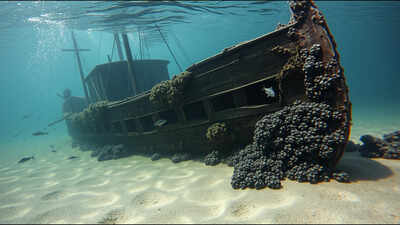
On the night of October 13, 1872, the steamer Lac La Belle left Milwaukee for Grand Haven, Michigan, carrying 53 passengers and crew along with a cargo of barley, pork, flour and whiskey. About two hours into the voyage, the ship began taking on water uncontrollably, and the captain turned back toward Milwaukee, only for huge waves to extinguish the boiler fires and the storm to drive the vessel south. Around 5 a.m., the captain ordered the lifeboats lowered, and the Lac La Belle went down stern-first, with one lifeboat capsizing and killing eight people. More than 150 years later, according to reporting by The Associated Press, shipwreck hunter Paul Ehorn finally located the wreck sitting roughly 20 miles offshore between Racine and Kenosha, Wisconsin, completing a search that began in 1965. The discovery also gives researchers a rare opportunity to document a well-preserved nineteenth-century vessel before invasive mussels cause further damage.
Why the Lac La Belle stayed lost in Lake Michigan for so long
Ehorn actually located the wreck in October 2022, but the discovery was not made public until February 2026, when Shipwreck World announced the find. According to the AP account, the team delayed the announcement because it wanted to include a three-dimensional video model of the ship, while poor weather and other commitments prevented the dive team from returning to the wreck until the previous summer. Ehorn has been searching for shipwrecks since he was 15 and had been trying to pinpoint the Lac La Belle’s exact location since 1965. The breakthrough came in 2022, when fellow wreck hunter and author Ross Richardson provided a lead from a commercial fisherman who had snagged an item that Richardson described as specific to steamships from the 1800s. Ehorn used the clue to narrow his search grid and located the wreck with side-scan sonar after about two hours on the lake.
What condition the Lac La Belle wreck is in after 150 years underwater
Despite the violence of its sinking, the wreck has remained remarkably well preserved. Ehorn told the AP that the upper cabins are gone and the exterior is covered in invasive quagga mussels, but the hull appears intact, and the oak interiors remain in good shape. The Lac La Belle was built in 1864 in Cleveland, Ohio, and was 217 feet long. It had already survived an earlier disaster: a collision sank the vessel in the St. Clair River in 1866 in about 25 feet of water. The ship was raised in 1869, completely reconditioned and later purchased by Milwaukee’s Englemann Transportation Company, which operated it in passenger service to Grand Haven.That earlier history adds to the significance of the wreck, particularly because the vessel’s repeated use and two sinkings provide a record of nineteenth-century Great Lakes transportation. The discovery also preserves a physical example of a passenger steamer that operated during an important period of commercial development on the lakes.
Why thousands of Great Lakes shipwrecks like this one remain undiscovered
The Lac La Belle is far from alone at the bottom of the Great Lakes. According to the University of Wisconsin-Madison’s Wisconsin Water Library, the five Great Lakes are home to an estimated 6,000 to 10,000 shipwrecks, with the vast majority still undiscovered. The exact number is unknown because so many wrecks have not yet been located. Cold freshwater conditions in the Great Lakes can also help preserve wrecks, allowing both wooden and metal vessels to survive for long periods underwater.That preservation is now under threat from invasive quagga mussels, which have colonised shipwrecks across the Great Lakes and can contribute to their deterioration. The growing concern over mussel damage has added urgency to efforts to locate and document wrecks before their remains become harder to study.For Ehorn, the Lac La Belle became his 15th confirmed shipwreck discovery. He has already said he is moving on to the next one, while acknowledging that the easier wrecks have increasingly been found.