




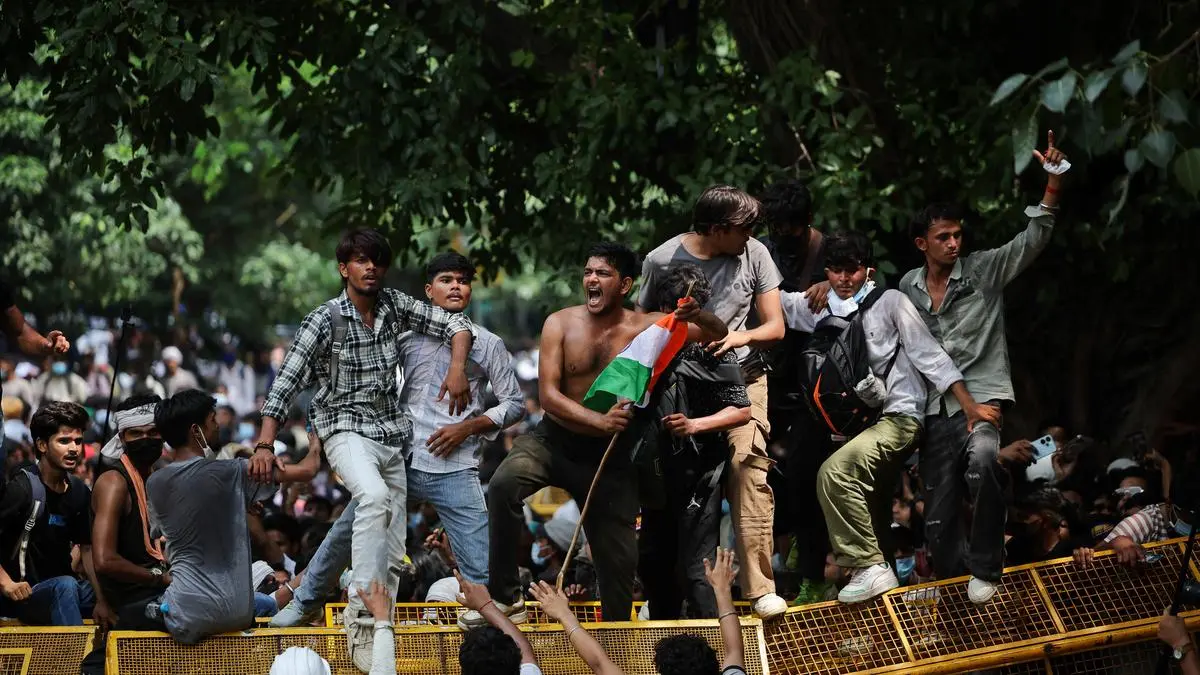
The Cockroach Janta Party (CJP)-led protest, which was called off after Education Minister Dharmendra Pradhan resigned on July 25, unleashed a reservoir of anger building up for years. What we see now is a crack in the hegemonic project of Hindutva. To understand what is beginning to rupture, it is worth returning to the historical moment that gave rise to the current political order.
Around 35 years ago, India saw a similar student mobilisation, triggered by the tabling of the Mandal Commission report in Parliament. The commission’s report recommended reservation for Other Backward Classes (OBCs) in government employment, bringing historically excluded communities, pegged at 52 per cent of the population by the commission, into greater political and economic relevance. It led to a backlash, led largely by dominant castes, drawing support from sections of civil society, the media, lawyers, and the upper class.
Students became its most visible and potent force, many of whom saw reservation as threatening their access to government jobs and educational opportunities; for others, the very prospect of redistribution was injustice. Nearly 200 attempted self-immolation; 63 died of their burn injuries.
The political irony of the moment is hard to miss. The anti-Mandal movement mobilised against the redistribution of access to state resources. Today’s students and graduates mobilised because the state has failed to produce enough opportunities to distribute at all.
In an eerie, all-too-familiar political reflex, the old anti-Mandal refrain has now resurfaced online, with fresh calls to abolish reservation spreading rapidly across social media. Mandal represented more than just a reservation policy. It threatened the dominance of the ruling castes by opening up institutions through which the state distributed employment, educational, and economic opportunities. Among its recommendations, which were not implemented, were radical moves like land redistribution:
“It is the Commission’s firm conviction that a radical transformation of the existing production relations is the most important single step that can be taken for the welfare and upliftment of all backward classes.… The Commission, therefore, strongly recommends that all the State Governments should be directed to enact and implement progressive land legislation so as to effect basic structural changes in the existing production relations in the countryside.”
When the Mandal recommendations were announced, India was still formally a socialist democracy. The commission itself emerged from processes shaped by a long socialist and anti-caste tradition, particularly by Ram Manohar Lohia and others of the Socialist Party of the 1960s, who insisted that in India, the class question could not be separated from caste.
Although the Nehruvian-era social democratic state built a strong public sector, investing in science, technology, higher education, and heavy industry, India could not put in place a broad, labour-intensive manufacturing base to absorb its vast workforce on the scale that China did after 1978.
Scholars have argued that this was partly because caste relations obstructed large-scale organising of labour and partly because India’s development strategy prioritised capital-intensive heavy industry (steel, cement, fertilizers) over mass manufacturing (garments, consumer goods, electronics).
The same lopsidedness led to more investment in elite higher education than in universal primary schooling. The result was a peculiar development model: islands of extraordinary technical and educational excellence (the IITs) surrounded by vast seas excluded from these centres. This, too, was a question of caste.
The communities Mandal sought to bring into relevance included productive castes historically engaged in agriculture, artisanal production, pastoralism, and craft, which had helped sustain the subcontinent as one of the largest economies in the pre-colonial period. India’s postcolonial development model failed to expand opportunities for these communities.
The anti-Mandal mobilisation is emblematic of a broader historical pattern in democratic politics: attempts to redistribute power and resources often provoke resistance from entrenched social elites, from the backlash against Kerala’s land reforms in 1959 to the overthrow of Salvador Allende’s redistributive government in Chile in 1973, or even the US-orchestrated demonstrations against Mohammad Mosaddegh’s oil nationalisation in Iran in 1953. The anti-Mandal right wing counter-mobilised through Hindutva or Mandir, deepening what is also known as the Mandal-Kamandal schism.
Construction of the Muslim “other”
As against Mandal’s idea of reorganising politics around internal caste contradictions, Hindutva sought to forge a unified Hindu identity against an external “other”: the Muslim. Caste polarity was deflected to create religious polarity.
This had the added effect of displacing the question of who gets a share in the resources of the nation to one of who constitutes the nation. Mandir became the symbolic centre of that displacement.
At almost precisely the same historical moment, the state was also withdrawing from the economic sphere. The Mandal-Kamandal conflict became central to politics just as liberalisation was transforming the relationship between the state, jobs, and opportunity. The question of redistribution was therefore displaced along two axes: Mandir and Market.
After 1991, the neoliberal market economy systematically dismantled the state-led welfarist model, transferring economic power from the public sector—where reservation is constitutionally mandated—to the private sector, where no affirmative action exists.
Massive student protest in Ranchi against alleged irregularities in examinations conducted by the Jharkhand Public Service Commission,
on July 31. The BJP’s hard pivot to privatisation has gutted the public sector.
| Photo Credit:
PTI
“Mandir and Market” were not opposing projects; they functioned as complementary strategies of class and caste power. As the political theorist Aditya Nigam has observed, they helped produce an important ideological inversion: the privileged castes with historical power presented themselves as victims of Mandal; capital as the victim of the socialist state; and the Hindu majority as the victim of the Muslim minority.
If Hindutva helped restore political power to the ruling castes, liberalisation helped concentrate social and economic power in the hands of capital and those who were already best positioned to accumulate it.
A fundamental contradiction
Both projects, however, contained a fundamental contradiction. They could only postpone the question of redistribution, not abolish it. Mandir, especially, was a political project with a built-in expiry date. Its mobilising power, and much of its political utility, would necessarily diminish once the temple was erected in Ayodhya. The temple was inaugurated in January 2024, months before the BJP won its third term. Two years on, it has scarcely ushered in the Ram Rajyathat the party or its supporters promised.
That the BJP has already moved on from the temple can be surmised from the recently exposed Ram Mandir donation scandal, where crores have reportedly been siphoned off from the offerings. It is almost as if once Hindutva’s central promise was fulfilled, the temple project simply slipped into the daily dynamics of corruption and institutional opacity.
Having exhausted its symbolic promise, Hindutva must now grapple with the material reality it has always tried to transcend. The public is discovering that no amount of spittle-flecked chanting of Jai Shri Ram can generate jobs and that bulldozing a Muslim man’s home does not make rents cheaper. The anger and abuse earlier incited against Muslims and Dalits is now being channelled towards the source.
India finds itself in an economic crisis whose consequences are borne most heavily by the working classes, the poor, and the aspirational lower middle classes. This crisis is unfolding at a time when the global economic order is itself under severe strain, with imperialist wars on sovereign development in West Asia impacting fuel prices, inflation, and employment. The return of protectionism, most visibly through US President Donald Trump’s tariff regime and the weaponisation of international trade, threatens to slow global growth and further squeeze export-oriented economies such as India’s.
Meanwhile, inequality has deepened, even as the government seeks to downplay unemployment and suppress data. Numbers are misstated to serve the narrative, and an army of patriotic news anchors is on command to amplify falsehoods.
Hard pivot to privatisation
The BJP’s hard pivot to privatisation has gutted the public sector, a devastating proposition for a country with some of the world’s poorest populations. Education has been transformed from a public good to a site of profiteering and accumulation. The New Education Policy reflects this transformation: behind the language of flexibility, innovation, and technocratese lies the steady marketisation of education and the expansion of private participation.
Unsurprisingly, India’s public expenditure on education fell from 4.6 per cent of the Union Budget in 2013–14 to 2.5 per cent in 2021–22. For perspective, China spent $960 billion on education in 2024, a 6.7 per cent increase from the previous year.
The consequences are visible in the enrolment data. Government schools have lost nearly 86 lakh students in just the last two academic years. India now has more than 60,000 higher-education institutions, with private institutions forming the majority. Families are forced to sell land so that their children can attend private coaching classes, merely to enter an overcrowded labour market.
The rot runs deeper. Last year, 2.4 million students sat for the NEET examination. India has roughly 1.3 lakh MBBS seats in total, about 60,000 of them in government colleges where fees are nominal, the rest in private and deemed institutions where a degree can cost upwards of a crore. Only about 1 in 15 qualified candidates will secure a seat at all. The remaining 2 million must find another path.
The crisis is this: India has entered this moment of global economic uncertainty without having resolved the structural problems that liberalisation was supposed to solve. The country has produced more educated and ambitious young people than ever before but failed to create enough secure employment or other avenues to realise their dreams. It has democratised aspirations but privatised the means of achieving them.
The BJP’s great achievement has been to construct an alliance capable of absorbing enormous social contradictions without posing a challenge to the distribution of power. It stitched together the middle classes, the working classes, Brahmin-Banias, non-dominant OBCs, and Dalits, as well as corporate capital under the rubric of Hindutva.
That awning is cracking. This is possibly the first significant moment when the material contradictions in the Hindutva order are beginning to break through the ideological shell that contained them so far.
A generation brought up on the belief that education would lead to mobility is discovering that it leads to debt and unemployment. The crisis of failed expectations and betrayal of promises explains the sudden and sustained denunciation of the government; the collective frustration has outweighed the fear hanging over the population for over a decade. We are also at an inflection point where questions around the role of the market and the distribution of resources have become increasingly urgent.
The old neoliberal consensus—that the market, left to itself, is the most efficient mechanism for allocating opportunity—is losing legitimacy even in the West as it struggles to meet basic social needs. Housing, education, healthcare, and employment cannot be left to the logic of profit and private accumulation. This moment demands that we ask: what would socialism with Indian characteristics look like? Not a return to the commanding heights of the Nehruvian era but the deeper traditions of Jyotiba Phule, B.R. Ambedkar, and Lohia.
Whose aspirations will the economy serve?
Any development model for the future has to confront a question that previous models evaded: whose aspirations is the economy designed to serve? The productive communities whose labour has historically produced much of India’s wealth cannot remain excluded from institutions and decision-making. The next development model cannot again be designed around the aspirations of the already privileged while treating the productive majority merely as labour, votes, or consumers.
There are, of course, secondary contradictions within this mobilisation. A privileged-caste graduate and a Dalit graduate may both be victims of the employment crisis, but one may see reservation as an obstacle while the other sees it as the minimum safeguard against historical injustice. This explains the resurgence of anti-Mandal handles across social media. The question of why there are so few opportunities risks being displaced again by the question of who should have access to them.
Peoples Democratic Party workers stage a protest for the release of recruitment advertisements for approximately 25,000 vacant posts, in Srinagar, on June 23, 2026.
| Photo Credit:
ANI
The choice for a nation of 1.5 billion cannot be between reservation or not. It must be between a politics that expands the pool of opportunity and one that forces communities to fight over an artificially restricted supply of education and employment. The political task is to expand opportunities without dismantling safeguards for the excluded.
The question of opportunities and distribution that Mandal raised was never resolved. This protest only saw it return via Gen Z.
Shone Satheesh is a journalist and multimedia producer based in New York, focussing on caste histories, politics and social movements in South Asia.
Also Read | It was one big protestival
Also Read | Gen Z changed politics: Saurav Das